
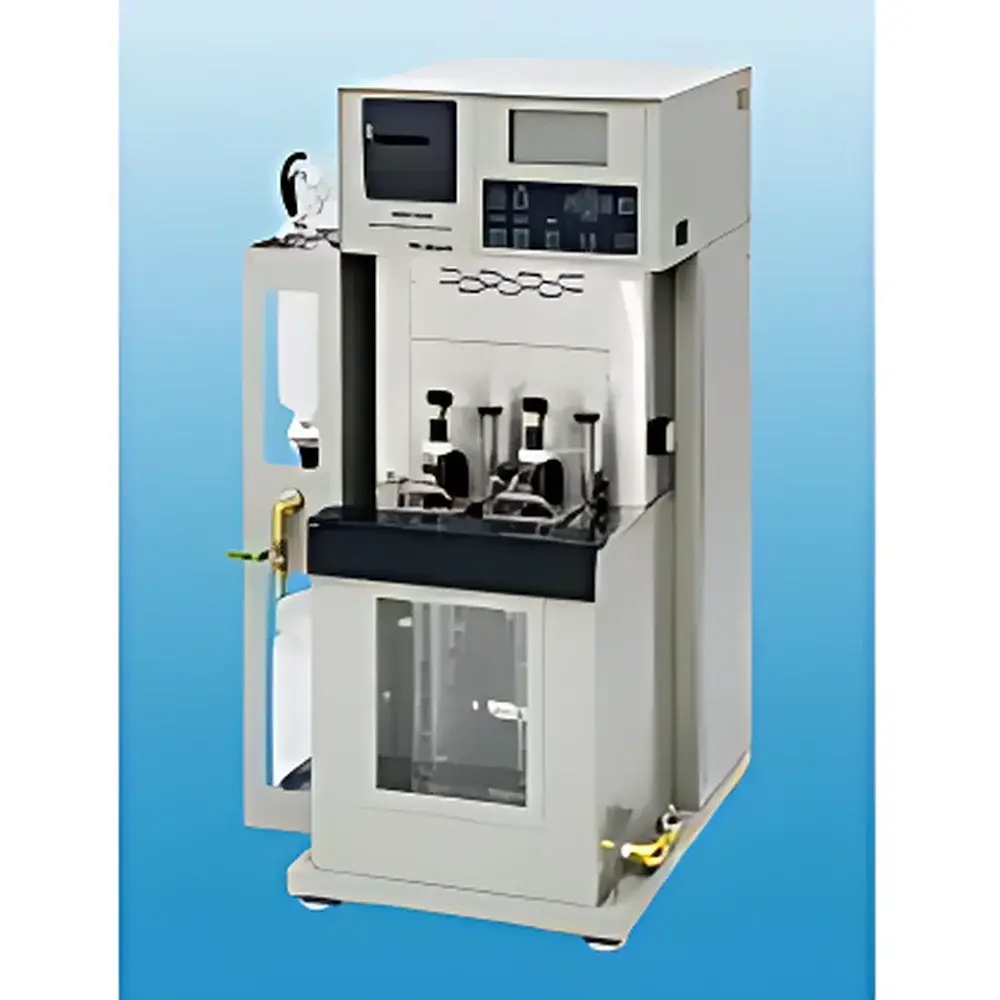
Tanaka AKV-202 Automated Kinematic Viscosity Tester
| Brand | Tanaka |
|---|---|
| Origin | Japan |
| Model | AKV-202 |
| Viscosity Range | 0.75–1,100,000 mm²/s |
| Temperature Bath Range | 20–100 °C (setpoints: 20, 40, 50, 80, 100 °C) |
| Temperature Stability | ±0.01 °C at setpoint |
| Capillary Type | Dual adjustable Ubbelohde-type (Lantz-Stokes design) |
| Detection Method | Filtered photoelectric sensor system |
| Cleaning System | Dual-reservoir solvent/drying agent delivery |
| Printer | Integrated thermal printer |
| Interface | RS-232C (bidirectional data exchange with internal PC and external host) |
| Safety Monitoring | Solvent vapor detection, liquid level sensing, overtemperature protection |
| Dimensions (W×D×H) | 600 × 680 × 680 mm |
| Weight | 75 kg |
Overview
The Tanaka AKV-202 Automated Kinematic Viscosity Tester is a precision-engineered benchtop instrument designed for fully automated determination of kinematic viscosity in petroleum products and related hydrocarbon-based fluids. It operates on the fundamental principle of capillary flow viscometry—specifically, the Lantz-Stokes (Ubbelohde-type) capillary method—wherein the time required for a fixed volume of liquid to flow under gravity through a calibrated capillary tube is measured at precisely controlled temperatures. This time-to-flow measurement is converted into kinematic viscosity (mm²/s, equivalent to centistokes) using standardized calibration constants per ISO 3104 and ASTM D445. The AKV-202 supports both transparent and opaque samples—including diesel fuels, lubricating oils, base stocks, bitumens (after dilution), and synthetic esters—without manual intervention across its full 0.75–1,100,000 mm²/s dynamic range. Its integrated temperature-controlled bath maintains thermal stability within ±0.01 °C at user-selectable setpoints (20, 40, 50, 80, and 100 °C), ensuring compliance with international test method requirements for repeatability and reproducibility.
Key Features
- Dual independent Lantz-Stokes capillary viscometers—mechanically adjustable for optimal alignment and optimized for low- and high-viscosity ranges; eight standardized capillary types (TLZ-1 through TLZ-8) cover overlapping intervals from 0.75 to 1,100,000 mm²/s
- Automated workflow sequence: sample aspiration → thermal equilibration → flow timing → kinematic viscosity calculation → thermal printer output → solvent rinse → nitrogen-assisted drying—all executed without operator input
- High-stability forced-circulation bath with PID-controlled heating/cooling and dual platinum resistance thermometers (PRTs) for real-time feedback and spatial uniformity
- Optical detection system employing filtered photodiode sensors to precisely identify meniscus passage at upper and lower timing marks, minimizing human error and improving timing resolution
- Integrated dual-reservoir cleaning module: one chamber for certified cleaning solvents (e.g., toluene, xylene), another for anhydrous drying agents (e.g., dry air or nitrogen); programmable rinse duration and purge cycles
- Comprehensive safety architecture including solvent vapor concentration monitoring (catalytic bead sensor), real-time liquid level verification in capillaries and reservoirs, and redundant overtemperature cutoff circuits
- RS-232C serial interface supporting bidirectional communication: instrument status, raw timing data, calculated viscosity values, and calibration logs can be exported to LIMS or validated laboratory software platforms
Sample Compatibility & Compliance
The AKV-202 accommodates a broad spectrum of petroleum-derived and synthetic fluid samples—ranging from volatile naphthas to highly viscous residual fuel oils—provided they meet ISO 3104’s solubility and clarity prerequisites (or are rendered suitable via appropriate dilution per ASTM D1298). Its optical detection system enables reliable operation with mildly turbid or dyed samples where conventional visual timing would fail. All operational protocols align with ISO/IEC 17025:2017 general requirements for competence of testing and calibration laboratories. The instrument’s firmware and data handling support audit-trail generation and electronic signature capability, facilitating compliance with FDA 21 CFR Part 11 when deployed in regulated environments under documented SOPs. Routine verification against NIST-traceable standard oil reference materials (SRMs) is supported via built-in calibration mode.
Software & Data Management
The AKV-202 embeds a dedicated microcontroller-based control system with non-volatile memory for storing up to 500 test records—including timestamps, bath temperature, flow times, calculated viscosity, capillary ID, and pass/fail flags per ASTM D445 repeatability criteria. Data export via RS-232C follows ASCII-delimited format compatible with Excel, LabWare LIMS, and custom QA databases. Optional Tanaka ViscCalc™ desktop software (Windows 10/11) provides advanced features: multi-point calibration curve fitting, statistical trend analysis (X-bar/R charts), GLP-compliant report generation with digital signatures, and automatic flagging of outliers exceeding method-defined repeatability limits (e.g., >0.35% RSD for duplicate runs). All data modifications are logged with user ID, timestamp, and reason code—meeting ALCOA+ principles for data integrity.
Applications
- Quality control of finished lubricants (engine oils, gear oils, hydraulic fluids) per OEM specifications (e.g., SAE J300, API categories)
- Crude assay and distillation cut characterization in refinery laboratories
- Viscosity grading of asphalt binders (ASTM D36/D3461) following dilution protocols
- Stability assessment of biofuels (FAME, HVO) during oxidation and storage studies
- Research and development of novel base oils and additive packages requiring high-precision viscosity profiling across temperature gradients
- Contract testing services accredited to ISO/IEC 17025, where auditable traceability and method compliance are mandatory
FAQ
Does the AKV-202 support custom temperature setpoints beyond the standard 20/40/50/80/100 °C?
Yes—firmware allows configuration of additional setpoints between 20 °C and 100 °C in 0.1 °C increments, subject to bath thermal capacity limitations.
Can the instrument validate capillary calibration certificates internally?
It does not perform primary calibration but supports entry and storage of capillary constant files (K-values) with expiration dates; verification runs against SRMs trigger automatic deviation alerts.
Is nitrogen required for the drying cycle, or can compressed air be used?
Instrument accepts either dry nitrogen or oil-free compressed air (dew point ≤ –40 °C); optional inline desiccant filter recommended for air use.
How is compliance with ASTM D445 repeatability criteria enforced during testing?
The system calculates %RSD between duplicate runs in real time and displays PASS/FAIL status before finalizing the report; failed pairs require manual override with justification logging.
Are firmware updates provided, and how are they installed?
Tanaka releases periodic firmware patches via secure FTP; updates are applied via USB flash drive with checksum verification and rollback capability.






