
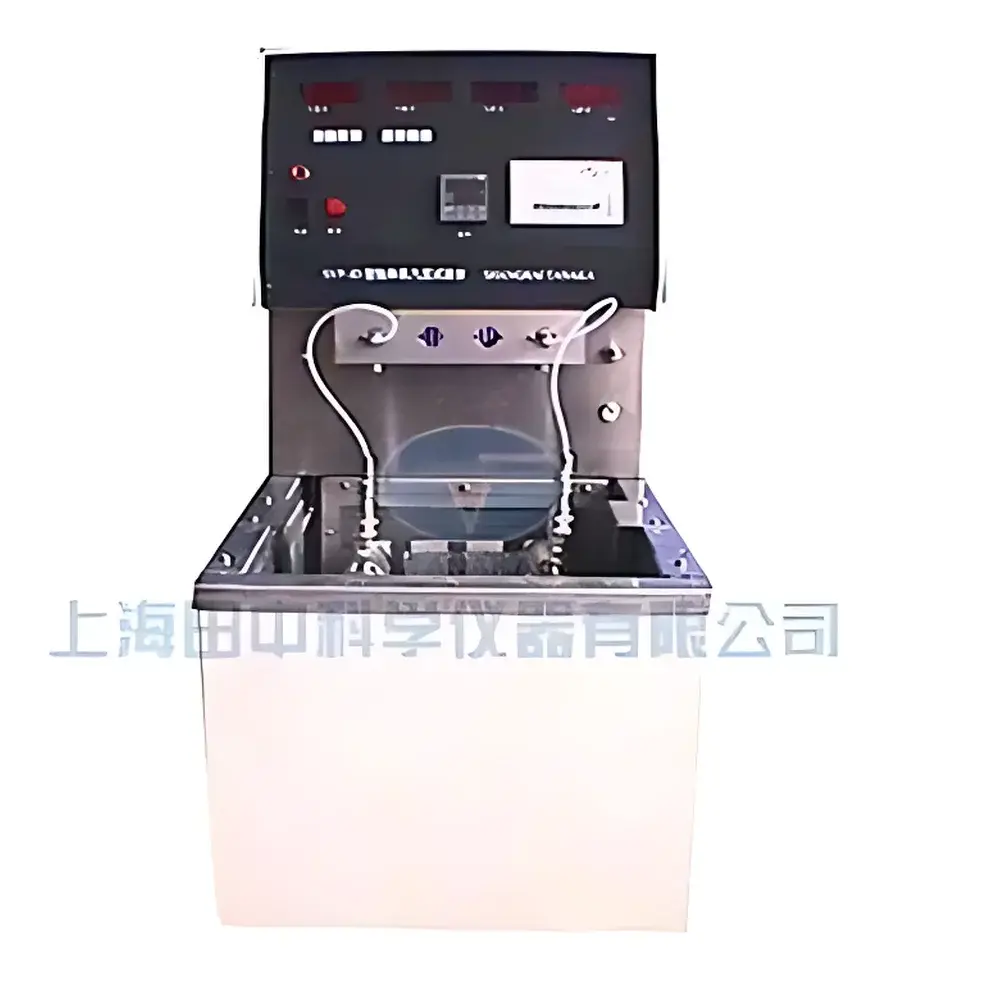
Tanaka AVP-30D2 Automatic Reid Vapor Pressure (RVP) Analyzer
| Brand | Tanaka |
|---|---|
| Origin | Japan |
| Model | AVP-30D2 |
| Test Range | 0–196 kPa (0–2.0 kgf/cm²) |
| Bomb Dimensions | 2/3 standard length, 1/3 standard volume |
| Pressure Sensor | Integrated semiconductor transducer |
| Display | 180 mm × 100 mm LCD |
| Oscillation | Lever-driven, ±15° tilt, 6 s cycle |
| Water Bath | Stainless steel, ~35 mL capacity, PID temperature control with motorized circulation |
| Power Supply | AC 220 V, 50/60 Hz, 15 A |
| Dimensions (W×D×H) | 400 × 600 × 740 mm |
| Weight | ~45 kg (empty bath) |
Overview
The Tanaka AVP-30D2 Automatic Reid Vapor Pressure (RVP) Analyzer is a precision-engineered instrument designed for the standardized determination of saturated vapor pressure of volatile petroleum products—including gasoline, naphthas, and light distillates—according to ASTM D323, GB/T 8017, and ISO 3007. It implements the classical Reid method, which measures the absolute vapor pressure exerted by a liquid–vapor equilibrium at 37.8 °C (100 °F) in a specified test chamber configuration. The system utilizes a controlled thermal environment, regulated mechanical agitation, and high-stability semiconductor pressure transduction to deliver repeatable, traceable results compliant with international refinery QC protocols. Its compact bomb design—reduced to two-thirds the length and one-third the internal volume of the standard ASTM D323 bomb—maintains metrological equivalence while optimizing laboratory footprint and thermal response time.
Key Features
- Microprocessor-controlled operation integrating bath temperature regulation, bomb oscillation, and real-time pressure acquisition—eliminating manual timing and subjective endpoint judgment.
- Large-format 180 mm × 100 mm LCD display provides direct digital readout of vapor pressure in kPa and kgf/cm², minimizing parallax and interpolation errors inherent in analog manometers.
- Compact stainless-steel vapor pressure bomb engineered to ASTM dimensional equivalency standards: validated for hydrostatic integrity, thermal mass consistency, and vapor-phase equilibration kinetics despite reduced physical scale.
- Integrated liquid-level detection circuit halts heating and triggers audible/visual alarm if water bath volume falls below operational threshold—preventing dry-heating damage and ensuring thermal uniformity.
- Programmable power-on timer enables scheduled startup (e.g., preheating overnight), supporting unattended operation in shift-based or high-throughput laboratory environments.
- Self-diagnostic firmware continuously monitors sensor linearity, thermal stability, oscillation actuation, and communication integrity; faults are displayed with descriptive codes for rapid troubleshooting.
- RS-232C serial interface supports bidirectional data exchange with LIMS or centralized QA software, enabling automated report generation, audit trail logging, and electronic record retention per FDA 21 CFR Part 11 requirements.
Sample Compatibility & Compliance
The AVP-30D2 is validated for use with crude oil fractions, motor fuels, aviation gasoline, and other hydrocarbon mixtures exhibiting initial boiling points below 250 °C and vapor pressures within the 0–196 kPa range. Sample introduction follows strict ASTM D323 procedural constraints: precise 1:4 liquid-to-vapor volume ratio, defined temperature conditioning prior to assembly, and mandatory 1-minute agitation interval post-immersion. The instrument’s thermal control architecture maintains bath stability within ±0.1 °C over the full 37.8 °C setpoint, meeting repeatability criteria stipulated in ISO 3007 Annex B. All pressure measurements are referenced to local barometric pressure via optional mercury manometer calibration (sold separately), ensuring conformity with USP <660>, ASTM E29 rounding rules, and GLP documentation workflows.
Software & Data Management
While the AVP-30D2 operates as a standalone unit with embedded firmware, its RS-232C port enables integration into enterprise-grade laboratory informatics systems. Raw pressure/time series data, test timestamps, operator IDs, and diagnostic logs can be streamed in ASCII format for ingestion into validated data acquisition platforms. When deployed under GMP or refinery QA frameworks, the instrument supports configurable audit trails—including user login events, parameter changes, and result exports—aligned with ALCOA+ principles (Attributable, Legible, Contemporaneous, Original, Accurate, Complete, Consistent, Enduring, Available). Optional air compressor and certified mercury reference manometer facilitate routine verification against NIST-traceable standards.
Applications
- Refinery quality assurance of reformulated gasoline blends for volatility compliance (EPA Tier 3 RVP limits).
- Contract testing laboratories performing third-party certification per API RP 2542 or JIS K 2259.
- Research on vapor–liquid equilibrium behavior of biofuel blends (e.g., ethanol–gasoline mixtures) under standardized conditions.
- In-process monitoring of stabilization units during crude distillation and fractionation.
- Educational laboratories teaching petroleum product characterization fundamentals aligned with ASTM D323 pedagogical guidelines.
FAQ
What standards does the AVP-30D2 comply with?
ASTM D323, GB/T 8017, and ISO 3007 for Reid Vapor Pressure measurement.
Can the instrument perform multi-bomb analysis simultaneously?
Yes—configurations supporting 2, 3, or 4 independent bomb assemblies are available upon order specification.
Is mercury manometer calibration required for regulatory submissions?
While semiconductor sensors provide operational convenience, regulatory bodies such as EPA and CNAS require periodic verification using a NIST-traceable mercury manometer (optional accessory).
Does the system support electronic signature and audit trail functions?
The instrument itself does not host electronic signatures, but its RS-232 output enables full integration with validated LIMS or ELN systems that enforce 21 CFR Part 11 compliance.
What maintenance intervals are recommended for long-term accuracy?
Annual calibration of the pressure transducer and thermal bath sensor is advised; quarterly verification of oscillation amplitude and bath level sensor functionality is recommended per ISO/IEC 17025 internal quality procedures.






