
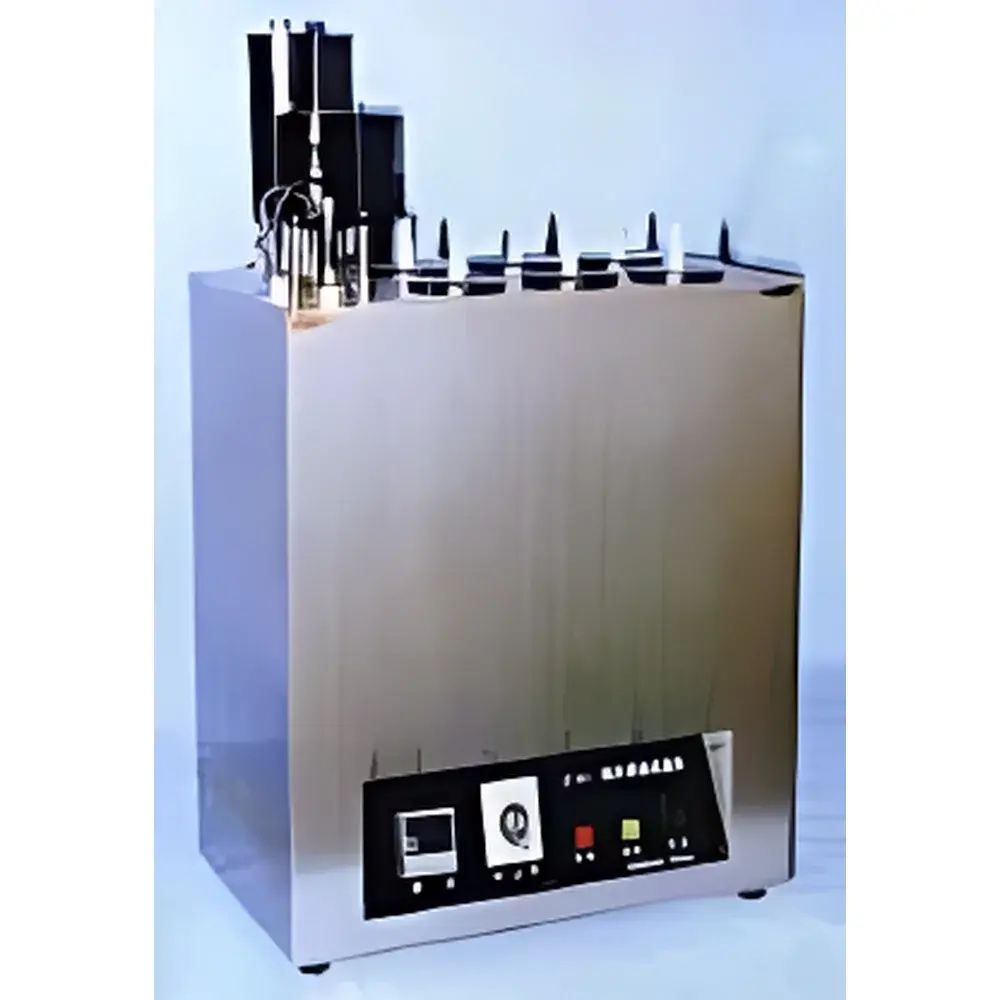
TANAKA ST1011 Copper Strip Corrosion Tester
| Brand | TANAKA |
|---|---|
| Origin | Japan |
| Model | ST1011 |
| Temperature Range | Ambient to 130 °C |
| Temperature Stability | ±0.2 °C |
| Number of Test Positions | 6 |
| Heating Power | 2 kW |
| Power Supply | AC 220 V, 50 Hz |
| Dimensions (W×D×H) | 260 × 450 × 455 mm |
| Weight | 20 kg |
| Construction | Full stainless-steel housing |
| Compliance | ASTM D130, IP 154, ISO 2160, GB/T 5096 |
Overview
The TANAKA ST1011 Copper Strip Corrosion Tester is a precision-engineered benchtop instrument designed for quantitative evaluation of copper corrosion tendency in petroleum products under standardized thermal exposure conditions. It operates on the principle of controlled immersion corrosion testing: polished copper strips are immersed in a representative sample and held at a precisely regulated temperature for a defined duration (typically 3 hours at 50 °C or 100 °C, per applicable method), after which the strip surface is visually compared against a certified ASTM/ISO reference color chart to assign a corrosion rating (Class 1–4). This gravimetric and chromatic assessment provides a direct, reproducible indicator of active sulfur compounds—such as mercaptans, sulfides, and elemental sulfur—that react with copper to form colored sulfide films. The ST1011 is not a detection instrument for specific sulfur species, but rather a pass/fail or severity-classification tool mandated by refining, blending, and quality assurance laboratories worldwide for compliance with fuel specifications.
Key Features
- Stainless-steel construction throughout—including bath vessel, test tube holders, and frame—ensures long-term resistance to thermal cycling, condensation, and chemical exposure in high-humidity laboratory environments.
- Microprocessor-controlled PID temperature regulation delivers stable thermal uniformity across all six test positions, with deviation maintained within ±0.2 °C over the full operating range (ambient to 130 °C).
- Six independent, identically configured test stations allow parallel evaluation of multiple samples or replicates, improving throughput and statistical confidence without cross-contamination risk.
- Dedicated copper strip mounting fixtures—precision-machined stainless steel positioning racks—ensure consistent immersion depth, vertical alignment, and minimal mechanical stress during heating.
- Integrated audible alarm with programmable timer eliminates operator dependency for endpoint detection, reducing human error and ensuring strict adherence to standard dwell times (e.g., 3 h ± 5 min per ASTM D130).
- High-efficiency 2 kW heating system enables rapid thermal equilibration and maintains setpoint stability even during ambient fluctuations or frequent lid opening.
Sample Compatibility & Compliance
The ST1011 is validated for use with hydrocarbon-based liquids meeting the volatility and composition criteria outlined in ASTM D130, ISO 2160, IP 154, and GB/T 5096. Compatible sample types include aviation gasoline, jet fuel (Jet A/A-1), motor gasoline, natural gasoline, naphthas, Stoddard solvent, kerosene, diesel fuel, distillate fuel oils, lubricating oils, and other refined petroleum fractions with Reid vapor pressure ≤ 124 kPa (930 mmHg). The instrument supports both routine QC screening and regulatory submission testing; its design facilitates traceable operation under GLP and refinery QA/QC frameworks. Optional accessories—including NIST-traceable ASTM color comparator charts (compliant with GB/T 9169) and dedicated copper polishing clamps—enable full method execution per standard requirements.
Software & Data Management
The ST1011 operates as a standalone hardware platform with no embedded software or digital interface. All operational parameters—including temperature setpoint, timer duration, and alarm activation—are managed via front-panel controls and analog indicators. This architecture ensures electromagnetic compatibility in electrically noisy refinery labs and eliminates firmware validation burdens under FDA 21 CFR Part 11 or EU Annex 11. For laboratories requiring electronic recordkeeping, external data loggers (e.g., calibrated thermocouple-based systems) may be integrated to capture bath temperature profiles, and manual test logs—including sample ID, operator, start/end time, observed rating, and reference chart used—can be maintained in LIMS or paper-based QA documentation compliant with ISO/IEC 17025.
Applications
- Refinery final product release testing for gasoline, diesel, and jet fuel prior to pipeline shipment or terminal transfer.
- Monitoring sulfur scavenger efficiency in hydrotreating unit downstream streams.
- Evaluation of storage stability in intermediate cuts and finished lubricants exposed to elevated temperatures.
- Supplier qualification testing for solvents, cleaning agents, and specialty hydrocarbons used in aerospace or electronics manufacturing.
- Root cause analysis of field-reported copper corrosion in fuel system components (injectors, pumps, heat exchangers).
- Method verification and inter-laboratory proficiency testing under ASTM D6300 guidelines.
FAQ
What copper strip specifications does the ST1011 require?
It accepts standard ASTM D130-compliant copper strips (12.5 mm × 75 mm × 1.5 mm, UNS C11000, minimum 99.9% purity), supplied unpolished and requiring user preparation using the included polishing clamp and specified abrasives.
Is calibration certificate included with shipment?
No factory calibration certificate is provided; users must perform initial verification using a NIST-traceable thermometer and documented procedure per ASTM D130 Annex A2 before first use.
Can the instrument be used for non-petroleum samples such as biofuels or synthetic hydrocarbons?
Only if the sample meets the volatility, polarity, and thermal stability constraints defined in the referenced standards; biodiesel (FAME) and hydrotreated esters require method adaptation and validation per ASTM D7462 or D8012.
Does the ST1011 support automated image-based corrosion grading?
No—it is a manual visual assessment system. Digital imaging and AI-based classification require third-party add-ons and are outside the scope of standard compliance.
What maintenance is required for long-term reliability?
Routine cleaning of the stainless bath with deionized water after each use, periodic inspection of heater element continuity, and annual verification of temperature uniformity across all six wells using calibrated probe thermometers.





