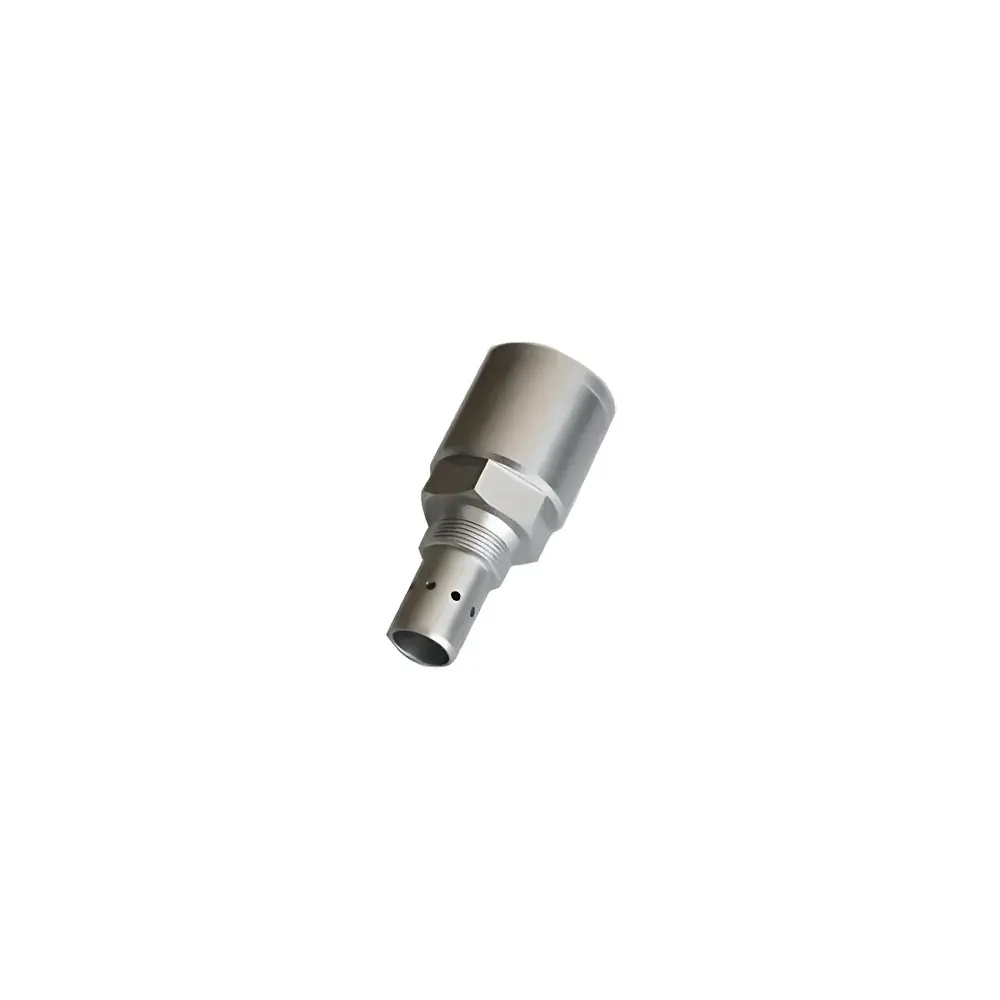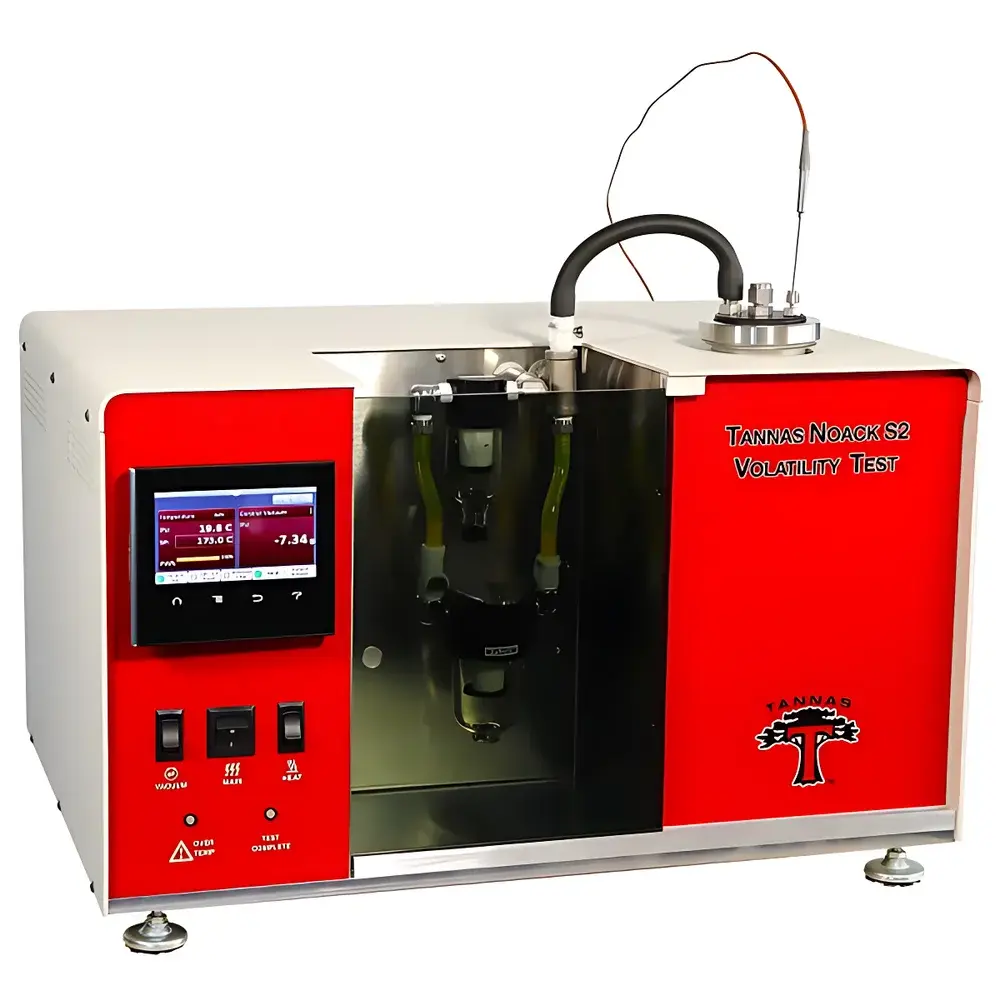
Tannas NOACK S2 Evaporation Loss Tester
| Brand | Tannas&King |
|---|---|
| Origin | USA |
| Manufacturer Status | Authorized Distributor |
| Product Origin | Imported |
| Model | NOACK S2 |
| Price | Upon Request |
| Category | Laboratory Instrument |
| Test Parameter | Evaporation Loss of Lubricating Oils |
| Compliance Standard | ASTM D5800 |
| Dimensions (W×D×H) | 55 × 40 × 33 cm |
| Weight | 33.85 kg |
| Voltage | 220 V |
| Frequency | 50/60 Hz |
| Heating Method | Solid-State Metal Heater (Wood’s Metal-Free) |
| Vacuum System | Integrated Vacuum Pump with Automatic Control |
| Vacuum Level | 20 mm H₂O |
| Test Temperature | 250 °C (±0.1 °C accuracy) |
| Test Duration | 60 min |
| Safety Features | Over-Temperature Protection, Heat-Shield Enclosure |
| Certification | CE |
| Data Output | RS232 Serial Interface for Printer |
Overview
The Tannas NOACK S2 Evaporation Loss Tester is a precision-engineered laboratory instrument designed to determine the evaporation loss of lubricating oils and base stocks under controlled high-temperature, low-pressure conditions—strictly in accordance with ASTM D5800, the standard test method for evaporation loss of lubricating oils (Noack method). Unlike legacy Noack apparatuses that rely on hazardous Wood’s metal bath heating—a eutectic alloy containing bismuth, lead, tin, and cadmium—the NOACK S2 implements a solid-state metal heating system that eliminates toxic exposure risks while ensuring thermal stability, repeatability, and operator safety. Introduced in 1997 as the world’s first commercially available Wood’s metal–free Noack tester, the current-generation NOACK S2 represents the second evolution of this platform, incorporating enhanced vacuum regulation, improved temperature uniformity, and robust electromechanical architecture suitable for routine QC labs and R&D facilities in lubricant manufacturing, additive development, and petroleum product certification.
Key Features
- Solid-state metal heating block engineered for precise, gradient-free thermal distribution at 250 °C ±0.1 °C—eliminating reliance on molten Wood’s metal baths and associated occupational health hazards.
- Integrated vacuum system with automatic pressure regulation maintains a stable 20 mm H₂O vacuum level throughout the 60-minute test cycle, minimizing inter-run variability and supporting strict ASTM D5800 compliance.
- CE-certified enclosure with heat-shield protection and dual-stage over-temperature cutoff safeguards personnel and equipment during extended high-temperature operation.
- Compact footprint (55 × 40 × 33 cm) and optimized weight distribution (33.85 kg) facilitate installation in space-constrained analytical laboratories without requiring structural floor reinforcement.
- RS232 serial interface enables direct data transfer to external printers or legacy LIMS systems—supporting traceable reporting without proprietary software dependency.
- Designed for continuous-duty operation in ISO/IEC 17025-accredited laboratories; compatible with GLP documentation workflows and internal audit requirements for method validation records.
Sample Compatibility & Compliance
The NOACK S2 accepts standard ASTM D5800 sample vessels (typically 50 mL glass flasks with calibrated necks) and accommodates a broad range of mineral, synthetic, and semi-synthetic lubricants—including engine oils, gear oils, hydraulic fluids, and greases after solvent dilution. Its thermal and vacuum control architecture ensures reproducible mass-loss quantification across viscosity grades from SAE 0W-20 to SAE 60. The instrument is fully compliant with ASTM D5800 Method A (the primary Noack procedure), and its design aligns with supporting regulatory expectations under API licensing programs, OEM specification testing (e.g., GM dexos®, Ford WSS-M2C945-A), and EU REACH substance evaluation protocols where volatility assessment informs classification of volatile organic compounds (VOCs) in finished lubricants.
Software & Data Management
The NOACK S2 operates in standalone mode with embedded firmware—no PC or proprietary software is required for basic operation. All critical parameters (setpoint temperature, actual chamber temperature, vacuum level, elapsed time) are displayed in real time on the front-panel LCD. RS232 output delivers ASCII-formatted results (including start/end timestamps, final mass loss %, and pass/fail flags per ASTM D5800 acceptance criteria) directly to dot-matrix or thermal label printers. For laboratories implementing electronic recordkeeping, the serial stream can be captured via terminal emulation (e.g., Tera Term, PuTTY) and parsed into CSV or XML formats compatible with validated ELN systems. While the device does not natively support FDA 21 CFR Part 11 electronic signatures, its deterministic output and hardware-level audit trail (via printed hardcopy logs) satisfy GLP/GMP documentation requirements when paired with SOP-controlled procedures.
Applications
- Quality control of finished engine oils for OEM approval and aftermarket certification.
- Formulation screening of base oil blends and volatility-sensitive additives (e.g., VI improvers, anti-wear agents).
- Regulatory submission testing for EPA Tier 3, ACEA, and JASO specifications where evaporation loss correlates with oil consumption and emissions performance.
- Failure analysis of in-service lubricants exhibiting excessive volatility-related thickening or sludge formation.
- Method transfer and cross-laboratory correlation studies in multi-site lubricant development programs.
FAQ
Does the NOACK S2 require calibration verification against NIST-traceable standards?
Yes—users must perform periodic temperature and vacuum calibration using certified reference instruments per ASTM D5800 Annex A2; Tannas provides calibration check protocols and traceable thermocouple verification kits upon request.
Can the instrument be used for non-petroleum-based lubricants such as silicone or polyglycol fluids?
It may be employed for preliminary screening, but ASTM D5800 explicitly limits scope to petroleum-derived lubricants; alternative methods (e.g., ASTM D6375 for synthetic esters) should be applied for formal compliance reporting.
Is the RS232 interface compatible with modern Windows 11 systems?
Yes—when connected via a USB-to-RS232 adapter with signed FTDI drivers, the output is readable by any serial terminal application; no vendor-specific driver installation is needed.
What maintenance intervals are recommended for the integrated vacuum pump?
The diaphragm-type pump requires oil-free operation and should undergo filter replacement every 500 test cycles or annually—whichever occurs first—as specified in the Maintenance Log section of the Operation Manual.
Does the NOACK S2 support automated sample loading or unloading?
No—it is a manual-load instrument per ASTM D5800 procedural requirements; automation would invalidate conformance to the standard’s defined operator intervention steps.