
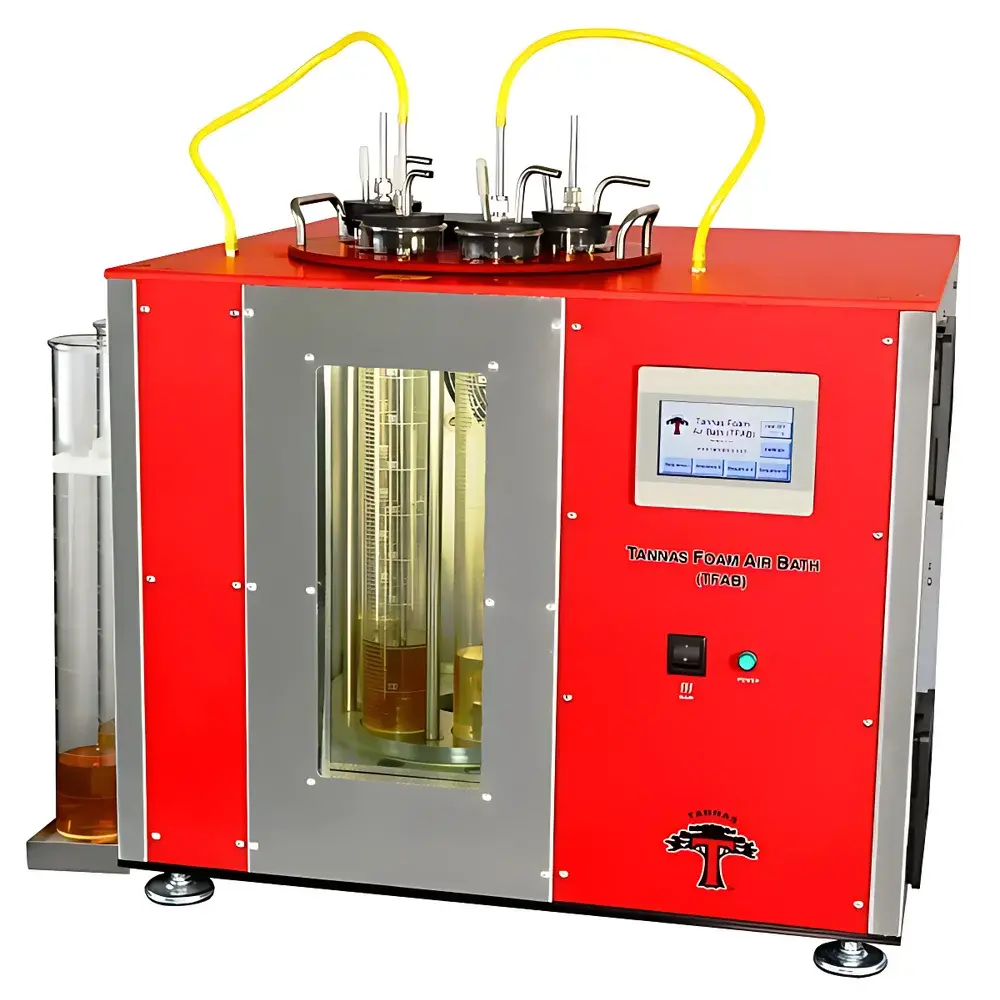
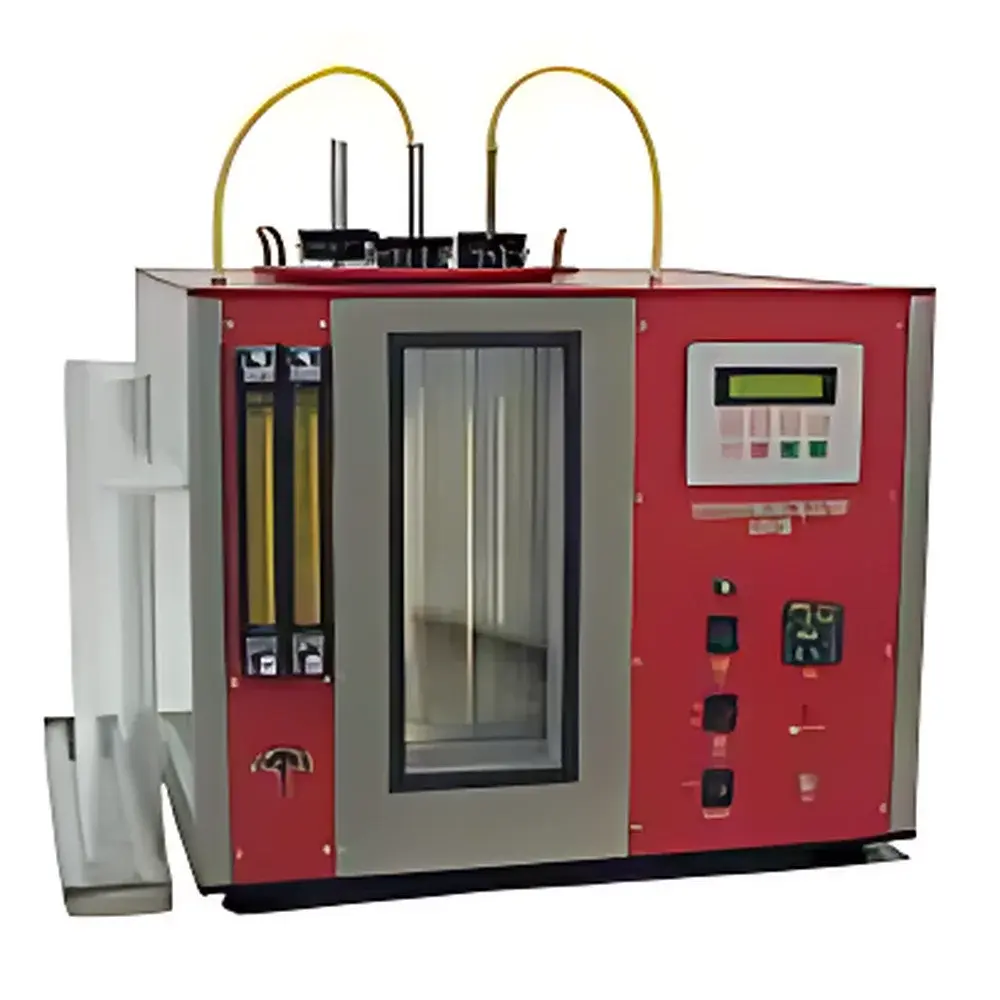
Tannas TFAB Lubricating Oil Foam Characteristics Tester
| Brand | Tannas & King |
|---|---|
| Origin | USA |
| Manufacturer Status | Authorized Distributor |
| Origin Category | Imported |
| Model | TFAB |
| Product Type | Laboratory Instrument |
| Test Parameter | Foam Characteristics |
| Compliance Standards | ASTM D892, IP 146, ISO 6247 |
| Dimensions (W×D×H) | 61 × 61 × 53 cm |
| Weight | 72.5 kg |
| Power Supply | 220 V, Single-phase, 10 A, 50/60 Hz |
| Heating Medium | Forced Air |
| Motor | DC-driven, maintenance-free |
| Aeration Head | Stainless steel cylindrical head with pre-heated air supply |
| Air Flow System | Dual integrated mass flow meters |
| Air Flow Rate | 94–200 mL/min (±5 mL/min) |
| Temperature Range | 20–175 °C (±0.1 °C) |
| Test Programs | Four standardized sequences (I: 24 °C, II: 93.5 °C, III: 24 °C, IV: 150 °C) |
| Sample Volume | 200 mL |
| Test Capacity | Six 1000-mL graduated cylinders |
| Display | Touchscreen controller with real-time digital readouts, programmable alarms, and elapsed time tracking |
| Safety | Dual thermal protection (fuse + current-limiting fuse), CE certified |
| Shipping Weight/Dimensions | ~90 kg / 71 × 71 × 122 cm |
Overview
The Tannas TFAB Lubricating Oil Foam Characteristics Tester is a precision-engineered laboratory instrument designed to evaluate the foaming tendency and stability of lubricating oils under controlled thermal and aerodynamic conditions. It operates in strict accordance with internationally recognized test standards—including ASTM D892 (Standard Test Method for Foaming Characteristics of Lubricating Oils), IP 146 (Institute of Petroleum), and ISO 6247—ensuring data compatibility across global R&D, quality control, and regulatory laboratories. Unlike traditional oil-bath-based foam testers, the TFAB employs a forced-air heating system that eliminates thermal degradation of bath fluids, reduces operator exposure to high-temperature hydrocarbon vapors, and enhances long-term calibration stability. Its single-bath configuration supports six simultaneous 1000-mL graduated cylinder tests, enabling efficient batch evaluation while maintaining traceable temperature uniformity (±0.1 °C) across all test positions.
Key Features
- Forced-air heating architecture eliminates need for mineral oil baths—reducing maintenance, eliminating oxidation-related calibration drift, and improving lab safety during extended high-temperature operation (up to 175 °C).
- DC-driven, brushless motor ensures silent, vibration-free aeration and zero scheduled maintenance over extended service life.
- Stainless steel cylindrical aeration head with pre-heated air supply guarantees consistent gas temperature at the point of oil contact—critical for reproducible foam generation per ASTM D892 Section 7.2.
- Dual integrated mass flow meters provide real-time, independent verification of air delivery (94–200 mL/min, ±5 mL/min), supporting GLP-compliant audit trails and method validation.
- Intuitive touchscreen controller with programmable alarm tones, elapsed time display, and on-screen sequence guidance streamlines operator training and minimizes procedural errors.
- Comprehensive thermal protection includes both thermal fuse and current-limiting fuse—meeting CE requirements and supporting safe unattended operation during multi-hour test cycles.
Sample Compatibility & Compliance
The TFAB accommodates standard 1000-mL graduated cylinders filled with 200 mL of sample—compatible with mineral, synthetic, and semi-synthetic lubricants including engine oils, hydraulic fluids, gear oils, and turbine oils. All operational parameters align precisely with the four test sequences defined in ASTM D892: Sequence I (24 °C), Sequence II (93.5 °C), Sequence III (24 °C), and Sequence IV (150 °C). The instrument’s temperature stability (±0.1 °C), airflow accuracy, and cylinder geometry have been validated through ASTM Round Robin interlaboratory studies, contributing directly to revisions that improved repeatability thresholds in the latest edition of the standard. It supports full compliance with ISO/IEC 17025 documentation requirements when integrated into accredited testing workflows.
Software & Data Management
The TFAB features embedded firmware with non-volatile memory for storing up to 100 test logs—including timestamp, sequence ID, setpoint temperature, actual air flow rate, and operator notes. While it does not require external PC software for basic operation, exported CSV files (via USB port) contain raw time-stamped foam height readings at 0, 5, and 10 minutes post-aeration—enabling integration with LIMS or statistical process control platforms. Audit trail functionality meets foundational expectations for FDA 21 CFR Part 11 compliance when paired with institutional electronic signature protocols; full 21 CFR Part 11 validation packages are available upon request for GMP-regulated environments.
Applications
- Formulation development of anti-foam additive packages for engine and industrial lubricants.
- Batch release testing in manufacturing QA/QC labs to verify conformance to OEM specifications (e.g., GM 6394M, Ford WSS-M2C945-A, API SP).
- Root-cause analysis of field-reported foaming issues in hydraulic systems or compressors.
- Comparative evaluation of base stock effects on foam persistence under thermal stress.
- Supporting technical service investigations requiring ASTM D892-compliant data for customer dispute resolution or warranty claims.
FAQ
Does the TFAB require calibration certification prior to first use?
Yes—each unit ships with a factory calibration certificate traceable to NIST standards, covering temperature uniformity, airflow accuracy, and timer synchronization.
Can the TFAB be used for non-lubricant samples such as greases or coolant concentrates?
No—the instrument is specifically engineered and validated for liquid lubricants per ASTM D892; viscosity limits and aeration dynamics make it unsuitable for semi-solids or aqueous solutions.
Is remote monitoring or network connectivity supported?
The TFAB does not include Ethernet or Wi-Fi interfaces; however, its USB data export function enables periodic off-line synchronization with centralized data repositories.
What maintenance intervals are recommended for the airflow system?
The stainless steel aeration head requires only periodic visual inspection and cleaning with isopropyl alcohol; the mass flow meters are sealed and require no routine servicing.
How is temperature uniformity verified across all six test positions?
Tannas provides a detailed verification protocol using calibrated PT100 probes; users may perform quarterly uniformity checks per ISO/IEC 17025 Clause 6.4.4.





