
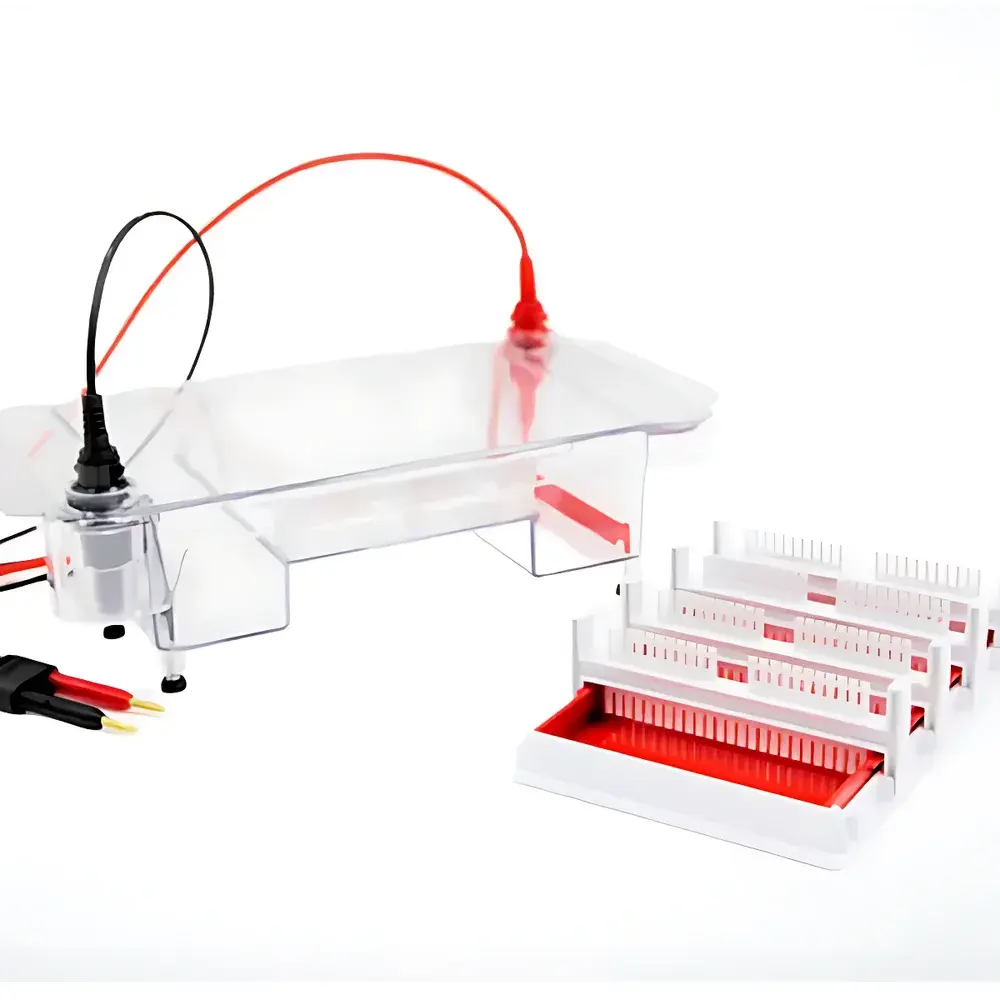
Tanon HE-220 High-Throughput Horizontal Electrophoresis System
| Brand | Tanon |
|---|---|
| Origin | Shanghai, China |
| Model | HE-220 |
| Maximum Gel Area | 18.5 × 12 cm |
| Gel Tray Dimensions | 18.5 × 12 cm |
| Comb Configuration | 25-well molded comb |
| External Dimensions (L×W×H) | 31 × 17.5 × 8 cm |
| Compatible Power Supplies | EPS-100, EPS-200, EPS-300, EPS-600 |
Overview
The Tanon HE-220 High-Throughput Horizontal Electrophoresis System is an engineered solution for rapid, parallel nucleic acid separation in modern molecular biology laboratories. Designed around the principles of constant-voltage horizontal electrophoresis in agarose or low-melting-point agarose gels, the HE-220 enables standardized, reproducible DNA fragment migration under controlled electric field conditions. Its architecture centers on a rigid acrylic tank with integrated buffer chamber, precisely aligned electrode assemblies (platinum-coated stainless steel), and a thermally stable gel tray platform. Unlike conventional horizontal systems optimized for low-sample workflows, the HE-220 integrates structural enhancements—such as an internal gel tray retention frame and reinforced comb alignment guides—to maintain positional fidelity during extended runs (up to 90 minutes at 120 V), minimizing band distortion and improving inter-gel reproducibility across high-density sample arrays.
Key Features
- Integrated gel tray immobilization frame: Prevents lateral displacement of the 18.5 × 12 cm casting tray during electrophoresis, ensuring consistent well-to-well alignment and eliminating gel slippage-induced band smearing.
- High-throughput comb compatibility: Precision-molded 25-well comb designed for direct integration with standard 12-channel pipettors—enabling simultaneous loading of up to 96 samples per gel (4 × 25-well combs or dual 25-well configuration depending on tray layout).
- Dual-safety electrode housing: Electrodes are recessed within sealed side compartments with overmolded insulation barriers, reducing risk of accidental contact and electrolyte leakage while maintaining uniform current distribution across the gel surface.
- Modular buffer chamber design: Removable bottom plate facilitates rapid buffer exchange and residue-free cleaning; buffer volume capacity supports ≥400 mL for thermal stability during multi-gel runs.
- UV-transparent acrylic construction: Tank body complies with ISO 10993-5 biocompatibility standards for non-cytotoxic materials and permits direct post-run UV visualization without gel transfer.
Sample Compatibility & Compliance
The HE-220 accommodates standard agarose concentrations (0.7–2.0% w/v) and certified low-EEO (electroendosmosis) agaroses for optimal resolution of DNA fragments ranging from 100 bp to 20 kbp. It supports both ethidium bromide and SYBR Safe staining protocols, and is validated for use with commercial DNA ladders (e.g., 100 bp DNA Ladder, Lambda HindIII Digest). The system conforms to IEC 61010-1:2010 safety requirements for laboratory electrical equipment and meets CE marking directives for in vitro diagnostic ancillary devices. When operated with Tanon EPS-series power supplies (EPS-200/EPS-300), it satisfies GLP-compliant documentation needs through synchronized run logging and voltage/time-stamped output records.
Software & Data Management
While the HE-220 is a standalone electrophoresis cell requiring no embedded firmware or onboard control, its mechanical design ensures full interoperability with Tanon’s GelDoc imaging platforms (e.g., Tanon 2500R, 4600SF) and associated Image Lab™ software suite. This integration enables automated lane detection, molecular weight calibration using reference ladders, and batch quantification of band intensities across multiple gels. Audit trail functionality—including user ID, gel ID, date/time stamp, and applied voltage—is preserved when paired with EPS power supplies supporting RS-232/USB data export. All raw image metadata adhere to MIAME-compliant annotation standards for downstream submission to public repositories such as GEO or SRA.
Applications
- High-volume genotyping workflows: Simultaneous screening of CRISPR-edited clones, SNP validation panels, or TILLING populations using multiplexed PCR amplicons.
- Plasmid QC in cloning pipelines: Parallel analysis of restriction digests across 96-well plate-derived samples prior to sequencing or transformation.
- Forensic DNA profiling: Co-electrophoresis of reference standards and casework samples under identical buffer and field conditions to minimize inter-assay variability.
- Gel extraction optimization: Recovery of discrete bands from large-format gels followed by electroelution or silica-column purification—facilitated by precise well geometry and minimal diffusion zones.
- Teaching laboratory scalability: Deployment in undergraduate genetics labs where throughput, safety, and reagent economy are critical operational constraints.
FAQ
Is the HE-220 compatible with polyacrylamide gels?
No—the HE-220 is specifically engineered for agarose-based horizontal electrophoresis. Its gel tray depth, comb geometry, and buffer volume are optimized for agarose viscosity and polymerization kinetics; polyacrylamide gels require vertical or specialized horizontal systems with different thermal management and casting protocols.
Can the 25-well comb be used with standard 96-well plate formats?
Yes—each 25-well comb aligns with four consecutive rows of a 96-well plate (A1–D1, A2–D2, etc.), enabling efficient 12-channel pipetting without tip repositioning. Comb spacing matches ANSI/SLAS microplate footprint tolerances (±0.1 mm).
What buffer types are recommended for optimal performance?
TAE (40 mM Tris-acetate, 1 mM EDTA) and TBE (89 mM Tris-borate, 2 mM EDTA) are fully supported. For high-throughput applications, pre-chilled 1× TAE is preferred due to lower conductivity and reduced Joule heating during extended runs.
Does the HE-220 include a lid with built-in UV shielding?
No—UV protection is provided externally via Tanon UV transilluminators or darkroom protocols. The transparent acrylic lid is optically neutral and intended for visual monitoring only; users must employ certified UV-blocking goggles and face shields during ethidium bromide visualization.
How is calibration verified for reproducible voltage application?
Calibration is performed at the power supply level (EPS series), not the HE-220 cell. Each EPS unit undergoes factory calibration traceable to NIST standards, with annual verification recommended per ISO/IEC 17025 guidelines for electrophoresis instrumentation.





