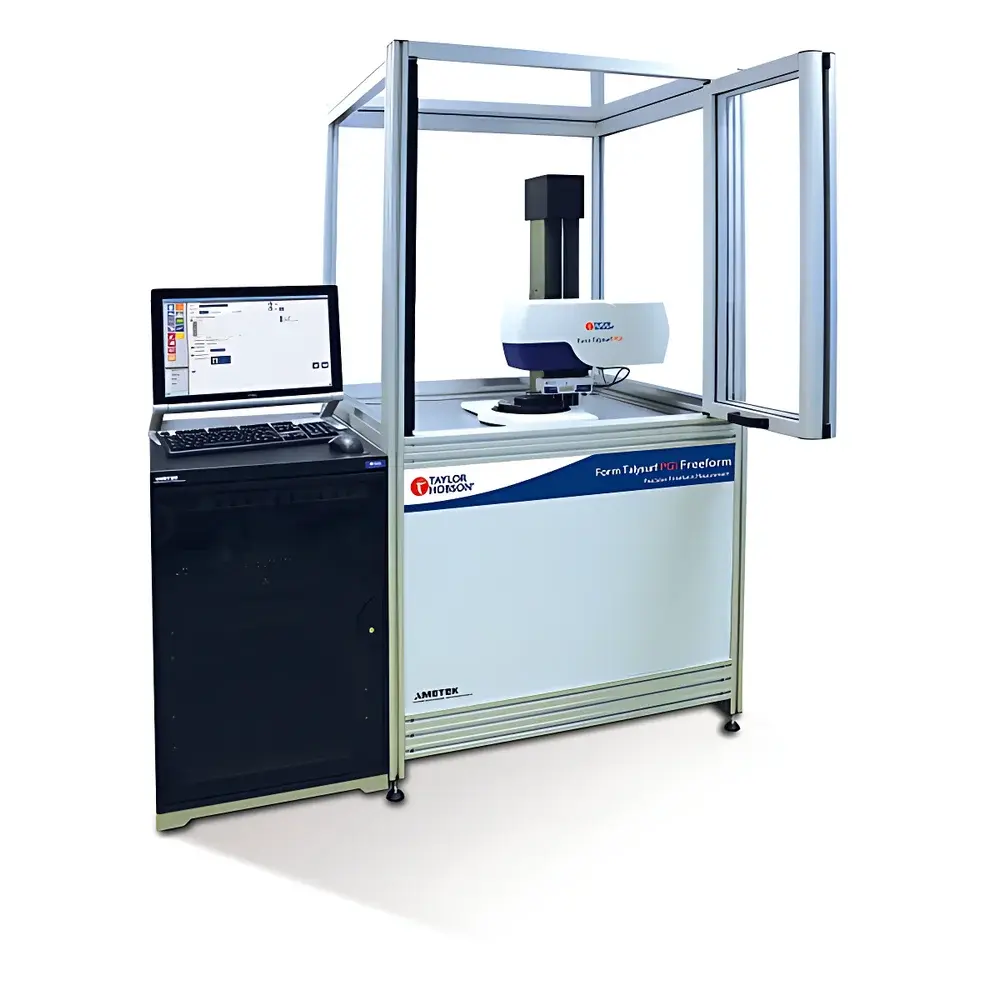
Taylor Hobson PGI Freeform Freeform Metrology System
| Brand | Taylor Hobson |
|---|---|
| Origin | United Kingdom |
| Model | PGI Freeform |
| Measurement Principle | Contact Stylus Profilometry with Radial & Grating-Scan Modes |
| Vertical Range | 28 mm |
| Vertical Resolution | 0.8 nm |
| Tilt Capability | ±50° |
| Form Error Accuracy | <150 nm PV |
| Motion Architecture | FEA-Optimized Ultra-Stiff Mechanical Axes |
| Compliance | ISO 10360, ISO 1101, ISO 16610, ISO 25178 (Part 2, Part 601–607), ASTM E1155, USP <1059>, GLP/GMP-ready audit trail support in software |
Overview
The Taylor Hobson PGI Freeform is a high-precision, contact-based metrology system engineered for the full three-dimensional characterization of complex optical and mechanical freeform surfaces. Unlike conventional profilometers limited to rotationally symmetric or simple aspheric geometries, the PGI Freeform implements dual-scan methodologies—radial scanning for axisymmetric features and grating-mode scanning for arbitrarily oriented surface topographies—enabling traceable, sub-nanometer resolution measurement of non-repetitive, mathematically defined surfaces. Its core architecture integrates decades of Taylor Hobson’s expertise in ultra-precision motion control, piezoelectric sensor design, and finite element analysis (FEA)-optimized mechanical stability. The system delivers calibrated form error data referenced directly to CAD models, supporting closed-loop manufacturing verification for next-generation optical systems used in aerospace, lithography, biomedical imaging, and adaptive optics.
Key Features
- Multi-modal scanning capability: Simultaneous radial and grating-scan modes for comprehensive coverage of spherical, aspherical, toroidal, biconic, NURBS-defined, Zernike-polynomial, and point-cloud-based freeform surfaces.
- Ultra-low-noise vertical metrology: High-stability transducer with 0.8 nm resolution and 28 mm vertical range, enabling single-pass measurement of steep slopes up to ±50° without stylus lift or repositioning.
- Thermally stable granite base and FEA-optimized gantry: Minimizes thermal drift and dynamic deflection, ensuring <150 nm PV form error reproducibility across multi-hour measurement sequences.
- Integrated calibration suite compliant with ISO 10360-2 (CMM performance verification) and ISO 1101 (geometrical tolerancing), with certified reference artifacts traceable to UKAS-accredited standards.
- Dual-axis tilt stage with motorized precision indexing: Enables accurate alignment of non-orthogonal surface normals relative to the stylus path, critical for measuring off-axis segments and segmented mirrors.
Sample Compatibility & Compliance
The PGI Freeform accommodates substrates ranging from 10 mm to 300 mm in diameter and up to 100 mm in height, including fused silica, BK7, CaF₂, silicon, and polished metal optics. Surface finishes down to λ/20 (≈30 nm RMS) are fully resolvable. All measurement workflows adhere to ISO 16610 (filtration), ISO 25178-2 (areal surface texture), ISO 25178-601–607 (freeform-specific parameters), and ASTM E1155 (floor flatness evaluation methodology). Data integrity protocols satisfy FDA 21 CFR Part 11 requirements through electronic signatures, role-based access control, and immutable audit trails embedded in the proprietary FormSurf™ software environment.
Software & Data Management
FormSurf™ software provides an integrated platform for measurement planning, real-time feedback, deviation mapping, and GD&T-compliant reporting. It supports direct import of STEP AP242, IGES, and ASCII point-cloud files, with automated best-fit alignment against nominal geometry using iterative closest point (ICP) algorithms. Residual error maps are generated in color-coded deviation plots with statistical overlays (PV, RMS, Sa, Sq, Sz). Export options include PDF reports with embedded metadata, CSV/Excel datasets, and native .STL/.PLY formats for downstream simulation or reverse engineering. All raw scan data is stored in vendor-neutral HDF5 containers, ensuring long-term archival compliance per ISO/IEC 17025 and GLP documentation requirements.
Applications
- Verification of diamond-turned or magnetorheological finished freeform mirrors in space telescope assemblies.
- Process validation of injection-molded plastic freeform lenses for augmented reality (AR) waveguides.
- GD&T assessment of toroidal laser scanner housings under ASME Y14.5–2018 standards.
- Surface fidelity analysis of Zernike-polynomial-corrected ophthalmic intraocular lenses (IOLs).
- Qualification of NURBS-defined turbine blade root profiles in high-pressure compressor stages.
FAQ
What surface mathematical representations does the PGI Freeform support for comparison?
It natively compares measured data against nominal surfaces defined by conic constants, polynomial expansions (including Q-type, XY-polynomial, and Zernike), NURBS patches, parametric B-splines, and discrete point clouds.
Is the system suitable for in-process metrology in cleanroom environments?
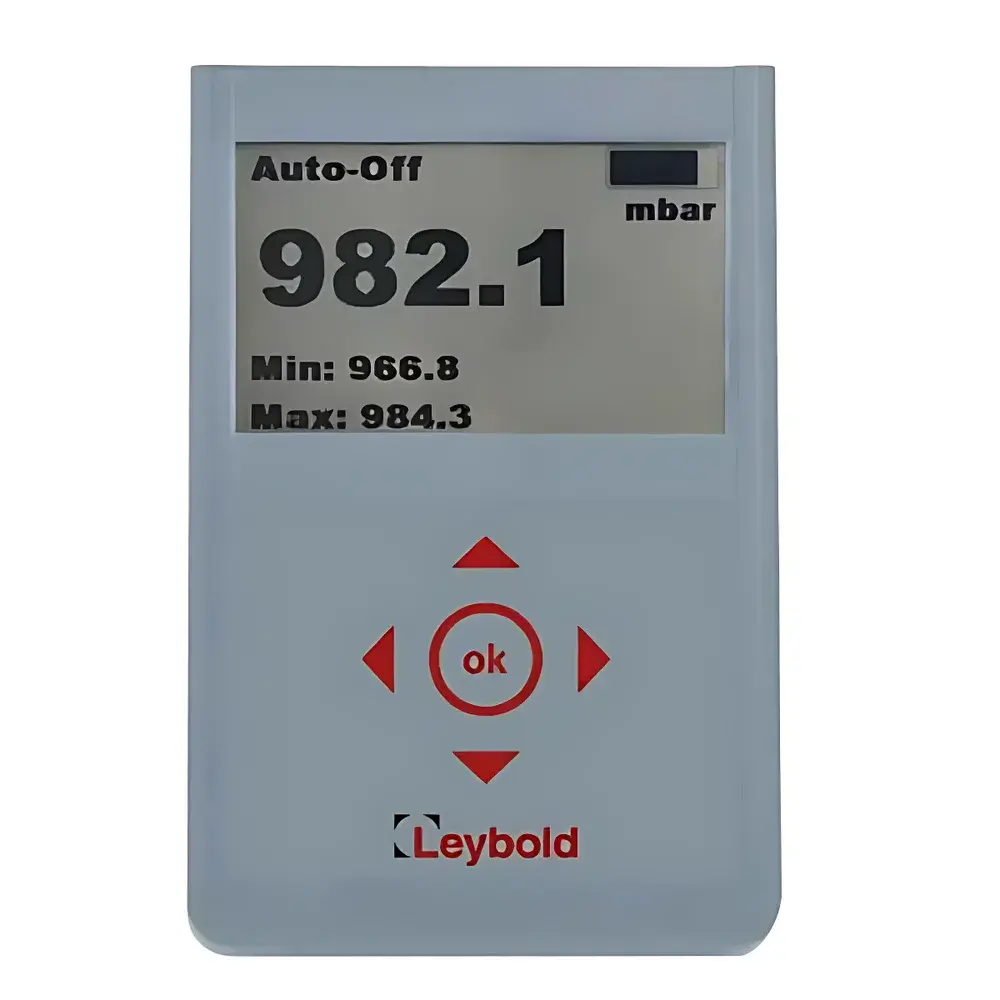
Yes—the PGI Freeform is available with ISO Class 5-compatible enclosures, vibration-isolated optical tables, and low-outgassing materials; optional environmental monitoring modules log temperature, humidity, and air pressure synchronously with each scan.
Can measurement uncertainty be quantified per ISO/IEC 17025 requirements?
Yes—uncertainty budgets are automatically generated using GUM-compliant Monte Carlo simulation within FormSurf™, incorporating contributions from probe tip radius, thermal expansion, stage positioning error, and calibration artifact uncertainty.
Does the system support automated batch measurement of multiple parts?
Yes—through scriptable macros and integration with factory MES via OPC UA, enabling unattended sequential measurement of up to 99 parts with pass/fail decision logic based on user-defined tolerance zones.