
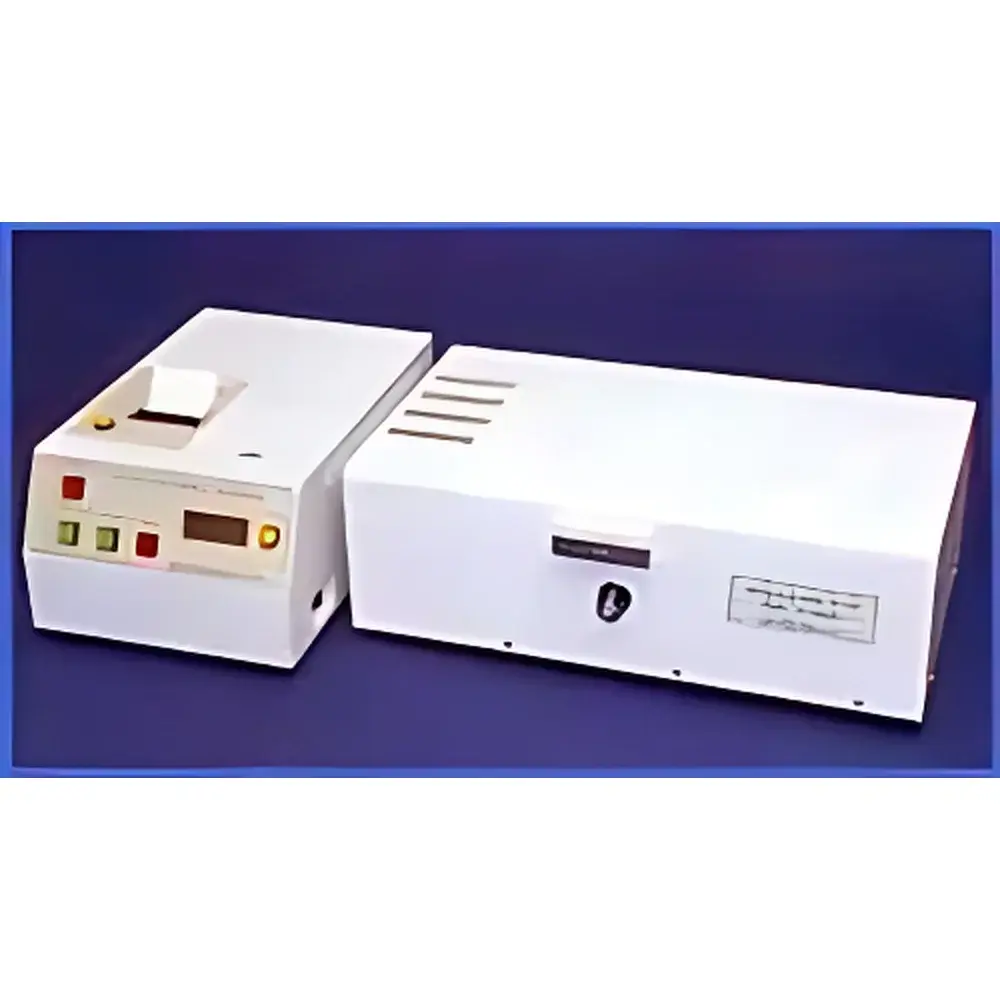
TC-HIIIDPK Automatic Haze Meter
| Origin | Imported |
|---|---|
| Manufacturer Type | Authorized Distributor |
| Model | TC-HIIIDPK |
| Pricing | Available Upon Request |
| Measurement Principle | Integrating Sphere (60 mm diameter) |
| Compliance | JIS K 6718, JIS K 7105, ASTM D1003 |
| Light Source | Tungsten-Halogen Lamp |
| Detector | Silicon Photodiode |
| Measuring Aperture | Ø10 mm |
| Display | Backlit LCD |
| Output | Built-in Thermal Printer |
| Measured Parameters | Total Transmittance (Tt %), Diffuse Transmittance (Td %), Specular Transmittance (Tp %), Haze (%), Max/Min/Average Statistics |
| A/D Adjustment | User-configurable reference voltage calibration |
| Power Supply | Stabilized DC source for measurement integrity |
Overview
The TC-HIIIDPK Automatic Haze Meter is a precision optical instrument engineered for the quantitative assessment of light scattering behavior in transparent and translucent materials. It operates on the integrating sphere principle—a standardized photometric configuration where incident light from a tungsten-halogen source is uniformly diffused across the inner reflective surface of a 60 mm diameter sphere, enabling accurate separation and detection of total, diffuse, and specular transmittance components. This architecture ensures high reproducibility and compliance with internationally recognized test standards including ASTM D1003, JIS K 7105, and JIS K 6718—protocols widely adopted in quality control laboratories for plastics, films, glass, coatings, and optical substrates. Designed for routine industrial metrology, the TC-HIIIDPK delivers traceable haze measurements (%) alongside transmittance metrics (Tt, Td, Tp) without manual alignment or iterative calibration steps.
Key Features
- Integrated 60 mm integrating sphere optical system optimized for ISO/ASTM-compliant haze evaluation
- One-touch automatic zero calibration (ACC) with full 100% offset compensation capability
- User-adjustable analog-to-digital (A/D) conversion threshold via reference voltage tuning—enabling optimization for varying sample spectral response
- Onboard statistical engine supporting real-time calculation and display of maximum, minimum, and arithmetic mean values across sequential measurements
- Dedicated stabilized DC power supply unit minimizing thermal drift and line-voltage sensitivity during extended operation
- Embedded thermal printer with customizable print layout—supporting selective output of raw data, statistics, timestamp, and operator ID per measurement record
Sample Compatibility & Compliance
The TC-HIIIDPK accommodates flat, rigid, or semi-rigid specimens up to 3 mm thickness with minimal edge effects, provided the measured area (Ø10 mm) lies fully within the illuminated zone. Its optical design meets the geometric and spectral requirements defined in ASTM D1003 Annex A1 (Method A) for opaque-backing haze determination and supports both transmission-mode configurations required by JIS K 7105. Instrument validation documentation—including factory calibration certificates traceable to NMIJ (National Metrology Institute of Japan) standards—is supplied with each unit. The device conforms to IEC 61000-4 electromagnetic compatibility directives and operates within Class II safety insulation per IEC 61010-1 for laboratory use.
Software & Data Management
While the TC-HIIIDPK operates as a standalone benchtop instrument, its thermal printer output provides auditable hardcopy records suitable for GLP and GMP environments. Each printed report includes measurement date/time, parameter identifiers (Haze %, Tt %, etc.), statistical summary, and user-defined annotation fields. For digital archiving, users may integrate external USB-based data loggers or implement serial (RS-232) communication protocols using third-party terminal emulation software. All firmware adheres to FDA 21 CFR Part 11 principles for electronic record integrity—ensuring secure audit trails when paired with validated host systems. Calibration history, operator logs, and maintenance events are retained in non-volatile memory.
Applications
- Quality assurance of PET, PC, PMMA, and polycarbonate sheets used in automotive glazing and display covers
- In-process verification of anti-fog coating uniformity on medical device packaging films
- Batch release testing of optical filters and IR-transmissive substrates in photonics manufacturing
- R&D evaluation of nanoparticle dispersion homogeneity in polymer nanocomposites
- Regulatory submission support for ISO 10993 biocompatibility assessments requiring optical clarity documentation
- Supplier qualification audits under IATF 16949 and AS9100 where haze specifications are contractually mandated
FAQ
Does the TC-HIIIDPK require annual recalibration?
Yes—recommended recalibration interval is 12 months or after 2,000 measurement cycles, whichever occurs first, using NIST-traceable reference standards.
Can the instrument measure curved or textured surfaces?
No—it is designed exclusively for planar samples; curvature or surface texture exceeding ±0.1 µm Ra introduces measurement uncertainty beyond ASTM D1003 tolerances.
Is the thermal printer compatible with continuous label stock?
The built-in mechanism accepts only standard 57 mm thermal paper rolls; custom media requires mechanical modification not covered under warranty.
What is the warm-up time before first measurement?
Stabilization time is ≤15 minutes from power-on to achieve thermal equilibrium of the halogen lamp and detector circuitry.
How is compliance with FDA 21 CFR Part 11 enforced?
The instrument itself does not implement electronic signatures or audit trail encryption; however, its deterministic output format enables integration into validated LIMS or ELN platforms that fulfill Part 11 requirements.




