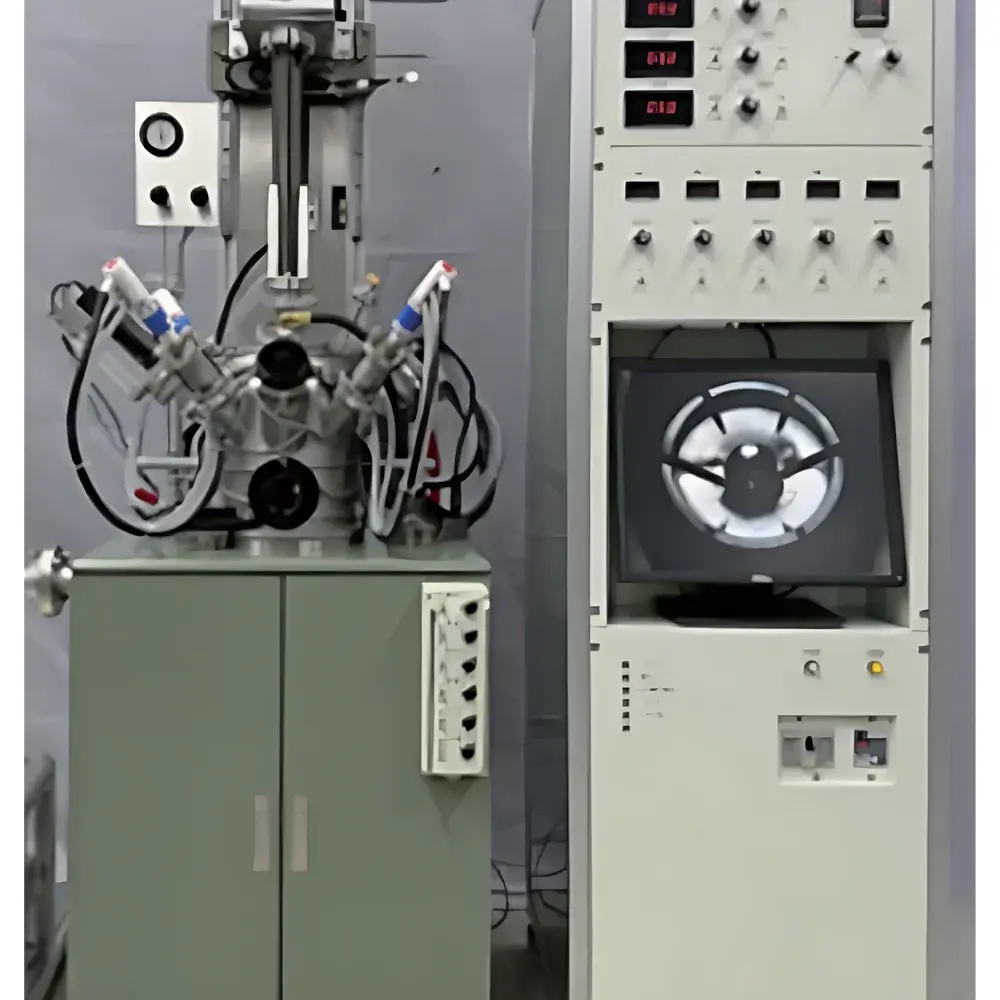
TCA4-6 Four-Electrode Arc Melting and Czochralski Crystal Growth Furnace by Techno Search Corp
| Brand | Techno Search Corp |
|---|---|
| Origin | Japan |
| Model | TCA4-6 |
| Maximum Operating Temperature | 2000–3000 °C |
| Chamber Vacuum Level | ≤1×10⁻⁶ Torr (≤1.3×10⁻⁴ Pa) |
| Atmosphere Control | High-purity Ar, pressure range 10⁻⁴ Pa to 1 atm |
| Crucible Rotation Speed | 1–10 rpm (manual) |
| Crystal Pulling Speed | 3–38 mm/hr |
| Pulling Stroke | 150 mm |
| Electrode Configuration | 4 arc-melting electrodes + 1 getter electrode |
| Sustained Arc Current | up to 75 A (adjustable) |
| Peak Arc Current | up to 150 A (short-term, adjustable) |
| Crucible Material | Water-cooled copper |
| Chamber Material | Stainless steel |
| Real-time Visual Monitoring | Integrated high-temperature CCD camera with viewport |
Overview
The TCA4-6 Four-Electrode Arc Melting and Czochralski Crystal Growth Furnace is a precision-engineered system designed for the synthesis and directional solidification of highly reactive, high-melting-point intermetallic compounds—particularly those containing rare-earth elements (e.g., Ce, Nd, U, V) or actinides (e.g., U). Unlike conventional resistance-heated or induction-based crystal growth furnaces, the TCA4-6 employs a four-electrode DC arc melting configuration to generate localized, ultra-high-temperature plasma zones (>2500 °C) directly within the molten charge. This enables rapid, contamination-free melting of refractory alloys without crucible interaction—critical for maintaining stoichiometric fidelity in metastable or oxygen-sensitive phases. Following melt homogenization under inert argon atmosphere, single crystals are grown via a modified Czochralski (Cz) technique: the molten zone is precisely stabilized at the crucible surface, and the seed crystal is withdrawn vertically under synchronized rotation and translation control. The furnace integrates a high-vacuum base chamber (≤1×10⁻⁶ Torr), compatible with subsequent backfilling to controlled Ar partial pressures (10⁻⁴ Pa to 1 atm), ensuring reproducible redox conditions during nucleation and growth.
Key Features
- Four independent, water-cooled tungsten or thoriated-tungsten arc electrodes enabling symmetrical, stable plasma distribution and uniform melt pool geometry—reducing thermal gradients and suppressing convective instabilities.
- Dual-stage vacuum architecture: turbomolecular pumping backed by dry scroll pump ensures rapid evacuation and low partial pressure of reactive gases (O₂, H₂O, N₂), essential for uranium- or cerium-based intermetallics.
- Motorized vertical pulling mechanism with sub-millimeter positional resolution and programmable speed profiles (3–38 mm/hr), supporting both constant-rate and multi-step growth protocols.
- Rotating, water-cooled copper crucible (1–10 rpm, manual fine adjustment) optimized for electromagnetic confinement and thermal dissipation—minimizing thermal stress on the growing crystal interface.
- Integrated high-temperature CCD camera system with quartz viewport and calibrated thermal imaging overlay, enabling real-time observation of meniscus shape, solid–liquid interface curvature, and defect formation dynamics.
- Single dedicated getter electrode for active removal of residual oxygen and nitrogen during melting—enhancing phase purity in oxygen-sensitive systems such as UGe₂ or URu₂Si₂.
Sample Compatibility & Compliance
The TCA4-6 is validated for crystal growth of complex intermetallic systems including but not limited to: UGe₂, UPt₃, URhAl, UNiAl, URu₂Si₂, V₃Si, CePd₂Al₃, Nd₂Fe₁₄B, RE₂Co₁₇ (RE = La, Ce, Pr, Nd), and RENi₅ (RE = Y, Gd, Tb). Its design conforms to ISO 27327-1:2017 (vacuum equipment safety) and incorporates electrical grounding and arc containment per IEC 61000-6-4 (EMC immunity). All stainless-steel vacuum components meet ASTM A240/A240M standards for corrosion-resistant austenitic alloys. The system supports GLP-compliant operation when paired with external data loggers meeting FDA 21 CFR Part 11 requirements for electronic records and signatures.
Software & Data Management
While the TCA4-6 operates primarily via hardware-integrated analog controls (current regulation, motion sequencing, vacuum interlocks), it provides standardized 0–10 V analog outputs and RS-485 Modbus RTU interfaces for integration into laboratory-wide SCADA or custom LabVIEW-based monitoring platforms. Users may log time-stamped parameters—including arc current, crucible rotation, pull speed, chamber pressure, and thermographic frame metadata—for post-growth correlation with XRD, EPMA, or magnetization data. Optional OEM firmware upgrades support automated recipe storage, alarm-triggered emergency shutdown sequences, and audit-trail-enabled parameter change logging—aligning with ISO/IEC 17025 quality management frameworks.
Applications
- Growth of quantum critical and heavy-fermion single crystals for low-temperature transport and specific heat measurements (e.g., URu₂Si₂, CePd₂Al₃).
- Synthesis of high-coercivity permanent magnet precursors (Nd₂Fe₁₄B, RE₂Co₁₇) with minimized α-Fe secondary phase segregation.
- Preparation of actinide-containing intermetallics under ultra-low oxygen fugacity for neutron scattering and Mössbauer spectroscopy.
- Phase diagram validation studies requiring millimeter-scale, compositionally homogeneous boules of ternary and quaternary intermetallics.
- In-situ investigation of solidification kinetics in refractory B2- and Laves-phase alloys (e.g., V₃Si, REFe₁₀Ti₂).
FAQ
What types of materials are incompatible with the TCA4-6 system?
Materials with high vapor pressure below 2000 °C (e.g., Zn, Cd, Mg) or strong reactivity with tungsten electrodes (e.g., Ti, Nb in excess stoichiometry) are not recommended. Chloride- or fluoride-based precursors must be pre-purified to avoid corrosive arc byproducts.
Can the system operate under dynamic gas flow conditions?
Yes—the gas inlet manifold supports mass-flow-controlled Ar introduction; however, continuous flow above 100 sccm requires optional differential pumping to maintain base vacuum integrity during melting.
Is remote operation supported?
Hardware-level remote start/stop and emergency stop are available via dry-contact I/O; full parameter control requires integration with third-party PLC or DAQ software using the provided Modbus register map.
What maintenance intervals are recommended for arc electrodes?
Electrode tip dressing is advised after every 15–20 h of cumulative arc-on time; replacement frequency depends on current density and material volatility—typically 50–100 h for U- or Ce-bearing melts.
Does the system include temperature calibration traceability?
No integrated pyrometer is supplied; users must install and calibrate a separate two-color or spectral pyrometer (e.g., Impac IGA 12-LO) against NIST-traceable blackbody sources prior to first use.