
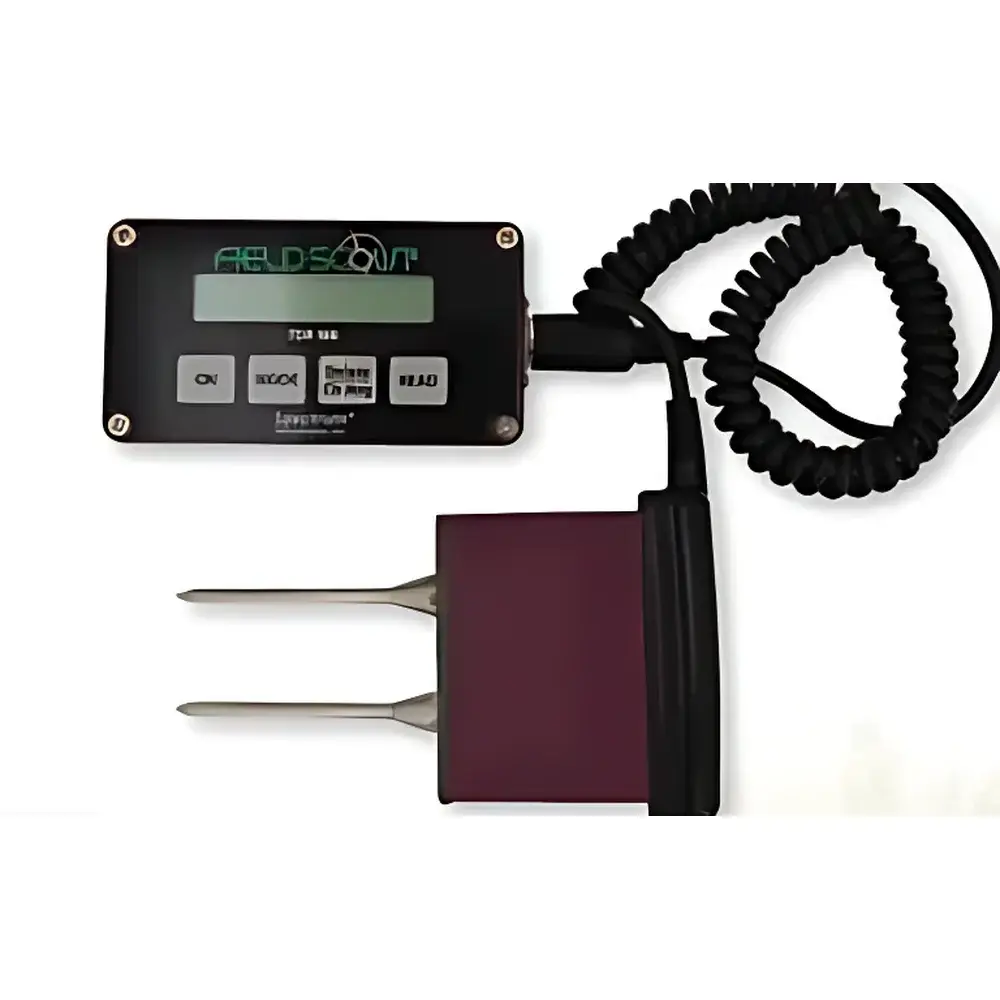
TDR-100 Soil Moisture Analyzer
| Origin | USA |
|---|---|
| Manufacturer Type | Authorized Distributor |
| Origin Category | Imported |
| Model | TDR-100 |
| Instrument Type | Soil Water Content Analyzer |
| Resolution | 1% vol |
| Accuracy | ±3.0% vol (EC < 2 dS/m, clay content < 30%) |
| Measurement Range | 0–~50% vol (saturation limit varies by soil texture) |
| Probe Options | 7.5 cm, 12 cm, 20 cm rod length |
| Power Supply | 4 × AAA alkaline batteries (~12 months typical life) |
| Display | 2-line × 16-character LCD |
| Weight | 0.68 kg |
| Dimensions (meter) | 10.5 cm × 7.0 cm × 1.8 cm |
| Probe Diameter | 1.0 cm |
| Probe Spacing | 3.3 cm |
Overview
The TDR-100 Soil Moisture Analyzer is a field-deployable time-domain reflectometry (TDR) instrument engineered for rapid, non-destructive quantification of volumetric water content (θv) in mineral and organic soils. Based on the physical principle that electromagnetic wave propagation velocity in soil is inversely proportional to its dielectric permittivity—and that water (εr ≈ 80) exhibits significantly higher permittivity than dry soil matrix (εr ≈ 3–5) and air (εr = 1)—the TDR-100 measures the travel time of a high-frequency pulse along parallel stainless-steel rods inserted into the soil. This transit time is converted directly into θv using empirically validated calibration equations (e.g., Topp et al., 1980), with optional relative moisture mode for irrigation scheduling support. Designed for consistent performance across diverse soil textures—including sandy loam, silt loam, and clay loam—the analyzer operates reliably under variable salinity conditions (EC ≤ 2 dS/m) and moderate clay fractions (<30%). Its handheld architecture enables immediate spot measurements in agricultural fields, greenhouse substrates, turfgrass systems, and controlled-environment laboratories.
Key Features
- Handheld, battery-powered design optimized for portability and single-operator field use
- Dual-display mode: volumetric water content (% vol) and relative soil moisture index for irrigation decision support
- Robust stainless-steel probe options (7.5 cm, 12 cm, and 20 cm rod lengths) for shallow-rooted crops, deep-profile monitoring, or containerized media
- Integrated signal conditioning and digital timing circuitry ensuring stable pulse reflection analysis across temperature gradients (−10°C to +50°C operating range)
- Calibration-compatible with standard TDR-based soil moisture models per ASTM D5778 and ISO 11274
- Low-power consumption enabling >12 months of typical operation on four AAA alkaline cells
Sample Compatibility & Compliance
The TDR-100 is validated for use in mineral soils, peat-based growing media, and amended horticultural substrates. It meets the functional requirements for field soil moisture assessment under USDA-NRCS Soil Survey Field and Laboratory Methods Manual (2014) and supports GLP-aligned data collection protocols when used with documented calibration checks and probe insertion consistency. While not a certified metrological standard, its ±3.0% vol accuracy specification conforms to the performance expectations for Class II portable soil moisture instruments as defined in ISO/IEC 17025-compliant environmental testing laboratories. The device does not require regulatory certification for routine agronomic or ecological monitoring applications; however, users deploying it in regulated irrigation reporting contexts should perform site-specific validation against gravimetric reference methods per ASTM D4959.
Software & Data Management
The TDR-100 operates as a standalone measurement terminal without embedded data logging. All readings are displayed in real time on the integrated 2×16-character LCD and must be manually recorded or transcribed. For traceable, audit-ready workflows, integration with external data loggers (e.g., Campbell Scientific CR1000X) or GPS-enabled mobile platforms is recommended. While the TDR-100 itself lacks USB, Bluetooth, or SD card interfaces, its analog output compatibility allows connection to third-party acquisition systems supporting 0–2.5 V or 4–20 mA input ranges. Users requiring electronic data capture should consider the TDR-300 variant, which includes RS-232 serial output and onboard memory for up to 3,250 timestamped records (reduced to 1,350 when paired with DGPS geotagging).
Applications
- Real-time irrigation scheduling in row crops, orchards, and vineyards
- Validation of soil hydraulic property models (e.g., van Genuchten parameters)
- Root-zone moisture profiling during drought stress experiments
- Quality control of containerized nursery stock and hydroponic substrates
- Field verification of remote-sensing soil moisture products (e.g., Sentinel-1 SAR, SMAP L2/L3)
- Long-term ecological monitoring in grassland, forest, and restoration sites
FAQ
Does the TDR-100 require factory calibration before first use?
No—each unit ships with a pre-installed factory calibration optimized for mineral soils. However, users working with high-organic-matter substrates (e.g., peat moss >40% OM) or saline soils (>2 dS/m) should conduct a two-point gravimetric validation using representative samples from their site.
Can the TDR-100 measure frozen soil moisture?
No. Ice has a dielectric constant (~3.2) close to that of dry soil, rendering TDR ineffective below 0°C. Measurements must be conducted above freezing temperature with unfrozen pore water present.
What is the minimum soil bulk density for reliable TDR-100 readings?
Reliable operation requires bulk densities ≥1.1 g/cm³. In highly porous media (e.g., perlite, coarse bark), air gaps around probes may cause signal scattering and elevated noise; compaction or use of dielectric coupling gel is advised.
Is the probe compatible with automated insertion systems?
The standard 12 cm probe features a rigid 1.0 cm diameter stainless-steel construction rated for manual insertion only. Custom mounting brackets or pneumatic drivers are not supported and may compromise rod alignment or signal integrity.
Related Products







