
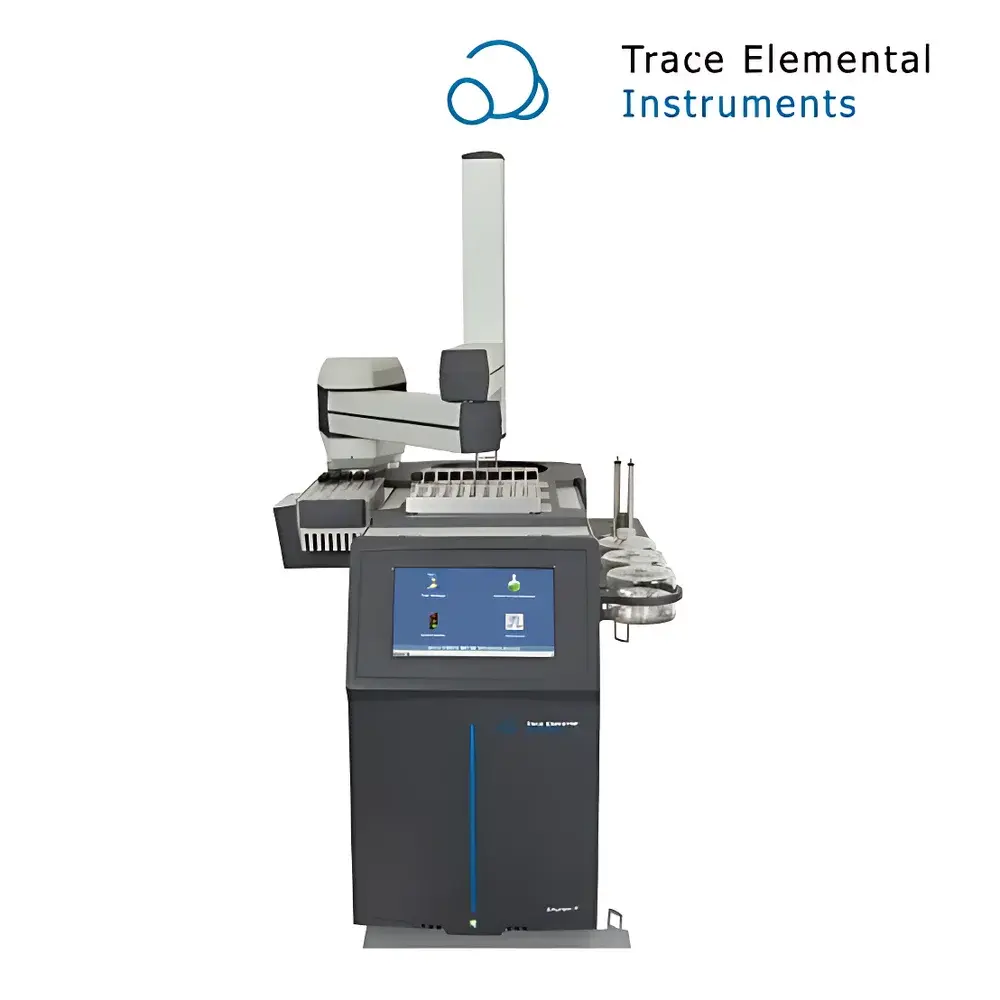
TE XPLORER-V Total Sulfur and Total Nitrogen Analyzer
| Brand | TE / Trace Elemental Instruments |
|---|---|
| Origin | Netherlands |
| Model | XPLORER-V with VECTRA Liquid Autosampler |
| Analytical Method | Combustion Microcoulometry |
| Measurement Range | 0–10,000 ppm |
| Accuracy | ≤2% CV |
| Detection Limit | 10 ppb |
| Resolution | ≤2% CV |
Overview
The TE XPLORER-V Total Sulfur and Total Nitrogen Analyzer is a high-precision, combustion-based elemental analyzer engineered for trace-level quantification of total sulfur (TS) and total nitrogen (TN) in liquid hydrocarbon matrices—including gasoline, diesel, jet fuel, lubricants, biofuels, and aqueous environmental samples. Operating on the principle of high-temperature catalytic combustion followed by microcoulometric detection, the system converts all organic and inorganic sulfur/nitrogen compounds into SO₂ or NO/NO₂, which are then selectively titrated in an electrochemical cell. This method delivers stoichiometric response, matrix-independent recovery, and compliance with internationally recognized standard test methods including ASTM D5453 (sulfur), ASTM D4294 (sulfur, XRF alternative), ASTM D5762 (nitrogen), ISO 20846, ISO 20884, UOP 979, and SH/T 0689. The XPLORER-V integrates seamlessly with the VECTRA liquid autosampler to enable unattended, high-throughput operation—making it suitable for routine QC/QA laboratories operating under GLP, ISO/IEC 17025, or refinery-specific quality management systems.
Key Features
- Combustion microcoulometry platform with Xpro-V™ self-cleaning quartz combustion tube—minimizes carryover and eliminates manual maintenance between runs
- VECTRA autosampler supporting up to 350 sample positions with programmable vial size compatibility (2–20 mL), integrated syringe auto-replacement, and solvent rinse cycles
- Analysis time per sample: 2.5–5 minutes, depending on matrix complexity and concentration level
- Dual-channel detection architecture enabling simultaneous or sequential TS/TN analysis without hardware reconfiguration
- Robust thermal management system ensuring stable furnace temperature (900–1100 °C) and consistent oxidation efficiency across diverse sample types
- Integrated carrier gas control (ultra-high-purity oxygen and helium/argon mixtures) with real-time pressure monitoring and leak diagnostics
Sample Compatibility & Compliance
The XPLORER-V accepts a broad range of liquid samples: petroleum distillates, crude oils (with dilution), biodiesel blends (FAME, HVO), wastewater extracts, soil leachates, and pharmaceutical solvents. Sample introduction is optimized for low-viscosity liquids (<20 cP); optional heated injection modules support higher-boiling-point matrices. All hardware and software components comply with IEC 61000-6-3 (EMC), CE marking requirements, and RoHS directives. Method validation documentation supports alignment with FDA 21 CFR Part 11 data integrity expectations when used with TEIS software audit trail functionality. Instrument qualification packages—including IQ/OQ/PQ protocols—are available for regulated environments requiring GMP or EPA-compliant reporting.
Software & Data Management
TEIS (Trace Elemental Instrument Software) provides full instrument control, sequence definition, calibration curve management (linear, quadratic, or multi-point weighted regression), and automated report generation in PDF/CSV formats. The software implements role-based user access, electronic signatures, and immutable audit trails meeting ALCOA+ principles. Raw detector signals, combustion profiles, and coulometric titration curves are stored with timestamped metadata. Data export interfaces include OPC UA and direct SQL database connectivity for LIMS integration. Optional 21 CFR Part 11 compliance module enables electronic records retention, signature verification, and change control logging—fully auditable during regulatory inspections.
Applications
- Refinery process stream monitoring per ASTM D7183 (jet fuel sulfur) and ASTM D7039 (gasoline sulfur)
- Environmental compliance testing of wastewater effluents (EPA Method 9096A adaptation) and sediment pore water
- Quality assurance of renewable diesel and sustainable aviation fuel (SAF) per ASTM D7566 Annex A2
- R&D support for catalyst poisoning studies and hydrotreating optimization
- Contract testing laboratories performing ISO/IEC 17025-accredited TN/TS analyses
- Regulatory submission testing for fuel certification programs (e.g., EU EN 228, EN 590, CARB)
FAQ
What sample types require dilution prior to analysis?
High-sulfur crudes, heavy fuel oils, and undiluted biodiesel feedstocks typically require 1:10 to 1:100 dilution with low-sulfur/nitrogen solvent (e.g., xylene or iso-octane) to remain within linear dynamic range and avoid detector saturation.
Can the XPLORER-V analyze solid samples?
No—the XPLORER-V is designed exclusively for liquid injection. Solid or semi-solid samples (e.g., sludge, polymers) must be pre-digested via microwave-assisted acid digestion or solvent extraction before analysis.
Is method transfer possible from older TE instruments?
Yes. Calibration parameters, sequence templates, and method files from XPERT series instruments are fully compatible with TEIS v4.2+, enabling seamless migration without re-validation of established workflows.
How often does the combustion tube require replacement?
Under normal operation (≤500 injections/week), the Xpro-V™ quartz tube demonstrates >12 months service life; automatic cleaning cycles extend longevity and reduce scheduled downtime.
Does the system support ASTM D5453 and D5762 simultaneously?
Yes—method selection is software-defined. Dual calibration curves and independent detector gain settings allow switching between sulfur- and nitrogen-specific protocols without hardware modification.
Related Products







