
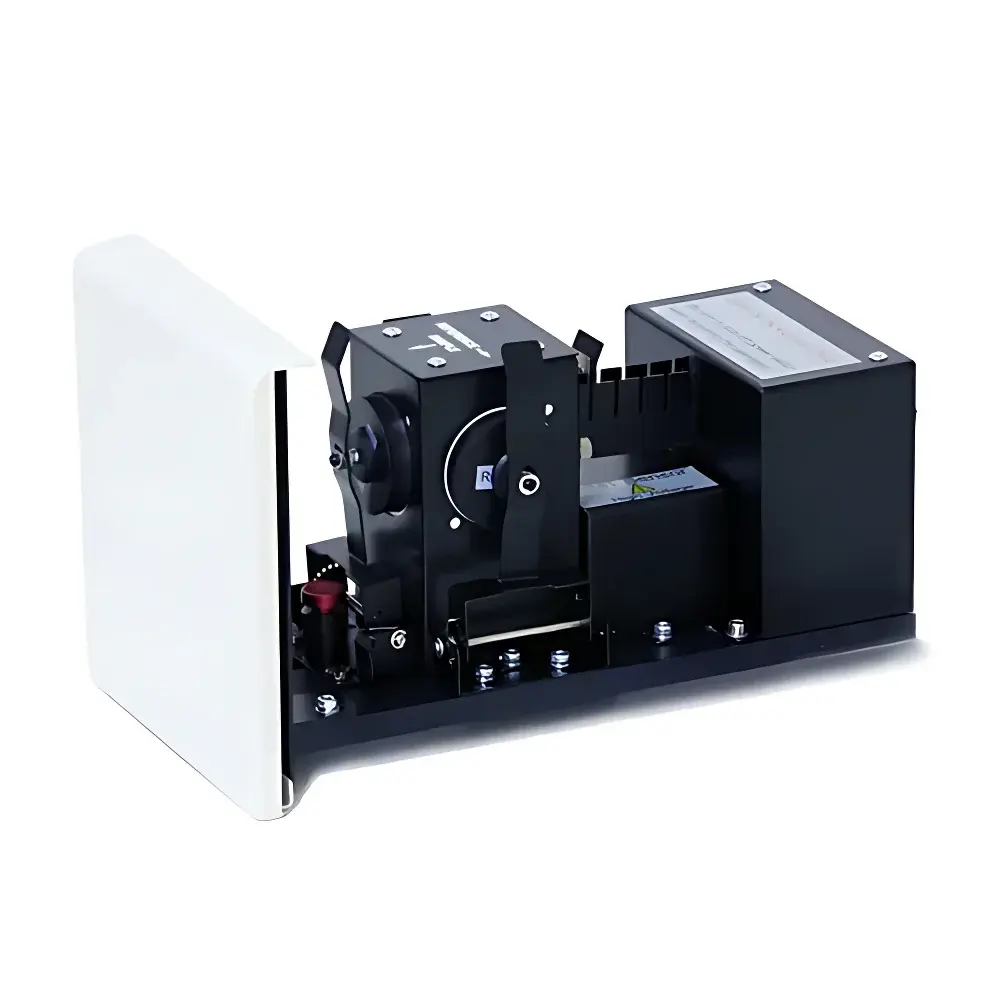
Techcomp IS-2600 High-Sensitivity Integrating Sphere
| Brand | Techcomp |
|---|---|
| Origin | Shanghai, China |
| Manufacturer Type | Original Equipment Manufacturer (OEM) |
| Country of Origin | China |
| Model | IS-2600 |
| Price Range | USD 2,800 – 7,000 |
Overview
The Techcomp IS-2600 High-Sensitivity Integrating Sphere is an optically engineered accessory designed for precise bidirectional reflectance and transmittance measurements in UV-Vis spectroscopy systems. Engineered to interface seamlessly with the Techcomp UV2600 spectrophotometer and compatible double-beam UV-Vis platforms, the IS-2600 operates on the principle of spatial integration of diffuse radiation within a geometrically defined spherical cavity. Its 60 mm internal diameter sphere features a proprietary sintered polytetrafluoroethylene (PTFE) coating—certified for >99% spectral reflectance across 250–2500 nm—ensuring minimal wavelength-dependent absorption and exceptional signal-to-noise ratio in low-light applications. The sphere’s 4.9% port area ratio (aperture-to-surface-area) minimizes measurement error from port losses while maintaining mechanical stability and thermal uniformity during extended acquisition cycles. Its fixed 0°/8° illumination geometry conforms to ISO 13655:2017 and ASTM E308-22 standards for colorimetric and reflectance metrology, enabling traceable quantification of both specular-included (SCI) and specular-excluded (SCE) reflectance modes without optical realignment.
Key Features
- 60 mm internal diameter integrating sphere with sintered PTFE inner coating (≥99% diffuse reflectance, 250–2500 nm)
- Optimized port geometry yielding 4.9% total aperture area ratio—reducing stray light contribution and enhancing photometric accuracy
- Integrated 0°/8° illumination configuration compliant with CIE and ISO geometries for standardized reflectance reporting
- Native S/R (Specular Component Included/Excluded) mode switching via host instrument control—no manual filter exchange or accessory reconfiguration required
- Simultaneous support for solid-sample diffuse reflectance (e.g., powders, films, painted panels) and liquid-sample transmittance (in cuvette-compatible holders)
- Mechanically robust aluminum housing with black-anodized exterior and temperature-stabilized mounting interface for vibration-damped operation
Sample Compatibility & Compliance
The IS-2600 accommodates standard 10 mm pathlength quartz or glass cuvettes (for transmission), as well as flat, opaque, or semi-transparent solid specimens up to 25 mm × 25 mm × 5 mm (thickness). Its internal baffle design prevents first-order direct illumination of the detector, ensuring compliance with NIST-traceable sphere performance criteria outlined in NIST SP 250-95. All optical interfaces are aligned to Techcomp UV2600’s beam height and focal plane specifications, eliminating collimation drift. The system meets essential requirements for GLP-compliant laboratories under ISO/IEC 17025:2017, supporting audit-ready documentation of calibration history, operator identity, and environmental conditions (via optional RS-232 or USB logging). It does not require external power or auxiliary electronics—operating entirely through the host spectrophotometer’s optical and control bus.
Software & Data Management
When paired with Techcomp UV2600’s native UVProbe software (v3.5+), the IS-2600 enables automated acquisition of Rdiff, Rtotal, Tdiff, and Ttotal spectra with configurable averaging, baseline correction, and Kubelka-Munk transformation. Raw intensity data is exported in ASCII (.txt) or JCAMP-DX (.jdx) format for third-party analysis in MATLAB, Python (SciPy), or commercial chemometrics packages. Audit trails—including parameter settings, date/time stamps, and user login IDs—are retained per FDA 21 CFR Part 11 guidelines when UVProbe is configured in secure mode with electronic signatures enabled. Firmware updates are delivered via USB flash drive and validated using SHA-256 checksums to ensure integrity.
Applications
- Quantitative pigment dispersion analysis in coatings and inks (per ASTM D2805)
- Whiteness index and yellowness index determination in paper, textiles, and polymers (ISO 11475, ISO 105-J02)
- Thin-film thickness estimation via interference fringe analysis in transparent substrates
- Photocatalytic activity assessment via normalized reflectance decay kinetics (e.g., TiO₂ degradation studies)
- Quality control of anti-reflective and high-reflectance optical coatings
- Calibration transfer between benchtop and portable spectrophotometers using sphere-based reference standards
FAQ
Is the IS-2600 compatible with non-Techcomp spectrophotometers?
Yes—provided the host instrument supports external accessory recognition via TTL-level handshake signals and offers programmable slit-width and scan-speed control. Custom driver integration may be required for full S/R mode automation.
What is the recommended recalibration interval for the PTFE coating?
NIST-recommended practice specifies annual verification against a certified reflectance standard (e.g., NIST SRM 2020); visual inspection for discoloration or abrasion should occur before each high-accuracy session.
Can the IS-2600 measure fluorescence quantum yield?
No—it lacks excitation monochromator synchronization and integrating sphere correction factors for absolute quantum efficiency; dedicated fluorometer accessories are required.
Does the sphere include a built-in shutter or beam blocker?
No—beam interruption is managed via the host instrument’s internal shutter mechanism; no mechanical add-ons are included or supported.
Is ISO/IEC 17025 calibration documentation available?
Yes—factory calibration certificates (traceable to NPL and NIST) are supplied with each unit; accredited third-party calibration services are available upon request.
Related Products




