
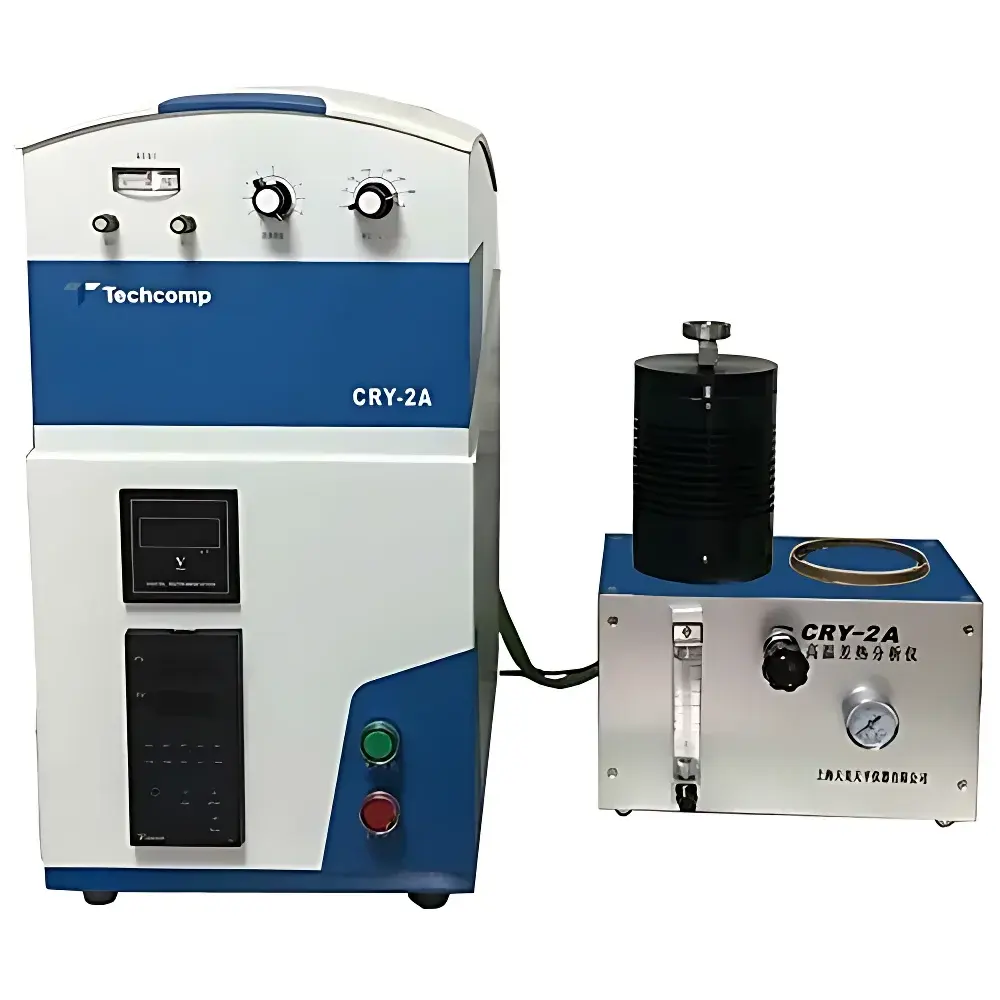
Techcomp CRY-2A / CRY-1A Differential Thermal Analyzer (DTA)
| Brand | Techcomp |
|---|---|
| Origin | Shanghai, China |
| Manufacturer Type | Direct Manufacturer |
| Product Origin | Domestic (China) |
| Model | CRY-2A / CRY-1A |
| Price Range | USD 7,000–14,000 (FOB Shanghai) |
| Temperature Range | Ambient to 1450 °C |
| Temperature Accuracy | ±0.1 °C |
| Heating/Cooling Rate | 0.1–50 K/min |
Overview
The Techcomp CRY-2A and CRY-1A Differential Thermal Analyzers (DTA) are precision benchtop instruments engineered for quantitative thermal event detection under controlled temperature programs. DTA operates on the principle of measuring the temperature difference (ΔT) between a sample and an inert reference material—typically high-purity α-alumina—as both are subjected to identical linear or non-linear heating or cooling profiles. This differential signal reflects endothermic or exothermic transitions arising from solid-state transformations such as polymorphic transitions, melting, crystallization, dehydration, decomposition, oxidation, and glass transitions. Unlike DSC, which quantifies heat flow, DTA delivers high-sensitivity qualitative and semi-quantitative thermal profiling with excellent baseline stability and low thermal inertia. The instrument’s compact furnace design—featuring low thermal mass ceramic insulation and optimized thermocouple geometry—enables rapid thermal response and high reproducibility across repeated runs, making it suitable for routine QC, materials R&D, and academic thermal characterization laboratories.
Key Features
- High-precision temperature control system with ±0.1 °C accuracy over the full operating range (ambient to 1450 °C), verified against NIST-traceable calibration standards
- Programmable heating and cooling rates from 0.1 to 50 K/min, supporting both isothermal holds and multi-segment dynamic ramps
- Low-thermal-mass furnace architecture ensures fast equilibration, minimal overshoot, and superior temperature linearity
- Integrated dual-channel analog-to-digital conversion with 24-bit resolution for high-fidelity ΔT signal acquisition
- CRY-2A model includes a built-in protective atmosphere module with dual-gas inlet capability (e.g., N₂/Ar for inert conditions; synthetic air for oxidative studies), enhancing thermocouple longevity at elevated temperatures
- CRY-1A supports optional atmospheric control unit for precise, independent regulation of two gas streams with mass flow controllers (MFCs) and automated valve switching
- Full software-driven instrument calibration suite—including temperature, enthalpy, and baseline correction—using certified reference materials (e.g., In, Sn, Zn, Al₂O₃)
Sample Compatibility & Compliance
The CRY series accommodates standard alumina or platinum crucibles (typically 70–100 µL capacity), supporting solid powders, granules, thin films, and small metallic specimens up to 100 mg. Sample containment is compatible with inert, oxidizing, reducing, and vacuum environments (down to 10⁻² mbar with optional vacuum interface). The system meets essential requirements for GLP-compliant thermal analysis workflows: audit-trail-enabled software logging, user-access-level permissions, electronic signature support, and raw data immutability per FDA 21 CFR Part 11 guidelines. Data output conforms to ASTM E1131 (Standard Test Method for Compositional Analysis by Thermogravimetry) and ISO 11357-4 (Plastics — Differential Scanning Calorimetry — Part 4: Determination of Specific Heat Capacity), with DTA-to-DSC conversion functionality enabling cross-platform method alignment.
Software & Data Management
The proprietary ThermoAnalyst™ software provides a unified platform for real-time acquisition, post-run processing, and regulatory reporting. It supports concurrent measurement and analysis tasks, customizable plot scaling (linear/logarithmic X/Y axes), and export to CSV, TXT, and universal thermal analysis formats (e.g., .itx, .q5). All analytical functions—including extrapolated onset/offset temperature (Tonset, Tend), peak temperature (Tp), enthalpy integration (ΔH), glass transition midpoint (Tg), oxidation induction time (OIT), and kinetic parameter estimation (e.g., Ozawa-Flynn-Wall model)—are implemented in accordance with ISO 11357-2 and ASTM E698. Baseline fitting employs polynomial or spline algorithms; slope-point adjustment allows manual refinement of inflection-based transition identification. Software updates and custom module development (e.g., API integration, LIMS connectivity) are available under extended support contracts.
Applications
- Identification and quantification of phase transitions in pharmaceuticals (e.g., polymorph screening, hydrate/anhydrate interconversion)
- Thermal stability assessment of catalysts, battery cathode materials, and refractory ceramics
- Decomposition kinetics of polymers, composites, and energetic materials
- Quality control of inorganic pigments, clays, and cementitious systems
- Validation of sintering profiles and heat-treatment schedules in metallurgy and powder processing
- Supporting ISO/IEC 17025-accredited testing in third-party labs requiring traceable, repeatable thermal event documentation
FAQ
What is the difference between DTA and DSC, and when should I choose DTA?
DTA measures the temperature difference between sample and reference under identical thermal programs, offering high sensitivity to transition onset and excellent signal-to-noise for qualitative screening. DSC directly quantifies heat flow and is preferred for absolute enthalpy determination. DTA remains optimal for high-temperature applications (>1000 °C), corrosive atmospheres, or when cost-effective, robust thermal profiling is required.
Can the CRY-2A perform simultaneous DTA-TG measurements?
No—the CRY-2A and CRY-1A are dedicated DTA platforms. For combined thermal analysis, Techcomp offers complementary TG and DSC instruments with synchronized temperature control and co-located furnace zones.
Is NIST-traceable calibration supported out of the box?
Yes—each system ships with a certified calibration kit including indium, tin, zinc, and alumina standards, along with step-by-step SOPs for in-house verification per ISO/IEC 17025 Clause 6.5.
Does the software comply with 21 CFR Part 11 for regulated environments?
ThermoAnalyst™ v4.2+ includes full electronic signature, audit trail, and data integrity features validated for GMP/GLP compliance; validation documentation packages are available upon request.
What maintenance intervals are recommended for long-term reliability?
Annual thermocouple verification and furnace insulation inspection are advised; protective atmosphere modules extend thermocouple service life by ≥3× at 1300–1450 °C operation.
Related Products



