
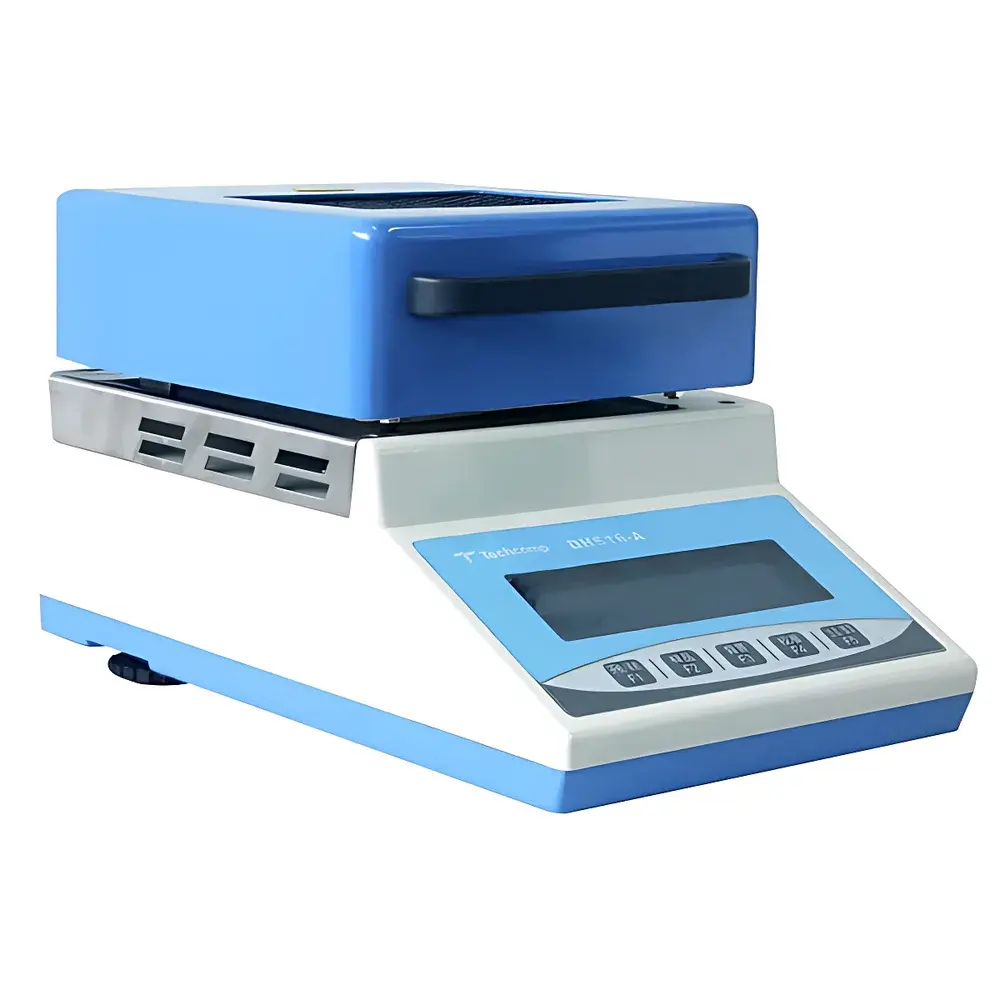
Techcomp DHS Series Infrared Moisture Analyzer
| Brand | Techcomp |
|---|---|
| Origin | Shanghai, China |
| Manufacturer Type | Manufacturer |
| Product Line | DHS Series |
| Heating Method | Infrared |
| Max Capacity | 61 g / 100 g / 120 g |
| Readability | 0.1 mg / 0.001% (HR models), 1 mg / 0.01% |
| Display | Backlit LCD with 5-key interface |
| Temperature Range | 50–160 °C (DHS-16A), 50–200 °C (DHS-20A) |
| Temperature Increment | 1 °C (from 50 °C) |
| Heating Time Setting | 0–99 min (1-min steps) |
| Termination Modes | Auto (weight stability), Timed, Manual |
| Built-in Methods | 50 user-programmable protocols |
| Output Parameters | Initial mass (g), Residual mass (g), Moisture content (% w/w), Dry matter (%), Moisture loss (%), Regain (%), Wet basis moisture (%), Heating mode, Set temperature, Duration |
| Calibration | External weight calibration (100 g standard |
| Interface | RS232 |
| Compliance Support | IQ/OQ/PQ documentation templates available |
| Power Supply | 220 VAC (±15% / −10%), 50 Hz |
| Power Consumption | 400 W |
| Operating Environment | 5–40 °C, 25–85% RH (non-condensing) |
| Optimal | 15–30 °C, 50–75% RH (non-condensing) |
| Dimensions (W×D×H) | 510 × 353 × 333 mm |
| Weight | 8.9 kg |
Overview
The Techcomp DHS Series Infrared Moisture Analyzer is a precision laboratory instrument engineered for rapid, gravimetric determination of moisture content in solid and semi-solid samples using infrared (IR) heating technology. Unlike traditional oven-drying methods requiring hours, the DHS Series employs focused IR radiation to induce controlled, uniform thermal dehydration—enabling moisture analysis in minutes while maintaining traceable mass-loss measurement integrity. The system operates on the fundamental principle of thermogravimetry: sample mass is continuously monitored during heating via a high-stability electromagnetic force compensation (EMFC) sensor, and moisture content is calculated from the proportional mass loss relative to initial weight. Designed for routine QC, R&D, and incoming inspection workflows, the DHS Series meets methodological expectations aligned with ASTM D4457 (for polymer resins), ISO 13779 (for ceramics), and USP & Ph. Eur. general chapters on loss on drying (LOD). Its robust aluminum housing, ESD-safe construction, and sealed heating chamber support stable operation in regulated manufacturing environments—including those governed by GLP and GMP frameworks.
Key Features
- High-resolution EMFC sensor (0.1 mg readability on HR variants) ensures consistent repeatability across full weighing range (up to 120 g), independent of load position or ambient draft.
- Dedicated infrared heating module delivers rapid thermal response (<30 s to reach setpoint) and homogeneous energy distribution—minimizing surface charring and improving accuracy for heat-sensitive matrices such as dairy powders or botanical extracts.
- Intuitive backlit LCD interface with five tactile keys enables direct parameter entry without menu nesting; real-time display includes current temperature, elapsed time, instantaneous mass, and derivative moisture trend.
- Four programmable termination logic options—Auto (based on Δm/Δt threshold), Timed, Manual, and Endpoint Confirmation—support method flexibility across diverse regulatory requirements.
- 50 built-in method slots allow storage of SOP-compliant protocols with unique identifiers, including temperature ramp profiles, dwell times, and pass/fail criteria for automated pass/fail reporting.
- RS232 serial interface enables bidirectional data exchange with LIMS or ERP systems; supports ASCII output formatting compatible with CSV import and audit trail logging per FDA 21 CFR Part 11 guidelines (when paired with compliant software).
- Tool-free chamber access, anti-splash heater guard, and ergonomic sample tongs facilitate rapid cleaning and safe handling—critical for high-throughput labs processing allergenic or hygroscopic materials.
Sample Compatibility & Compliance
The DHS Series accommodates a broad spectrum of sample types—including granular foodstuffs (e.g., flour, sugar, coffee beans), powdered pharmaceuticals (APIs, excipients), mineral aggregates (cement, gypsum), polymer pellets, and cosmetic emulsions—provided they exhibit sufficient thermal stability below 200 °C. It excludes volatile organic solvents or low-boiling-point compounds where evaporation may exceed water loss. Instrument qualification packages (IQ/OQ/PQ) are provided to support validation under ISO/IEC 17025, EU GMP Annex 15, and USP . All units undergo factory verification against NIST-traceable weights and calibrated thermal sensors; certificate of conformance includes linearity, repeatability, eccentricity, and temperature uniformity test reports.
Software & Data Management
While the DHS Series operates autonomously via front-panel controls, optional PC-based software (Techcomp MoistureLink™) extends functionality with electronic signature capture, customizable report templates (PDF/Excel), statistical process control (SPC) charting, and secure user-level access (admin/operator/auditor roles). Audit trails record all method modifications, calibration events, and result exports—including timestamps, operator IDs, and device serial numbers—to satisfy ALCOA+ data integrity principles. Raw mass-vs.-time datasets can be exported for secondary modeling (e.g., kinetic drying curve fitting) or integration into enterprise analytics platforms.
Applications
- Food & Beverage: Moisture specification verification in baked goods, dairy powders, tea leaves, spices, and pet food—ensuring shelf-life stability and microbial safety per Codex Alimentarius standards.
- Pharmaceuticals: LOD testing of tablet granules, lyophilized products, and herbal extracts in accordance with USP and ICH Q5C guidelines.
- Agriculture & Feed: Grain moisture monitoring at intake points and silos to prevent mycotoxin development; compliance with ISO 6540 and AOAC 952.07.
- Building Materials: Rapid assessment of plaster, mortar, and adhesive moisture prior to application—reducing efflorescence and adhesion failure risks.
- Chemicals & Polymers: Resin drying validation pre-compounding; catalyst hydration state screening in R&D laboratories.
FAQ
What is the difference between DHS and LHS models?
The DHS series uses infrared heating elements optimized for speed and uniform surface heating, whereas the LHS series employs halogen lamps offering finer temperature control and broader ramping capability—including multi-stage programs not available on DHS units.
Can the DHS analyzer be used for volatile organic content (VOC) determination?
No. The DHS measures total volatile loss interpreted as moisture under defined conditions. For VOC-specific quantification, dedicated headspace-GC or Karl Fischer titration is required.
Is external calibration mandatory before first use?
Yes. Factory calibration is verified using certified weights; however, end-user external calibration with traceable standards (e.g., 100 g Class M1) is required prior to analytical use and after any relocation or mechanical shock.
Does the instrument support GLP-compliant data archiving?
When operated with MoistureLink™ software and configured with role-based permissions and digital signatures, full audit trail generation—including metadata and change history—meets GLP and 21 CFR Part 11 requirements.
How often should preventive maintenance be performed?
Biannual inspection of heater alignment, sensor drift verification, and chamber seal integrity is recommended. Full service calibration is advised annually or after 1,000 operating hours, whichever occurs first.
Related Products





