
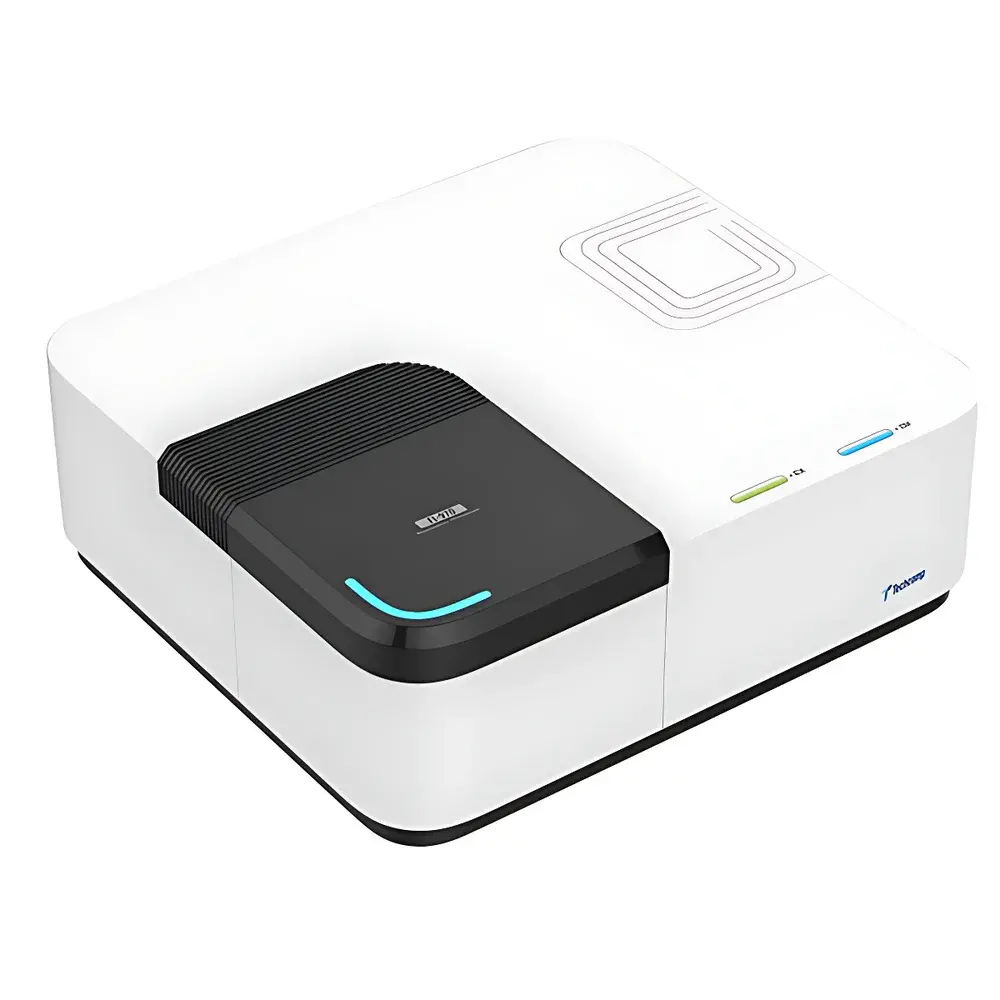
Techcomp FL970 Advanced Steady-State Molecular Fluorescence Spectrometer
| Brand | Techcomp |
|---|---|
| Origin | Shanghai, China |
| Manufacturer Type | Original Equipment Manufacturer (OEM) |
| Instrument Type | Steady-State Fluorescence Spectrometer |
| Wavelength Dispersion Element | Holographic Grating |
| Slit Width (Spectral Bandpass) | 1.0–20.0 nm |
| Optical Resolution | 0.2 nm |
| Sensitivity | 1200:1 (RMS), 15,000:1 (RMS with Background Subtraction) |
| Wavelength Accuracy | ±2 nm |
| Excitation Source | Pulsed Xenon Arc Lamp |
| PMT Detection Range | Up to 900 nm |
| Maximum Scan Speed | 30,000 nm/min |
| Software | FL Analyst (English & Chinese GUI) |
Overview
The Techcomp FL970 is a high-performance steady-state molecular fluorescence spectrometer engineered for quantitative and qualitative analysis of fluorescent, chemiluminescent, bioluminescent, and electroluminescent emissions across research, quality control, and regulatory environments. Based on dual-monochromator optical architecture with holographic gratings and a pulsed xenon arc lamp excitation source, the FL970 delivers exceptional spectral purity, low stray light (< 1 × 10⁻⁵), and precise wavelength registration—critical for trace-level detection and multi-component spectral deconvolution. Its design adheres to core principles of photometric linearity, photomultiplier tube (PMT) quantum efficiency optimization, and thermal drift compensation, enabling reproducible measurements under ambient laboratory conditions without active cooling requirements. The instrument operates in both fixed-wavelength and scanning modes, supporting synchronous, excitation-emission matrix (EEM), and time-resolved fluorescence acquisition protocols—though time resolution is limited by its steady-state configuration.
Key Features
- Dual-grating monochromators with motorized slit control (1.0–20.0 nm adjustable) ensure high spectral selectivity and flexibility for optimizing signal-to-noise ratio per application.
- High-dynamic-range PMT detector with extended red response (up to 900 nm) enables sensitive detection of near-infrared fluorophores such as Cy7, IRDye800CW, and quantum dots.
- Wavelength accuracy of ±2 nm and resolution of 0.2 nm meet ISO 17025 traceability requirements when calibrated with NIST-traceable holmium oxide or didymium filters.
- Scan speed up to 30,000 nm/min allows rapid EEM mapping (e.g., full 200–600 nm excitation × 250–800 nm emission grids in < 90 seconds), facilitating high-throughput screening in pharmaceutical stability studies.
- Large sample compartment (≥ 200 × 150 × 120 mm) accommodates standard 10-mm cuvettes, microvolume cells, solid-sample holders, fiber-optic probes, and temperature-controlled accessories (Peltier or circulating bath).
- Integrated auto-alignment and performance verification routines validate lamp intensity, monochromator tracking, and PMT gain stability prior to each analytical session—supporting GLP-compliant audit trails.
Sample Compatibility & Compliance
The FL970 supports liquid, solid, powder, and thin-film samples via interchangeable optical configurations including front-face, right-angle, and integrating sphere geometries. It complies with ASTM E1318 (Standard Practice for Fluorescence Spectroscopy), ISO 12099 (Animal feeding stuffs — Guidance on fluorescence measurement), and USP residual solvent method development requirements. Data integrity features include electronic signatures, user access levels, and configurable audit logs aligned with FDA 21 CFR Part 11 expectations for regulated laboratories. All firmware and software updates are version-controlled and documented per ICH Q5A and Q5B guidelines.
Software & Data Management
FL Analyst software provides a dual-language interface (English/Chinese) with modular workflows for instrument control, spectral processing, multivariate analysis (PCA, PARAFAC), and report generation. Raw data is stored in vendor-neutral HDF5 format with embedded metadata (wavelength calibration, slit settings, integration time, PMT voltage). Batch processing supports automated peak identification, quenching correction (Stern–Volmer), FRET efficiency calculation, and lifetime approximation via second-derivative analysis. Export options include CSV, JCAMP-DX, and PDF reports compliant with internal SOP templates. Remote monitoring and scheduled calibration reminders are configurable via network-enabled operation.
Applications
- Pharmaceutical QC: Quantification of intrinsic/extrinsic fluorophores in APIs, excipient interaction studies, and photostability assessment per ICH Q1B.
- Life Sciences: Protein folding/unfolding kinetics, ligand-binding affinity (Kd) determination, nucleic acid hybridization assays, and cellular metabolite profiling (e.g., NADH/FAD redox ratios).
- Environmental Analysis: PAHs, humic substances, and dissolved organic carbon (DOC) characterization in water matrices using EEM-PARAFAC modeling.
- Materials Science: Characterization of OLED emitters, perovskite nanocrystals, and carbon dot quantum yield determination via integrating sphere coupling.
- Academic Research: Teaching spectroscopic fundamentals, method validation exercises, and undergraduate thesis projects requiring ISO/IEC 17025-aligned instrumentation.
FAQ
Is the FL970 suitable for GMP-regulated environments?
Yes—the system supports 21 CFR Part 11 compliance through role-based access control, electronic signatures, and immutable audit logs when deployed with validated FL Analyst software configurations.
Can it measure quantum yield?
Quantum yield determination requires an integrating sphere accessory and reference standards (e.g., quinine sulfate); the base FL970 platform supports this capability with optional hardware integration.
Does it support kinetic fluorescence measurements?
It performs time-point series (multi-scan kinetics) at user-defined intervals but does not offer true time-resolved detection (nanosecond resolution) due to its steady-state architecture.
What maintenance is required for the xenon lamp?
Lamp lifetime is rated at ≥ 1,000 hours; output stability is monitored automatically, and replacement is recommended after 800 hours or upon >15% intensity drift.
Is third-party software integration possible?
Yes—DLL and COM interfaces allow bidirectional communication with MATLAB, Python (via PyVISA), and LabVIEW for custom automation and data pipeline integration.






