
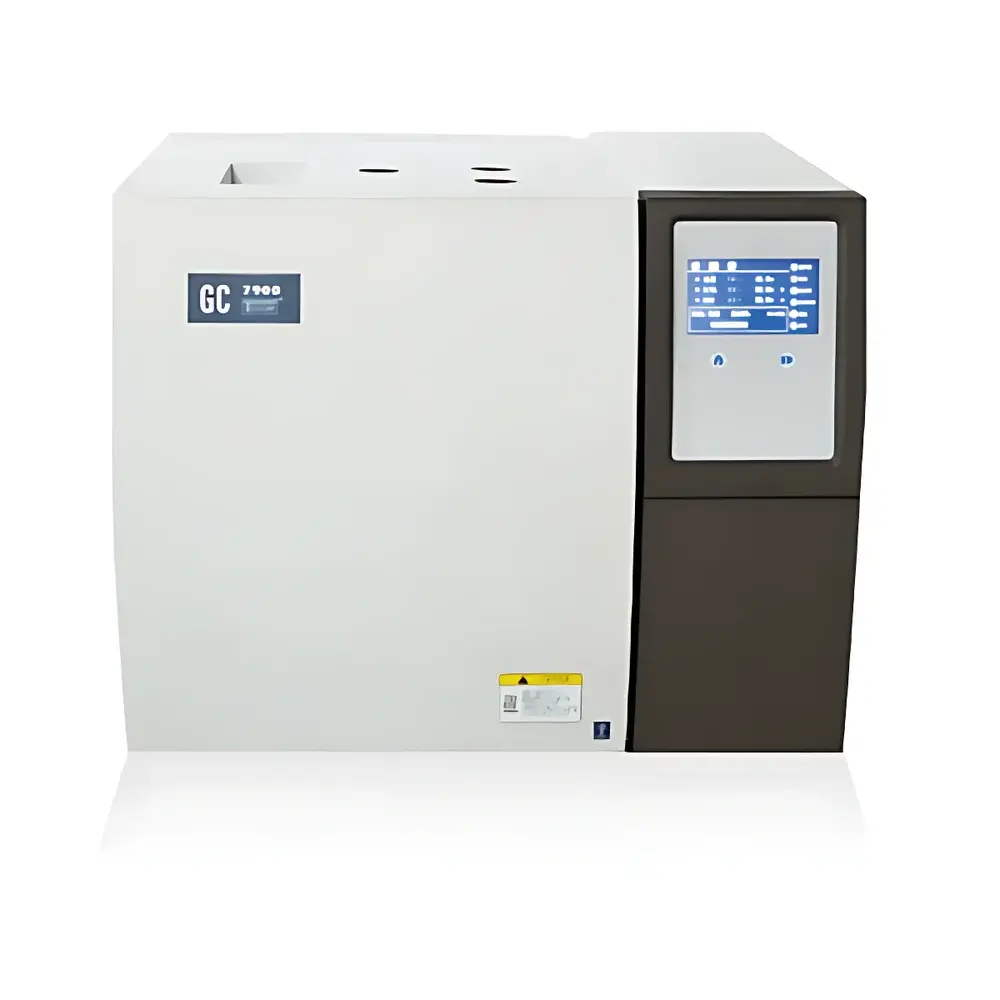
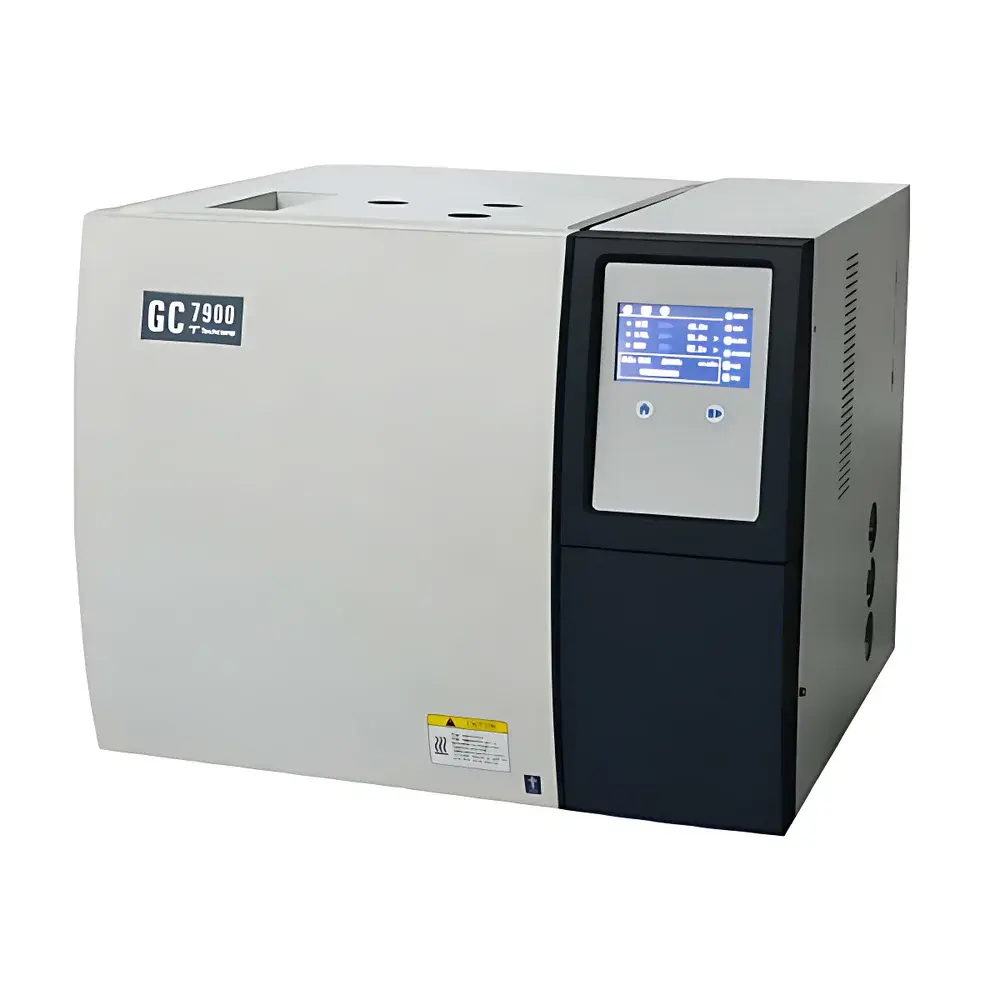
Techcomp GC7900 Laboratory Gas Chromatograph
| Brand | Techcomp |
|---|---|
| Origin | Shanghai, China |
| Manufacturer Type | Original Equipment Manufacturer (OEM) |
| Instrument Type | Benchtop Laboratory Gas Chromatograph |
| Application Scope | General-Purpose Analytical Chemistry |
| Oven Temperature Range | 5 °C above ambient to 400 °C |
| Oven Ramp Rate | 0.1–39 °C/min |
| Oven Cooling Rate | 50 °C/min |
| Injector Maximum Operating Temperature | 400 °C |
| Programmable Temperature Ramping | 9-Step |
| Injector Configurations | Up to 3 simultaneous inlets (Split/Splitless with septum purge, Packed Column, and Optional Capillary Inlet) |
| Detector Capacity | Up to 3 detectors installed concurrently |
| Detector Options | FID, TCD, ECD, FPD, NPD, PID, Micro-TCD |
| Signal Outputs | 3 analog channels + 1 digital interface (RS-232/USB) |
| User Interface | Touch-sensitive keypad with large LCD display supporting dual real-time chromatogram overlay |
Overview
The Techcomp GC7900 is a benchtop laboratory gas chromatograph engineered for precision, reproducibility, and operational flexibility in routine and method-development environments. Built upon proven gas chromatographic principles—separation based on differential partitioning of analytes between a mobile phase (carrier gas, e.g., He, H₂, or N₂) and a stationary phase coated inside a fused-silica capillary column—the GC7900 delivers robust performance across volatile and semi-volatile organic compound analysis. Its modular architecture supports multi-inlet and multi-detector configurations, enabling concurrent method validation, parallel sample screening, or multi-analyte quantification without hardware reconfiguration. Designed and manufactured in Shanghai under ISO 9001-aligned production controls, the instrument meets international quality benchmarks for analytical instrumentation used in academic research, pharmaceutical QC, environmental testing, and petrochemical laboratories.
Key Features
- Thermostatically controlled oven with 9-step programmable temperature ramping, spanning 5 °C above ambient to 400 °C, and rapid cooling at up to 50 °C/min—enabling high-throughput method cycling and retention time stability.
- Dual-zone injector capability: three independent inlet positions support simultaneous operation of split/splitless injectors (with active septum purge to suppress ghost peaks), packed-column inlets, and optional large-bore capillary interfaces—ensuring compatibility with legacy and modern column formats.
- Back-pressure regulation via electronic pneumatic control (EPC) ensures consistent column head pressure across variable flow rates and temperature gradients—critical for retention time reproducibility in capillary GC applications.
- Modular detector bay accommodates up to three detectors concurrently from a validated set: Flame Ionization Detector (FID), Thermal Conductivity Detector (TCD), Electron Capture Detector (ECD), Flame Photometric Detector (FPD), Nitrogen-Phosphorus Detector (NPD), Photoionization Detector (PID), and miniature TCD—each with factory-calibrated baseline noise, linear dynamic range, and response factor traceability.
- Integrated user interface features a high-contrast LCD with touch-sensitive keypad, capable of displaying two synchronized real-time chromatograms, system status diagnostics (gas pressures, temperatures, detector baselines), and parameter entry without external PC dependency.
- Standard analog output (3 channels) and digital interface (RS-232/USB) ensure seamless integration with third-party data systems compliant with ASTM E1962, ISO/IEC 17025, and FDA 21 CFR Part 11 requirements when paired with validated chromatography data systems (CDS).
Sample Compatibility & Compliance
The GC7900 is validated for use with standard 0.1–0.53 mm ID fused-silica capillary columns and stainless-steel or glass-packed columns (up to ¼-inch OD). It supports common carrier gases (helium, hydrogen, nitrogen) with certified purity ≥99.999% and regulated flow control down to 0.1 mL/min. All thermal zones—including oven, injectors, and detectors—are independently calibrated per IEC 61000-4 electromagnetic compatibility standards and meet CE marking requirements for laboratory equipment. The system design conforms to GLP/GMP documentation practices: audit trails for method parameters, run logs with timestamped operator IDs, and detector signal archiving are fully supported when interfaced with compliant CDS software.
Software & Data Management
While the GC7900 operates autonomously via front-panel controls, its digital interface enables bidirectional communication with industry-standard chromatography data systems—including OpenLab CDS, Chromeleon, and Empower—supporting method transfer, electronic signatures, and automated report generation. Raw signal acquisition preserves full resolution (≥10 Hz sampling rate), allowing post-run integration optimization and peak deconvolution. All configuration changes—including temperature programs, detector gains, and valve timing—are stored with version timestamps and user attribution, satisfying ALCOA+ data integrity criteria (Attributable, Legible, Contemporaneous, Original, Accurate, Complete, Consistent, Enduring, Available).
Applications
The GC7900 serves as a primary analytical platform in diverse regulatory and research settings: residual solvent analysis per USP , pesticide residue screening in food matrices (AOAC 2007.01), hydrocarbon profiling in fuels (ASTM D3606, D5186), volatile organic compound (VOC) monitoring in indoor air (EPA TO-17), and impurity profiling in active pharmaceutical ingredients (ICH Q2(R2)). Its multi-detector capacity facilitates orthogonal detection—for example, simultaneous FID quantification and ECD-selective detection of organochlorine compounds—reducing total analysis time while enhancing confidence in identification.
FAQ
Does the GC7900 support method validation according to ICH guidelines?
Yes—when operated with a validated CDS and documented SOPs, the GC7900 meets ICH Q2(R2) requirements for specificity, linearity, accuracy, precision, and robustness testing.
Can the instrument be upgraded to include electronic pressure control (EPC) on all gas lines?
The standard configuration includes EPC for carrier gas and detector make-up gases; optional EPC modules are available for auxiliary gas lines (e.g., hydrogen for FID, air for FID/FPD).
Is firmware update capability available remotely?
Firmware updates are performed locally via USB drive using signed binary packages issued by Techcomp Technical Support; remote execution is disabled by default to maintain system integrity and compliance.
What is the warranty coverage and service response time for international customers?
Techcomp provides a 24-month parts-and-labor warranty; global service network partners offer on-site response within 3 business days for priority contracts, subject to regional service agreements.
Are calibration certificates traceable to NIST or other national metrology institutes?
Factory-installed temperature and flow sensors are calibrated against NIST-traceable references; individual instrument certificates—including uncertainty budgets—are supplied with each unit.





