
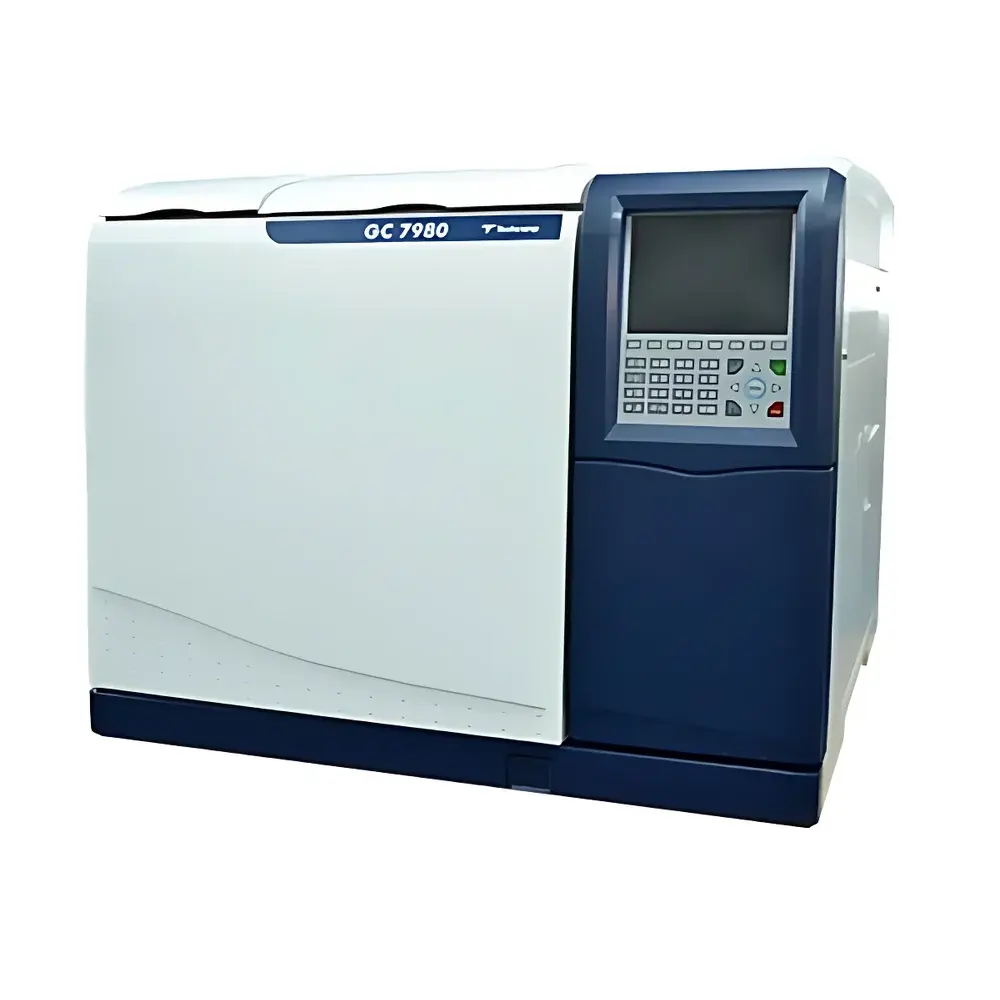
Techcomp GC7980Plus Laboratory Gas Chromatograph
| Origin | Shanghai, China |
|---|---|
| Manufacturer Type | Authorized Distributor |
| Origin Category | Domestic (China) |
| Model | GC7980Plus |
| Instrument Type | Benchtop Laboratory Gas Chromatograph |
| Application Scope | General-Purpose |
| Oven Temperature Range | Ambient to 450 °C |
| Oven Ramp Rate | 0.1–80 °C/min |
| Oven Cool-Down Rate | 0.1–80 °C/min |
| Carrier Gas Flow Range & Control | 0–1500 mL/min |
| Carrier Gas Pressure Range & Control | 0–150 psi |
| Injector Maximum Operating Temperature | 420 °C |
| Injector Pressure Setting Range | 0–150 psi |
| Injector Total Flow Setting Range | 0–1500 mL/min |
| Electronic Pressure Control (EPC) Precision | ±0.001 psi |
| Detector | High-Sensitivity Flame Ionization Detector (FID) with Ceramic Jet |
| Injector Configuration | Modular Split/Splitless Injector |
| Software | CompassCDS Chromatography Data System (CDS), FDA 21 CFR Part 11 Compliant |
Overview
The Techcomp GC7980Plus is a high-performance benchtop gas chromatograph engineered for precision, reproducibility, and regulatory compliance in routine and research-grade analytical laboratories. Built upon the proven GC7980 platform and enhanced with select core technologies licensed from Thermo Fisher Scientific’s former Serian division, the GC7980Plus integrates advanced electronic pressure control (EPC), thermally robust oven architecture, and a low-noise, high-stability FID detector. Its operation is grounded in classical gas chromatographic separation principles—where volatile and semi-volatile analytes are partitioned between a mobile phase (inert carrier gas) and a stationary phase (capillary column) under precisely controlled temperature gradients. The system delivers trace-level quantification with high resolution and retention time stability, making it suitable for applications requiring method robustness across multi-day sequences and inter-laboratory transfer.
Key Features
- Ultra-precise Electronic Pressure Control (EPC): Dual-channel EPC modules deliver pressure regulation accuracy of ±0.001 psi across all pneumatic zones—oven, injector, and detector—ensuring exceptional retention time reproducibility (<0.005 min RSD) and method transfer fidelity.
- Modular Injector Architecture: A field-upgradable split/splitless inlet supports both high-efficiency sample introduction and low-level analysis, with selectable liner types, active flow splitting, and backflush capability for extended column life and reduced maintenance downtime.
- Ceramic-Jet FID Detector: Engineered for long-term baseline stability and low detection limits (≤1.5 pg C/s for n-decane), the ceramic nozzle minimizes carbon buildup and improves peak symmetry—particularly critical for complex matrices such as environmental extracts or biological fluids.
- Thermally Optimized Oven System: Featuring dual-zone heating elements, insulated chamber walls, and active air circulation, the oven achieves linear ramp rates from 0.1 to 80 °C/min and rapid cool-down (≤3.5 min from 450 °C to 50 °C), enabling high-throughput method development and routine analysis.
- Open Hardware Platform: Standard RS-232, USB, and Ethernet interfaces support integration with third-party autosamplers, auxiliary detectors (e.g., ECD, TCD), and LIMS environments. All firmware and hardware I/O protocols are documented for custom automation scripting.
Sample Compatibility & Compliance
The GC7980Plus accommodates a broad range of sample types—including aqueous extracts, organic solvent solutions, headspace vials, and thermal desorption tubes—when paired with appropriate inlet liners, septa, and column chemistries (e.g., 5% phenyl methyl siloxane, PEG-20M, or porous layer open tubular phases). It complies with internationally recognized standards for analytical instrumentation, including ISO/IEC 17025:2017 (general requirements for competence of testing and calibration laboratories), ASTM D3612 (analysis of dissolved gases in electrical insulating oil), and USP (chromatography). Its CompassCDS software includes full audit trail functionality, electronic signatures, and role-based access control—validated to meet FDA 21 CFR Part 11 and EU Annex 11 requirements for data integrity in regulated environments (GMP/GLP).
Software & Data Management
CompassCDS is a validated, Windows-based chromatography data system designed specifically for GC operation and reporting. It provides real-time instrument control, sequence management, peak integration with customizable baselines and retention time windows, and automated report generation in PDF, CSV, and XML formats. All raw data files (.cdf) are stored with embedded metadata (method parameters, calibration history, user ID, timestamp), and the system enforces secure user authentication, session logging, and immutable audit trails. Data backups can be scheduled to network drives or cloud storage endpoints via configurable scripts—supporting enterprise-scale data governance policies without reliance on proprietary file formats.
Applications
- Food Safety: Quantitative determination of organophosphate and carbamate pesticide residues in fruits, vegetables, and grains per AOAC 2007.01 and EU SANTE/11312/2021 guidelines.
- Pharmaceutical Quality Control: Residual solvent profiling (ICH Q3C Class 1–3) in APIs and finished dosage forms using static headspace-GC/FID.
- Clinical Toxicology: Forensic blood ethanol quantification via headspace-GC with internal standard calibration (n-propanol), compliant with CLIA and CAP requirements.
- Environmental Monitoring: Analysis of total volatile organic compounds (TVOCs) in indoor air per EPA TO-17 and ISO 16000-6.
- Petrochemical Testing: Speciation and quantification of oxygenated compounds (e.g., MTBE, ETBE, alcohols) in gasoline per ASTM D4815 and D5599.
- Electrical Equipment Diagnostics: Dissolved gas analysis (DGA) in transformer oil per IEEE C57.104 and IEC 60599, supporting predictive maintenance through fault gas ratio interpretation.
FAQ
Is the GC7980Plus compatible with third-party capillary columns and consumables?
Yes—the system accepts standard 0.1–0.53 mm ID fused silica columns with industry-standard ferrule dimensions (e.g., 0.4 mm ID graphite/Vespel). All inlet liners, septa, and O-rings conform to ASTM D6299 specifications.
Does the CompassCDS software support 21 CFR Part 11 compliance out-of-the-box?
Yes—audit trail, electronic signature, and user access control modules are pre-installed and validated. Full validation documentation (IQ/OQ/PQ protocols) is available upon request for regulated laboratories.
Can the GC7980Plus be operated remotely via LAN or VPN?
Yes—remote instrument control and data acquisition are supported over TCP/IP using CompassCDS client-server mode, with TLS 1.2 encryption and firewall-friendly port configuration.
What is the typical maintenance interval for the FID detector?
Under normal operating conditions (clean samples, proper gas filtration), the ceramic jet requires cleaning every 200–300 injections; full detector bake-out is recommended every 6 months or after exposure to highly non-volatile matrix components.
Is method transfer possible from Agilent or Shimadzu GC platforms?
Yes—CompassCDS supports import of .msd and .cdf files from major vendors, and retention time alignment tools enable seamless method porting with minimal re-optimization.






