
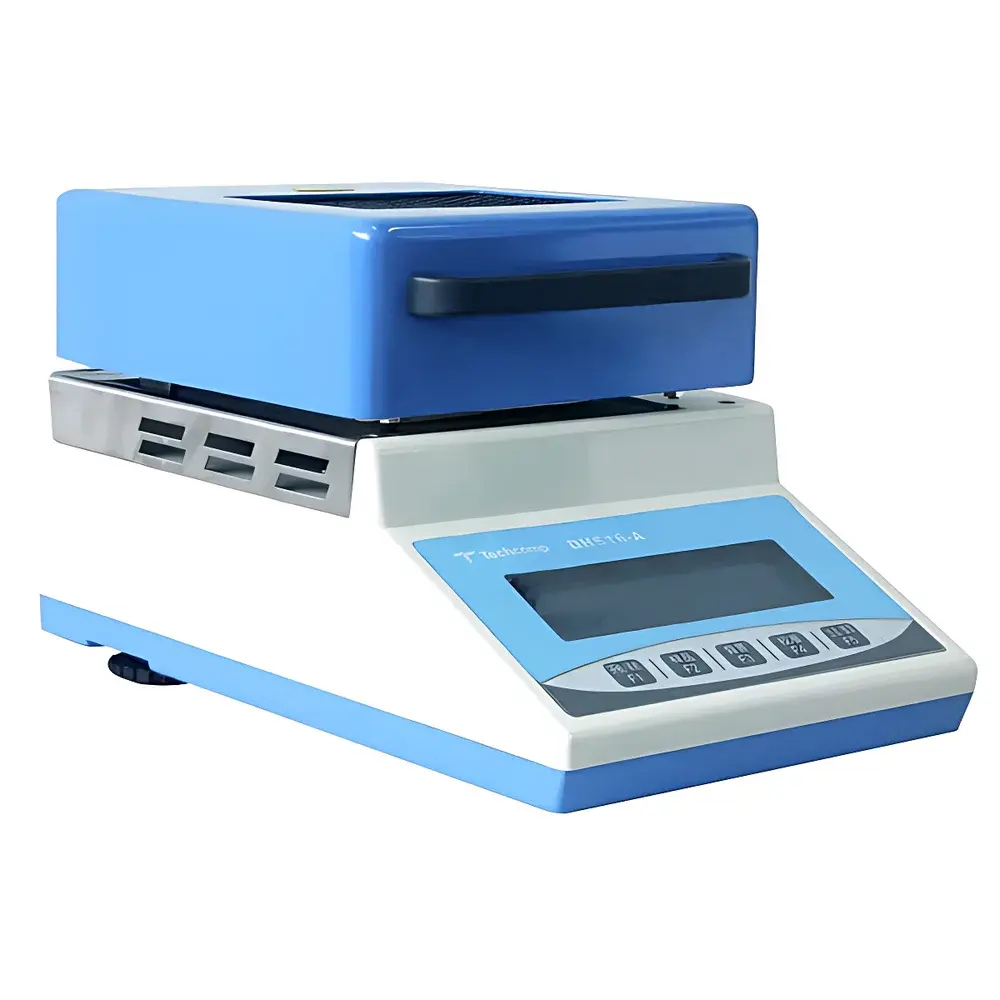
Techcomp LHS Series Halogen Moisture Analyzer
| Brand | Techcomp |
|---|---|
| Origin | Shanghai, China |
| Manufacturer Type | Manufacturer |
| Product Line | LHS Series |
| Heating Method | Halogen Lamp |
| Maximum Capacity | 61 g / 100 g / 120 g |
| Readability | 0.1 mg / 0.001% (HR models), 1 mg / 0.01% |
| Display | Backlit LCD with 5-key interface |
| Temperature Range | 50–160 °C (LHS-16 models), 50–200 °C (LHS-20 models) |
| Temperature Increment | 1 °C (from 50 °C) |
| Heating Time Setting | 0–99 min (1-min increments) |
| Termination Modes | Automatic (weight change-based), Timed, Manual |
| Built-in Methods | 50 pre-programmed |
| Result Outputs | Initial mass (g), Residual mass (g), Moisture content (%), Dry matter (%), Moisture loss (%), Rehydration ratio, Wet basis moisture (%) |
| Calibration | External weight calibration (100 g standard |
| Interface | RS232 |
| Compliance Support | IQ/OQ/PQ documentation support |
| Power Supply | 220 VAC (−15% to +10%), 50 Hz |
| Power Consumption | 420 W |
| Operating Environment | 5–40 °C, 25–85% RH (non-condensing) |
| Optimal | 15–30 °C, 50–75% RH (non-condensing) |
| Dimensions (W×D×H) | 510 × 353 × 333 mm |
| Net Weight | 8.9 kg |
Overview
The Techcomp LHS Series Halogen Moisture Analyzer is a precision laboratory instrument engineered for rapid, gravimetric determination of moisture content in solid and semi-solid samples using halogen lamp heating and high-resolution electromagnetic force compensation weighing technology. Based on the principle of thermogravimetry—where sample mass loss upon controlled thermal drying is directly correlated to moisture content—the LHS Series delivers reproducible, traceable results compliant with standardized test methodologies including ASTM D4442, ISO 712, AOAC 950.46, and USP <921>. Designed for routine quality control and R&D environments, it replaces traditional oven-drying methods by reducing analysis time from hours to minutes while maintaining metrological integrity through dual-sensor architecture and temperature-stabilized halogen heating.
Key Features
- High-precision electromagnetic force restoration (EMFR) sensor—developed by Techcomp’s MFR division—ensures consistent readability of 0.1 mg (HR models) across full capacity range (61 g, 100 g, or 120 g), independent of sample loading position or mass distribution.
- Optimized halogen heating module delivering uniform radiant energy distribution with <1.5 °C spatial temperature deviation across the sample pan surface—minimizing thermal gradients and charring risk.
- Four programmable heating profiles: Standard (linear ramp), Gentle (low-power pre-dry), Rapid (full-power onset), and Step (multi-stage temperature sequencing)—enabling method optimization for heat-sensitive or heterogeneous matrices.
- Real-time display of dynamic parameters: current temperature, elapsed time, instantaneous mass, first derivative of mass loss (dm/dt), and calculated moisture percentage—supporting in-process decision-making.
- Intelligent endpoint detection algorithms: automatic termination triggered by either absolute mass change threshold (e.g., ≤0.1 mg/30 s), relative rate threshold (e.g., ≤0.01 %/min), or user-defined timer—eliminating operator subjectivity.
- Robust aluminum alloy housing (anodized finish) provides ESD protection, corrosion resistance, and mechanical stability under continuous operation in QC labs or production floor environments.
- Ergonomic sample handling: integrated anti-scald handle, quick-release sample pan clamp, and front-accessible calibration port reduce procedural variability and operator fatigue.
Sample Compatibility & Compliance
The LHS Series accommodates diverse sample types—including powders, granules, pastes, films, and fibrous materials—within defined physical constraints (max. height: 35 mm; max. diameter: 90 mm). Its design conforms to GLP and GMP operational expectations: audit-trail-capable method storage (50 user-defined protocols), RS232 output for secure data export to LIMS or ELN systems, and full documentation support for Installation Qualification (IQ), Operational Qualification (OQ), and Performance Qualification (PQ) per FDA 21 CFR Part 11 requirements. All units undergo factory verification against NIST-traceable standards, with calibration certificates available upon request. Environmental operating specifications align with ISO/IEC 17025 clause 5.3 for measurement uncertainty management.
Software & Data Management
While the LHS Series operates as a standalone instrument with embedded firmware, its RS232 serial interface enables seamless integration with third-party data acquisition platforms. Raw measurement logs—including timestamped mass readings at 0.5-second intervals, temperature profiles, and method metadata—are exportable in CSV format for post-acquisition statistical analysis (e.g., ANOVA, trend charting, SPC control limits). The system supports configurable data field mapping to match enterprise LIMS schema, and optional PC software (Techcomp MoistureLink™) provides method templating, batch reporting, and electronic signature functionality compliant with 21 CFR Part 11 Annex 11 requirements.
Applications
Validated use cases span regulated and industrial sectors requiring fast, reliable moisture quantification: food & beverage (sugar crystallinity control, dairy powder specification, tea leaf moisture grading); pharmaceuticals (active ingredient drying validation, excipient moisture specification per ICH Q5C); agriculture (grain moisture indexing per USDA FGIS protocols); construction materials (gypsum hemihydrate assay, cement hydration monitoring); personal care (surfactant water content in paste formulations); and polymer processing (resin pellet moisture pre-drying verification prior to extrusion). Each application benefits from method-specific parameter tuning—e.g., gentle ramp for caramelized sugar, step heating for layered composite films—to preserve sample integrity while maximizing analytical accuracy.
FAQ
What calibration standards are required for routine verification?
External calibration using certified weights (100 g for LHS-16A/LHS-20A; 50 g for LHS-16-HR) is mandatory before first use and after any relocation or mechanical impact. Daily zero-point verification is recommended.
Can the LHS Series comply with ISO/IEC 17025 accreditation requirements?
Yes—when operated with documented procedures, traceable calibration records, environmental monitoring logs, and validated methods, the instrument satisfies Clause 6.4 (Equipment) and Clause 7.7 (Ensuring Validity of Results) of ISO/IEC 17025:2017.
Is halogen heating suitable for volatile organic compounds (VOCs)?
Halogen lamps emit broadband infrared radiation (peak ~1200 nm) with minimal UV emission; however, for VOC-rich samples, method development must include comparative testing against Karl Fischer titration to confirm absence of co-evaporation artifacts.
How is temperature uniformity verified during OQ?
A calibrated PT100 probe array (minimum 3 points: center + two diagonally opposite corners) is placed beneath the sample pan during a 160 °C hold test; maximum deviation must not exceed ±2.0 °C per ASTM E2251.




