
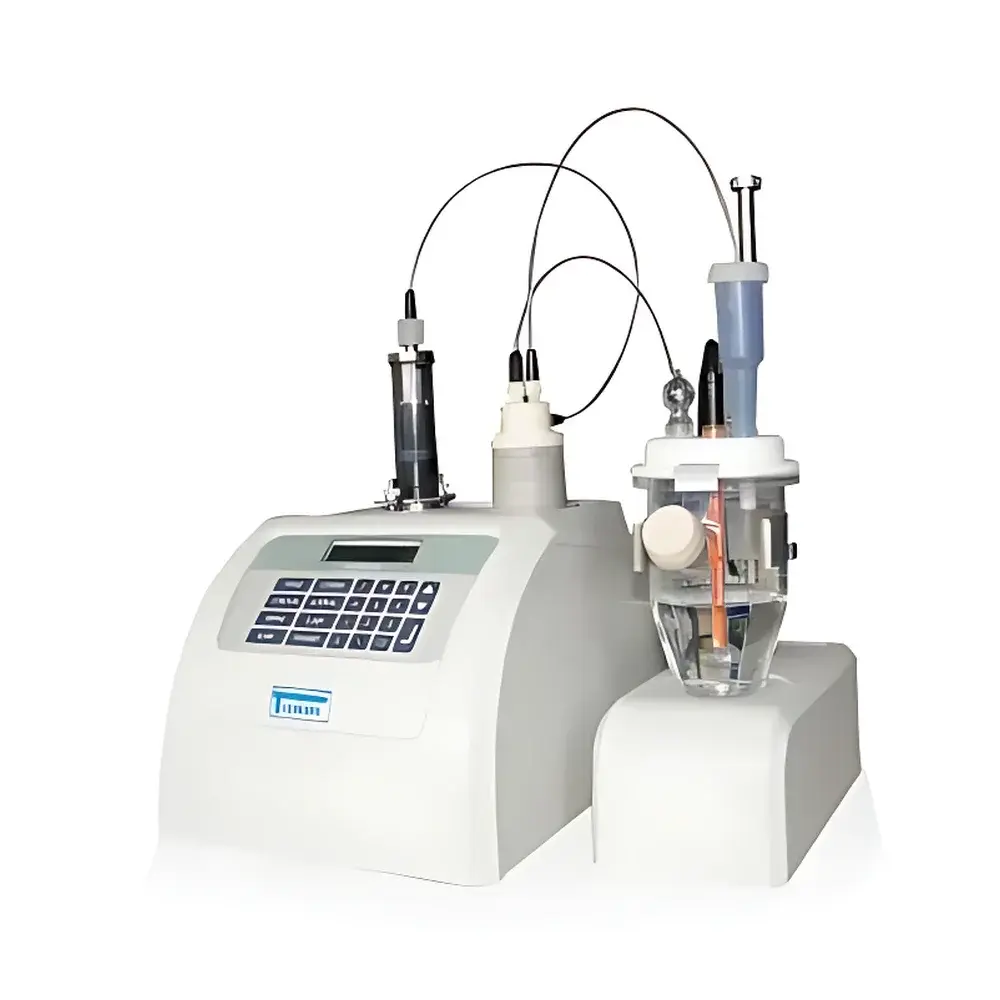
Techcomp MaxTitra20V Karl Fischer Moisture Analyzer
| Brand | Techcomp |
|---|---|
| Origin | Shanghai, China |
| Manufacturer | Yes |
| Country of Origin | China |
| Model | MaxTitra20V |
| Pricing | Upon Request |
| Titration Method | Volumetric Karl Fischer |
| Endpoint Detection | AC Polarization Potential Difference |
| Measurement Range | 0.1 mg – 500 mg H₂O (equivalent to 10 ppm – 100% w/w) |
| Minimum Dispensing Volume | 0.005 mL |
| Data Storage | 20 built-in methods & results |
| Display | 16-character × 2-line LCD with backlight |
| Interfaces | RS-232 for balance, printer, and PC |
| Power Supply | AC 100–240 V, 50/60 Hz, 100 W |
| Dimensions | 310 W × 270 D × 310 H mm |
| Weight | ~6 kg |
Overview
The Techcomp MaxTitra20V Karl Fischer Moisture Analyzer is a benchtop volumetric titrator engineered for precise and reproducible quantification of trace water content in diverse sample matrices—including liquids, solids, gases, and liquefied gases. It operates on the fundamental electrochemical principle of volumetric Karl Fischer (KF) titration, where iodine generated *in situ* via coulometric or generator-cell-assisted reaction stoichiometrically oxidizes water in anhydrous methanol-based solvent systems. The MaxTitra20V implements a controlled discontinuous titrant addition strategy near the endpoint, minimizing overshoot and enhancing measurement robustness across variable sample reactivity and matrix interference. Designed for routine QC laboratories and R&D environments, it delivers compliance-ready performance without requiring advanced operator expertise—making it suitable for regulated sectors including pharmaceuticals, food safety, polymer synthesis, and petrochemical quality control.
Key Features
- Volumetric KF titration platform with AC polarization potential difference endpoint detection—ensuring high sensitivity and low drift in complex matrices.
- Discontinuous titrant delivery algorithm optimized for stability at low water concentrations (<100 ppm), reducing reagent consumption and improving repeatability.
- Integrated 16×2 LCD interface with backlight—enabling clear visualization under varied ambient lighting conditions; all parameters configured via tactile membrane keypad.
- Four pre-stored method templates—customizable and recallable for rapid method switching across sample types (e.g., oils, powders, solvents).
- Compact footprint (310 × 270 × 310 mm) and lightweight design (~6 kg)—ideal for space-constrained analytical workstations.
- PBT resin housing—chemically resistant to common KF reagents (e.g., imidazole, SO₂, CH₃OH), minimizing degradation during extended operation and supporting GLP-compliant lab hygiene protocols.
- Standard RS-232 ports for seamless integration with analytical balances (auto-sample weight import), thermal printers (audit-trail hardcopy), and host PCs (data export and long-term archiving).
Sample Compatibility & Compliance
The MaxTitra20V accommodates heterogeneous samples through adaptable sample introduction protocols—direct injection for liquids, oven-coupled headspace analysis for thermolabile solids, and gas-tight syringe sampling for gaseous or volatile substances. Its measurement range (0.1–500 mg H₂O) aligns with ISO 8533:2017 (petroleum products), ASTM D6304–22 (liquid hydrocarbons), USP , and EP 2.5.12, enabling direct method transfer into GMP-regulated workflows. While the instrument itself does not embed 21 CFR Part 11 electronic signature functionality, its PC-connected data export supports validated third-party LIMS or ELN systems compliant with FDA audit requirements. All internal calculations adhere to stoichiometric equivalence (1 mol I₂ ≡ 1 mol H₂O), with endpoint confirmation verified via dual-electrode polarization current threshold crossing.
Software & Data Management
Data handling follows a tiered architecture: onboard memory retains up to 20 complete analysis records—including titrant volume, sample mass, calculated %H₂O, date/time stamp, and active method ID. For extended traceability, USB or RS-232 linkage to Windows-based PCs enables bulk export in CSV or TXT format—compatible with Excel, statistical process control (SPC) tools, and validated laboratory informatics platforms. No proprietary software is required; raw data fields map directly to standard analytical metadata schemas. Audit trails are maintained externally via timestamped printouts or PC-hosted logs—supporting ISO/IEC 17025 documentation integrity requirements.
Applications
- Pharmaceuticals: Quantification of residual moisture in APIs and excipients per USP ; validation of lyophilized product stability.
- Food & Beverage: Water activity assessment in edible oils (e.g., olive, palm), dairy powders, confectionery syrups, and tobacco blends—critical for shelf-life prediction and microbial risk mitigation.
- Polymers & Plastics: Monitoring moisture in hygroscopic resins (PA6, PET, PBT) prior to extrusion or injection molding to prevent hydrolytic degradation.
- Petrochemicals: Analysis of water in transformer oils (IEC 60814), jet fuels (ASTM D6304), and catalyst slurries—where sub-50 ppm levels impact corrosion and catalytic efficiency.
- Personal Care: Batch release testing of emulsions (creams, lotions), surfactant solutions, and anhydrous formulations (lipsticks, deodorants) per ISO 16128 guidelines.
FAQ
What types of Karl Fischer reagents are compatible with the MaxTitra20V?
The analyzer supports commercially available single-component and two-component volumetric KF reagents (e.g., Hydranal-Composite 5, Aquastar-R, Metrohm KF Reagent Type I). Solvent selection must ensure full sample solubility and absence of side reactions (e.g., aldehydes/ketones require aldehyde-compatible reagents).
Can the MaxTitra20V be used for solid samples like tablets or polymers?
Yes—via oven attachment (optional accessory) or manual dissolution in KF-compatible solvents (e.g., chloroform/methanol mixtures). Sample homogeneity and complete water extraction must be validated per ICH Q2(R2) methodology.
Is calibration verification required before each analysis?
While daily system suitability testing using certified water standards (e.g., 1.00 ± 0.02 mg H₂O standards) is recommended per ISO/IEC 17025, factory calibration of burette volume and electrode response remains stable over 6-month intervals under normal use.
Does the instrument support automatic titer determination?
No—the MaxTitra20V requires manual titer input prior to analysis. Titer verification must be performed separately using standardized water standards per ASTM D6304 Section 8.2.
Related Products






