
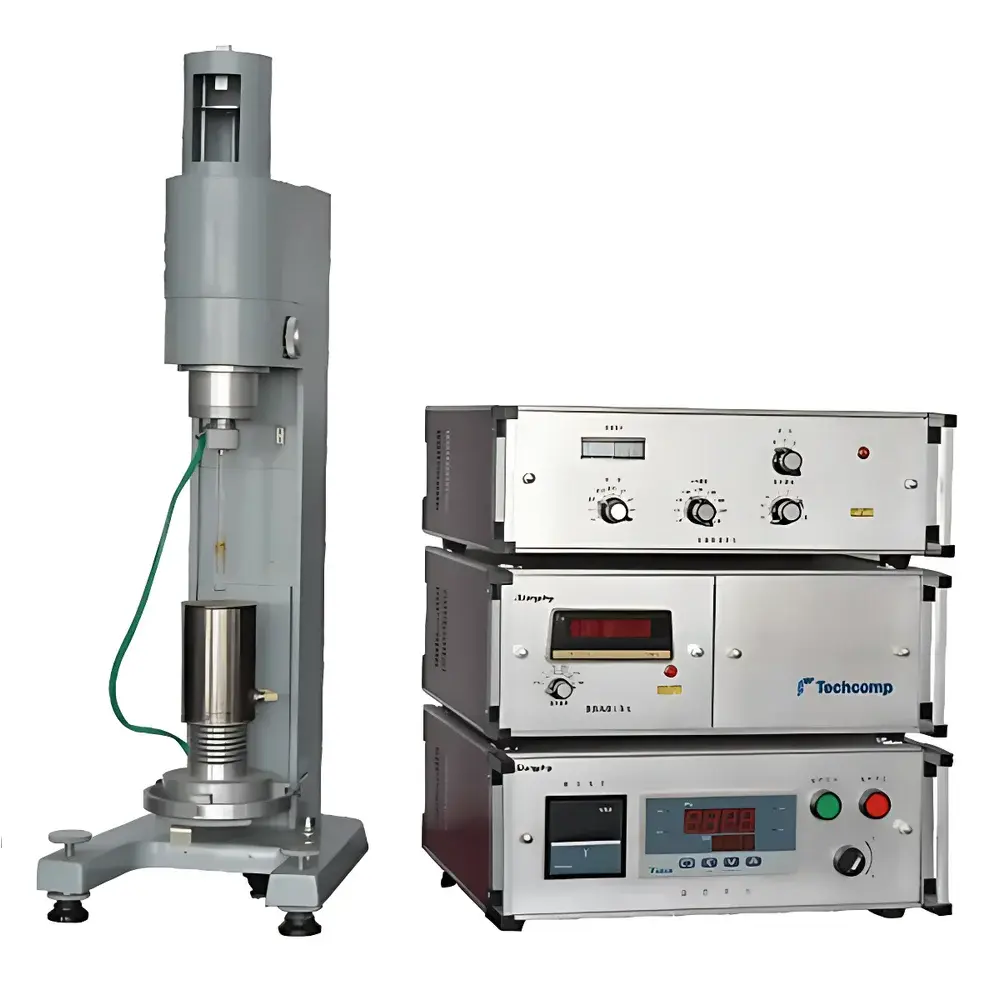
Techcomp RJY-1P Static Thermomechanical Analyzer
| Brand | Techcomp |
|---|---|
| Origin | Shanghai, China |
| Manufacturer Type | Direct Manufacturer |
| Regional Classification | Domestic (China) |
| Model | Techcomp RJY-1P |
| Instrument Type | Static Thermomechanical Analyzer (TMA) |
| Temperature Range | Ambient to 1000 °C |
| Temperature Accuracy | ±0.1 °C |
| Applied Load Range | Up to 250 g (static force) |
| Displacement Measurement Range | 0–2500 µm |
Overview
The Techcomp RJY-1P Static Thermomechanical Analyzer (TMA) is a precision-engineered instrument designed for quantitative measurement of dimensional changes in solid and semi-crystalline materials under controlled thermal conditions and static mechanical load. Operating on the fundamental principle of static thermomechanical analysis, the RJY-1P applies a constant, non-oscillatory compressive, tensile, or bending force to a sample while ramping temperature at programmable rates. The resulting dimensional response—linear expansion, contraction, softening, or creep—is recorded as a function of temperature or time. This method provides direct access to thermally induced structural transitions including coefficient of linear expansion (CTE), glass transition temperature (Tg), softening point, sintering onset, and curing shrinkage. Unlike dynamic mechanical analyzers (DMA), the RJY-1P employs purely static loading, eliminating viscoelastic oscillation artifacts and enabling high-resolution tracking of irreversible or slow-relaxation phenomena in polymers, ceramics, composites, and metallic alloys.
Key Features
- High-resolution displacement detection via quartz probe coupled to a differential transformer transducer (LVDT), delivering linearity and long-term stability over the full 0–2500 µm range;
- Vertically oriented furnace architecture with low thermal mass, enabling rapid heating and cooling rates up to 100 °C/min while maintaining excellent temperature uniformity;
- Water-cooled outer furnace jacket ensures linear thermal gradients and minimizes thermal lag, contributing to ±0.1 °C temperature accuracy across the full operating range (ambient to 1000 °C);
- Modular probe system supporting compression, tension, penetration, and three-point bending configurations for comprehensive sample geometry compatibility;
- Integrated calibration suite—including NIST-traceable reference standards and dedicated software modules—for user-performed displacement zeroing, temperature offset correction, and baseline drift compensation;
- Rugged mechanical design optimized for laboratory longevity, with vibration-damped base and electromagnetic shielding for stable signal acquisition in shared analytical environments.
Sample Compatibility & Compliance
The RJY-1P accommodates solid specimens up to 25 mm in height and 12 mm in diameter, including molded plastics, elastomeric sheets, ceramic green bodies, metal foils, fiber-reinforced laminates, and thin-film coatings on rigid substrates. Its static-load methodology complies with ASTM E831 (Standard Test Method for Linear Thermal Expansion of Solid Materials by Thermomechanical Analysis), ISO 11359-2 (Plastics — Thermomechanical Analysis — Part 2: Determination of Coefficient of Linear Expansion), and relevant sections of USP (Thermal Analysis). Data integrity protocols support GLP and GMP environments through audit-trail-enabled software logging, user-access controls, and electronic signature capability compliant with FDA 21 CFR Part 11 requirements when operated with validated configuration.
Software & Data Management
The RJY-1P is operated via a Windows-based multi-tasking control platform supporting concurrent data acquisition, real-time curve visualization, and post-run quantitative analysis. The software enables adjustable axis scaling, overlay of multiple runs, and export of raw displacement/temperature/time datasets in ASCII, CSV, and universal .tdf formats. Analytical functions include automatic calculation of CTE over user-defined temperature intervals, derivative (dTMA) curve generation, peak identification (onset, inflection, endset) using tangent and half-height methods, Tg and softening point annotation per ISO 11359-2 conventions, and instrument constant derivation from calibration standard responses. Baseline correction algorithms account for thermal drift and probe thermal expansion, ensuring metrological traceability without external intervention.
Applications
- Quantification of linear thermal expansion coefficients (CTE) in aerospace-grade carbon-fiber composites and thermal barrier coatings;
- Detection of glass transition and secondary relaxations in amorphous thermoplastics (e.g., PS, PC, PMMA) and thermoset resins during post-cure evaluation;
- Monitoring of densification kinetics and pore closure during ceramic sintering below 1000 °C;
- Characterization of dimensional stability in packaging films subjected to sterilization temperature cycles;
- Assessment of thermal shrinkage and warpage behavior in printed circuit board (PCB) laminates and underfill materials;
- Validation of thermal aging effects on elastomer seal performance in automotive and energy applications.
FAQ
What types of mechanical loads can the RJY-1P apply?
The RJY-1P applies static, unidirectional mechanical loads only—up to 250 g—in compression, tension, or bending modes. It does not support dynamic or oscillatory loading.
Is the temperature range verified across the entire 0–1000 °C span?
Yes—temperature accuracy of ±0.1 °C is validated at multiple points (e.g., Al, Zn, Sn, Ag melting references) per ASTM E537 and ISO 17025-compliant internal calibration procedures.
Can the system be integrated into a LIMS or enterprise QA workflow?
Raw data export (CSV, ASCII), metadata tagging, and 21 CFR Part 11-compliant audit logs enable seamless integration with laboratory information management systems and centralized quality documentation platforms.
Does the instrument require external cooling water or compressed air?
A continuous recirculating chiller (5–25 °C supply) is required for the furnace jacket; no compressed air or vacuum connections are needed.
How frequently must the displacement sensor be recalibrated?
Initial calibration is performed at installation using certified reference standards; routine verification is recommended before critical measurements or after mechanical shock, with full recalibration advised annually or per ISO/IEC 17025 internal quality schedule.



