
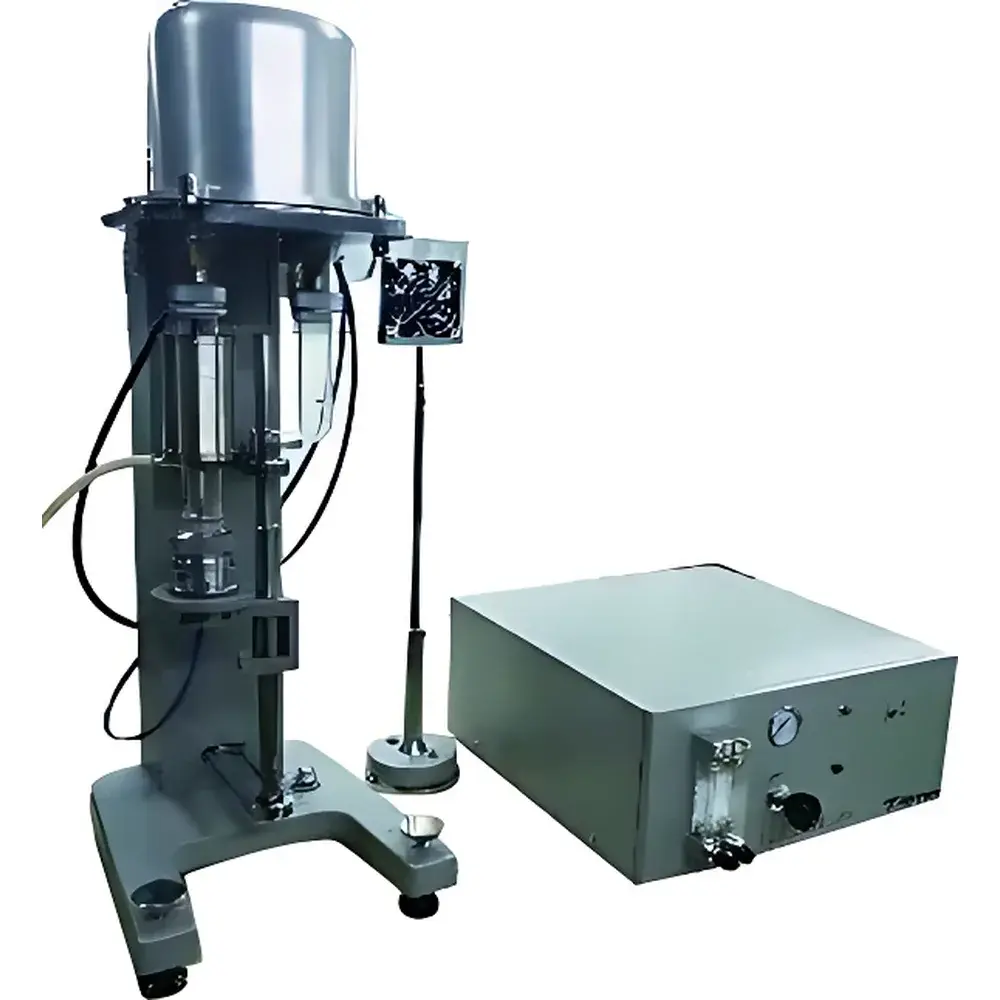
Techcomp RZY-1/RZY-2 Thermogravimetric Analyzer
| Brand | Techcomp |
|---|---|
| Origin | Shanghai, China |
| Manufacturer Type | Direct Manufacturer |
| Regional Classification | Domestic (China) |
| Model | RZY-1 / RZY-2 |
| Price Range | USD 7,000 – 14,000 |
| Temperature Range | Ambient to 1400 °C |
| Temperature Accuracy | ±0.1 K |
| Balance Sensitivity | 1 µg |
| Heating/Cooling Rate | 1–50 °C/min |
Overview
The Techcomp RZY-1 and RZY-2 Thermogravimetric Analyzers (TGA) are precision benchtop instruments engineered for high-fidelity measurement of mass change as a function of temperature or time under controlled atmospheric conditions. Operating on the fundamental principle of thermogravimetry—where sample mass is continuously monitored during programmed thermal cycles—these analyzers deliver quantitative insight into thermal decomposition pathways, compositional volatility, phase transitions, and reaction kinetics. Designed with direct lineage from Shanghai’s legacy in analytical balance and thermal instrumentation development since the 1960s, the RZY series integrates decades of indigenous expertise in microbalance mechanics, furnace thermal dynamics, and closed-loop temperature regulation. The instruments conform to core international TGA methodology standards including ASTM E1131, ISO 11358, and USP , supporting GLP-compliant workflows in regulated environments.
Key Features
- Compact dual-zone furnace architecture with low thermal mass, enabling rapid heating and cooling rates from 1 to 50 °C/min while maintaining ±0.1 K temperature accuracy across the full 25–1400 °C operating range.
- Bottom-loading monolithic microbalance system with 1 µg resolution and active drift compensation—optimized for minimal buoyancy interference and high baseline stability over extended runs.
- Integrated dual-gas mass flow control module supporting seamless switching between inert (N₂, Ar), oxidative (air, O₂), or reducing (H₂, CO) atmospheres with programmable gas purging sequences and real-time flow monitoring.
- Fully automated zeroing, tare, and auto-baseline correction routines executed prior to each analysis cycle—reducing operator dependency and enhancing inter-run reproducibility.
- Proprietary temperature controller firmware with adaptive PID tuning and thermal gradient compensation algorithms, ensuring uniform axial temperature distribution within the sample chamber.
- Modular calibration suite including certified reference materials (e.g., Ni, Cu, CaC₂O₄·H₂O) and instrument-specific calibration wizards for temperature, mass, and baseline validation—fully traceable to NIST-traceable standards.
Sample Compatibility & Compliance
The RZY platform accommodates solid powders, granules, thin films, fibers, and small metallic coupons (max. 100 mg typical loading). Sample pans are available in alumina, platinum, and stainless steel configurations to suit corrosive, high-temperature, or catalytic applications. All hardware and software modules comply with IEC 61000-4 electromagnetic compatibility requirements and meet CE safety directives. Data integrity features—including electronic audit trails, user-access level management, and password-protected method storage—align with FDA 21 CFR Part 11 readiness for pharmaceutical QC laboratories. Full documentation packages support IQ/OQ/PQ validation protocols per GMP Annex 15 guidelines.
Software & Data Management
The embedded TGA Analysis Suite provides native multi-tasking capability: simultaneous acquisition, real-time curve overlay, and post-run processing without interrupting ongoing measurements. Supported visualization modes include TG (mass % vs. temperature/time), DTG (derivative mass loss rate), and residual mass tracking. Advanced computational functions include stepwise mass-loss quantification (with extrapolated onset/offset determination), oxidation induction time (OIT) calculation per ASTM D3895, kinetic parameter estimation via Freeman-Carroll or Ozawa-Flynn-Wall methods, and automatic baseline subtraction using polynomial fitting or dynamic reference compensation. Data export options include CSV, ASCII, and universal .tdf formats compatible with third-party thermal analysis platforms such as TA Universal Analysis or Netzsch Proteus. All calibration records, method parameters, and raw datasets are timestamped and digitally signed to ensure ALCOA+ data governance principles.
Applications
- Quantitative determination of moisture, solvent residues, and volatile additives in polymer formulations (e.g., PVC plasticizers, epoxy curing agents).
- Thermal stability assessment of battery cathode/anode materials (LiCoO₂, Si anodes) under air and argon atmospheres.
- Decomposition profiling and ash content verification for catalysts, zeolites, and supported metal oxides.
- Residue-on-ignition (ROI) and loss-on-drying (LOD) testing per pharmacopeial monographs (USP , EP 2.2.32).
- Characterization of carbon black dispersion, filler degradation, and polymer–filler interaction in rubber composites.
- Reaction enthalpy and stoichiometric yield estimation in solid-state synthesis processes (e.g., metal oxide formation from nitrates or carbonates).
FAQ
What is the maximum recommended sample mass for optimal resolution and thermal response?
For routine operation, 5–20 mg is recommended; up to 100 mg may be used for high-mass-loss samples where signal-to-noise ratio permits.
Does the system support purge gas flow programming during a single run?
Yes—the dual-channel mass flow controller allows dynamic gas composition switching at user-defined temperature or time points, enabling multi-atmosphere experiments (e.g., N₂ → air oxidation sequence).
Is remote operation and data access supported?
The analyzer connects via Ethernet and supports secure remote desktop access through standard IT infrastructure; no proprietary cloud service is required.
How often should temperature and mass calibration be performed?
Initial calibration is mandatory before first use; subsequent verification is recommended every 3 months or after any maintenance event affecting furnace or balance alignment.
Can the software generate 21 CFR Part 11–compliant reports?
Yes—when deployed on a validated Windows OS environment with enabled audit trail logging, electronic signatures, and role-based permissions, the system meets core Part 11 technical requirements for electronic records and signatures.



