
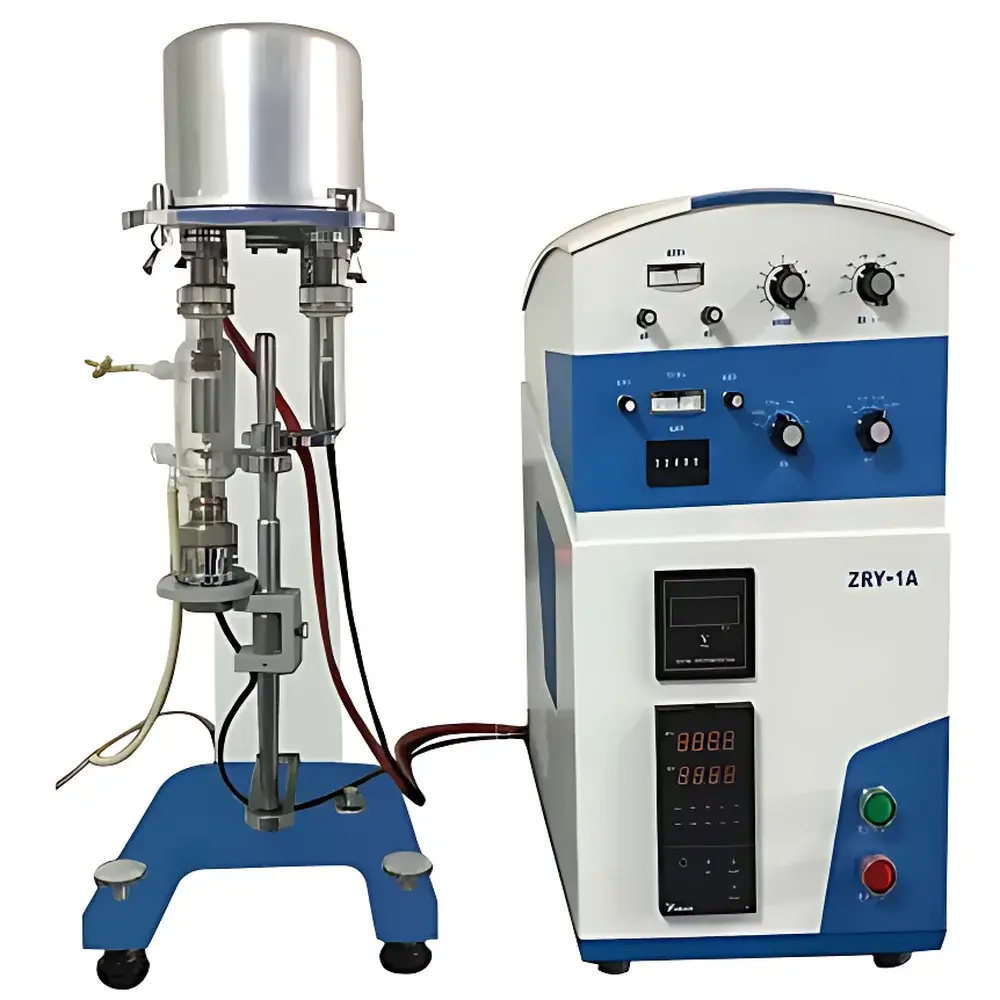
Techcomp ZRY-1A & ZRY-2A Simultaneous Thermal Analyzer (STA)
| Brand | Techcomp |
|---|---|
| Origin | Shanghai, China |
| Manufacturer Type | Direct Manufacturer |
| Product Category | Domestic |
| Model | ZRY-1A & ZRY-2A |
| Price Range | USD 14,000–42,000 (FOB Shanghai) |
| Heating Rate | 0.1–50 °C/min |
| Temperature Range | Ambient to 1450 °C |
| Temperature Stability | ±1.5 °C |
| Maximum Sample Mass | 2 g |
| Atmosphere Options | Inert, Oxidizing, Static, Dynamic |
Overview
The Techcomp ZRY-1A and ZRY-2A Simultaneous Thermal Analyzer (STA) is an integrated thermogravimetric analyzer (TGA) and differential thermal analyzer (DTA), engineered for precision coupling of mass change and thermal event detection in a single, synchronized measurement. Based on the fundamental principle of simultaneous thermal analysis—where sample mass (via high-sensitivity microbalance) and temperature-differential signal (via thermocouple-based DTA sensor) are acquired concurrently under identical thermal conditions—the instrument delivers intrinsically correlated data with strict temporal and thermal alignment. This architecture eliminates inter-run variability inherent in sequential TG/DTA or TG/DSC measurements, enabling unambiguous assignment of endothermic/exothermic transitions (e.g., melting, crystallization, glass transition, oxidation) to concurrent mass loss or gain events (e.g., dehydration, decomposition, oxidation uptake). Designed for rigorous materials characterization in R&D and quality control laboratories, the ZRY series supports ISO 11358, ASTM E1131, and ASTM E1641-compliant workflows and is routinely deployed in high-temperature ceramic sintering studies, catalyst stability screening, polymer degradation kinetics, and pharmaceutical solid-state form evaluation.
Key Features
- Compact, low-thermal-mass furnace with optimized Pt/Rh heating element—enables rapid heating/cooling rates up to 50 °C/min while maintaining ±1.5 °C temperature stability across the full 25–1450 °C operating range.
- Downward-hanging microbalance system featuring platinum suspension wire and lightweight metallic components—minimizes thermal conduction errors and achieves sub-1 µg resolution under dynamic conditions.
- Thermally isolated balance chamber with active thermal shielding—reduces baseline drift to <10 µg over 60 min at 1000 °C, ensuring high signal-to-noise ratio even during extended high-temperature holds.
- Dual independent gas flow control module—supports seamless switching between inert (N₂, Ar), oxidizing (air, O₂), static, or dynamic atmospheres; integrated purge gas pre-heating minimizes thermal shock and baseline disturbance during atmosphere transitions.
- Modular furnace design with quick-access sample pan compartment—facilitates rapid sample loading/unloading and enables routine maintenance without recalibration.
- Fully automated calibration suite—including certified reference materials for temperature (e.g., Ni, Al, In, Zn, Sn, Bi, Pb), enthalpy (KCl, KNO₃), and mass (certified weights)—with guided software workflow compliant with GLP documentation requirements.
Sample Compatibility & Compliance
The ZRY-1A/2A accommodates solid powders, granules, fibers, thin films, and small-volume pastes (≤2 g max load), with crucible options including alumina, platinum, and graphite for aggressive chemical environments. Its robust construction meets IEC 61010-1 safety standards for laboratory electrical equipment. Data integrity and audit readiness are supported via optional 21 CFR Part 11-compliant software modules, including electronic signatures, user role management, and immutable audit trails for all measurement and calibration events. The system is validated for use in GMP-regulated environments per USP and ISO/IEC 17025 analytical instrument qualification protocols.
Software & Data Management
Techcomp STA Control & Analysis Software (v4.x) operates under Windows OS and provides fully integrated acquisition, real-time visualization, and post-processing. Core capabilities include multi-task operation (simultaneous measurement and retrospective analysis), customizable time/temperature axis scaling, overlay of up to eight curves (TG, DTG, DTA, DSC-equivalent, derivative, residual mass %), and automatic peak detection with onset, peak, inflection, and offset temperature assignment. DTA-to-DSC conversion applies standardized sensitivity calibration using certified reference materials. All data files (.tdf) embed metadata (operator ID, instrument serial, calibration timestamp, atmosphere log) and support export to ASCII, CSV, and universal .itx formats compatible with OriginLab, MATLAB, and Thermo Scientific™ OMNIC™. Software validation documentation and IQ/OQ templates are provided upon request.
Applications
- Ceramics & Refractories: Quantification of binder burnout, phase transformation enthalpies (e.g., α→β quartz), and sintering onset temperatures.
- Metallurgy: Oxidation kinetics of alloys, decarburization behavior, and slag–metal interaction studies under controlled pO₂.
- Polymers & Composites: Thermal stability assessment (Tonset, Tmax), filler dispersion effects, flame retardant efficiency (via char yield), and OIT (oxidative induction time) per ASTM D3895.
- Pharmaceuticals: Hydrate/solvate desolvation profiling, polymorph interconversion, excipient compatibility screening, and amorphous content estimation.
- Energetic Materials: Decomposition mechanism mapping, sensitivity correlation (e.g., impact vs. thermal initiation), and aging stability prediction.
- Geochemistry & Catalysis: Mineral dehydration sequences, supported catalyst deactivation pathways (coking, sintering, sulfur poisoning), and redox cycling reversibility.
FAQ
What is the difference between ZRY-1A and ZRY-2A?
The ZRY-2A includes an upgraded DTA sensor with enhanced signal linearity above 1000 °C and integrated furnace temperature feedback for improved ramp accuracy during ultra-high-temperature runs; the ZRY-1A is optimized for routine applications up to 1200 °C.
Can the instrument perform quantitative DSC-like analysis?
Yes—via DTA-to-DSC conversion using certified enthalpy standards and user-defined calibration factors; results comply with ASTM E1269 for heat capacity determination when coupled with modulation routines.
Is vacuum operation supported?
No—ZRY systems are designed for controlled gas atmospheres only (positive pressure up to 5 bar optional); vacuum compatibility requires third-party modifications not covered under warranty.
How often must the microbalance be recalibrated?
Factory calibration remains valid for 12 months under normal use; however, daily zero-check and periodic mass/temperature verification using supplied standards are recommended prior to critical measurements.
Does the software support automated method sequencing?
Yes—multi-step temperature programs (e.g., hold-ramp-hold-cool-ramp) with atmosphere switching, dwell time, and trigger-based data logging are fully scriptable within the method editor.



