TECHNE Hybrigene HB-3D Molecular Hybridization Oven
| Origin | UK |
|---|---|
| Manufacturer Type | Authorized Distributor |
| Origin Category | Imported |
| Model | Hybrigene HB-3D |
| Price | Upon Request |
Overview
The TECHNE Hybrigene HB-3D Molecular Hybridization Oven is a precision-engineered thermal incubation system designed specifically for nucleic acid and protein hybridization applications in molecular biology laboratories. Operating on the principle of controlled convective heating combined with programmable rotational agitation, the HB-3D ensures uniform thermal energy distribution across hybridization vessels—critical for achieving high-stringency, reproducible probe-target binding in Southern, Northern, and Western blotting workflows. Unlike static incubators, its integrated rotation mechanism (0–20 rpm) minimizes boundary layer formation at membrane surfaces, thereby enhancing hybridization kinetics and signal-to-noise ratios. Engineered to ISO 9001-certified manufacturing standards in the UK, the HB-3D delivers laboratory-grade temperature fidelity essential for low-abundance target detection and quantitative comparative studies.
Key Features
- Precision temperature control from ambient +10°C to 80°C, with resolution of 0.1°C and accuracy better than ±0.3°C
- Thermal stability within the chamber maintained at <1.0°C; intra-vessel temperature variation held to <±0.1°C under steady-state conditions
- Uniformity across the heating cavity <±1.5°C; intra-tube uniformity <±0.5°C—validated per ASTM E2207 for thermal mapping of incubation devices
- Programmable rotation speed (0, 5–20 rpm) and optional orbital vibration (5–20 or 15–60 opm) to optimize hybridization efficiency across diverse probe chemistries (e.g., DIG-, biotin-, or radio-labeled probes)
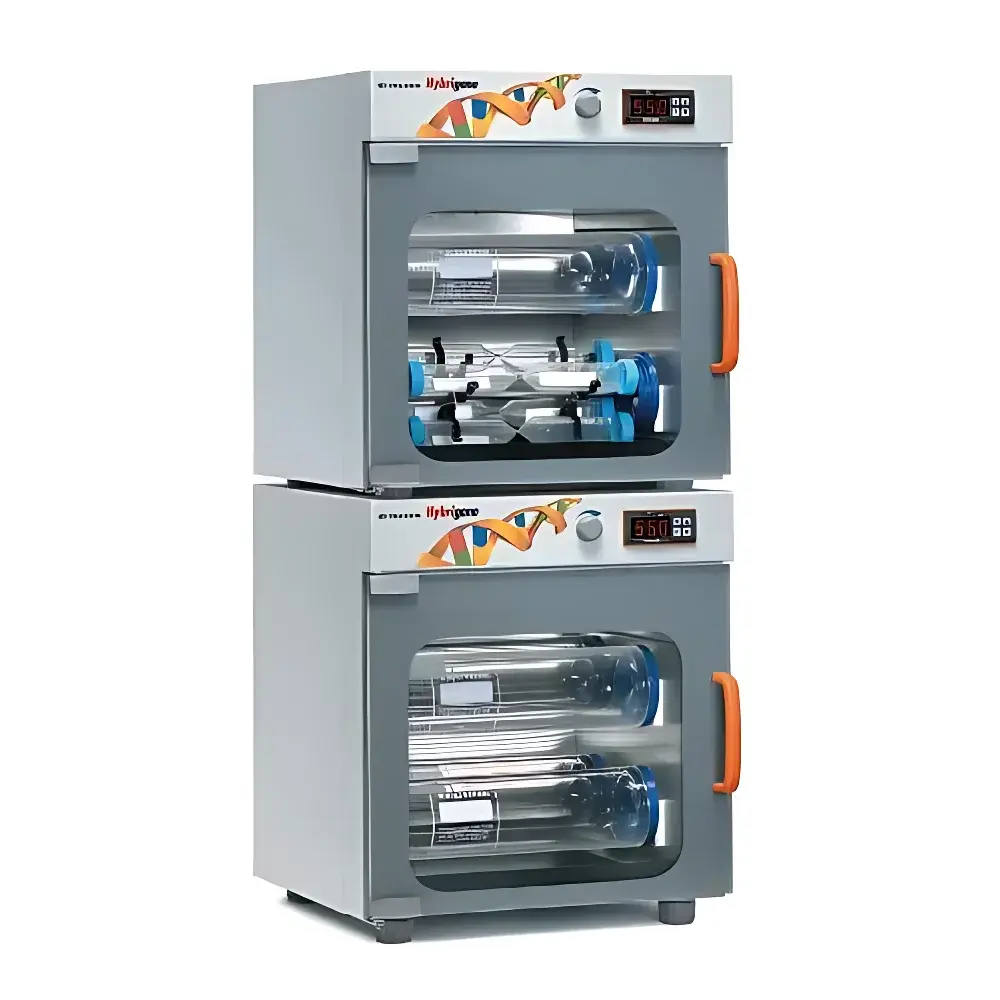
- Compact footprint (355 × 383 × 432 mm) enabling vertical stacking—up to three HB-3D units may be safely stacked without thermal cross-talk or mechanical instability
- Accommodates up to sixteen 12–15 mL glass hybridization tubes or four large-format tubes (up to 50 mL), compatible with standard nitrocellulose and nylon membrane formats
- Robust stainless-steel chamber construction with insulated double-wall housing for energy-efficient operation and reduced ambient heat emission
Sample Compatibility & Compliance
The HB-3D supports a broad range of molecular hybridization substrates including DNA-DNA, DNA-RNA, RNA-RNA, and antibody-antigen (Western) assays. It is routinely employed in protocols aligned with NIH, WHO, and CLSI guidelines for nucleic acid detection. The instrument meets essential requirements for GLP-compliant environments: full traceability of temperature setpoints, real-time logging capability (via optional RS232/USB interface), and audit-ready calibration records. While not inherently 21 CFR Part 11 compliant, its data output architecture supports integration with validated LIMS platforms for electronic record retention. All materials in contact with samples comply with USP Class VI biocompatibility standards.
Software & Data Management
The HB-3D operates via an intuitive front-panel interface with dual-line LCD display and tactile membrane keys. Temperature profiles, rotation parameters, and run duration are stored in non-volatile memory (up to 10 user-defined methods). Optional PC connectivity enables remote monitoring and method transfer using TECHNE’s proprietary Hybrilink™ software (Windows-compatible, .csv export enabled). Raw temperature logs—including chamber sensor readings and inferred tube-core estimates—are timestamped and exportable for QC documentation. Software-generated reports include thermal deviation summaries and pass/fail flags against preconfigured SOP tolerances.
Applications
- Southern blot hybridization for genomic DNA fragment identification and restriction mapping
- Northern blot analysis of RNA expression levels, splice variants, and degradation kinetics
- Western blot detection using enzyme- or fluorophore-conjugated secondary antibodies
- Fluorescence in situ hybridization (FISH) slide incubation with stringent wash compatibility
- Pre-hybridization blocking and post-hybridization stringency washes requiring precise thermal ramping
- High-throughput screening of oligonucleotide probe libraries under standardized thermal conditions
FAQ
What is the maximum recommended tube volume for optimal hybridization performance?
For consistent thermal equilibration and agitation efficacy, TECHNE recommends using tubes ≤15 mL for routine protocols. Larger volumes (up to 50 mL) are supported but require extended equilibration time and validation per application.
Can the HB-3D be used for high-stringency washes after hybridization?
Yes—the unit maintains stable temperature control during dynamic ramping and hold phases, making it suitable for post-hybridization wash steps defined in protocols such as those outlined in Current Protocols in Molecular Biology.
Is calibration certification included with shipment?
Each HB-3D ships with a factory-issued calibration certificate traceable to UKAS-accredited standards. On-site recalibration services are available through authorized TECHNE service partners.
How does stacking affect thermal performance or safety?
Stacking has been validated per IEC 61010-1:2010 for thermal management and structural integrity. No derating of temperature specifications or operational limits is required when stacking up to three units.
Does the HB-3D support external temperature probe input for vessel-core monitoring?
No—the system relies on internal platinum resistance thermometers (PT100) embedded in the chamber wall and air circulation path. Vessel-core estimation is derived algorithmically based on empirical thermal models validated during design verification testing.