
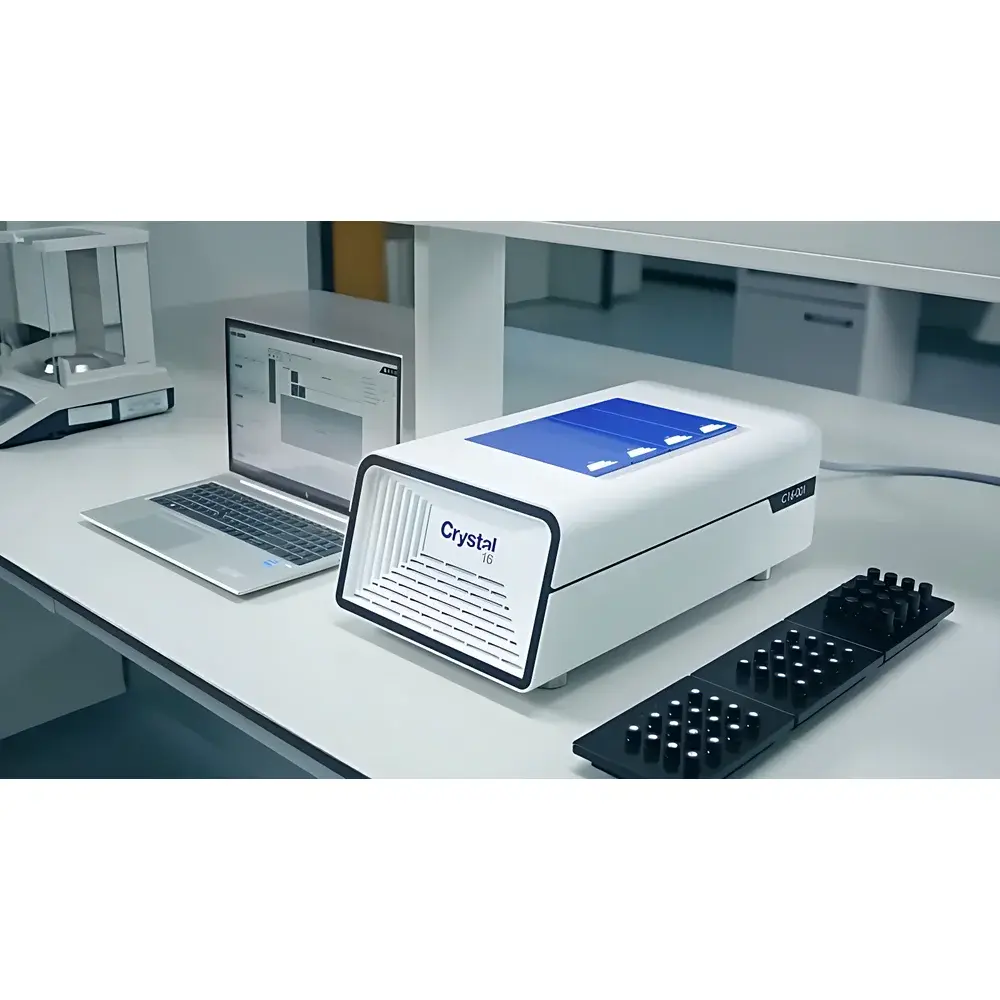
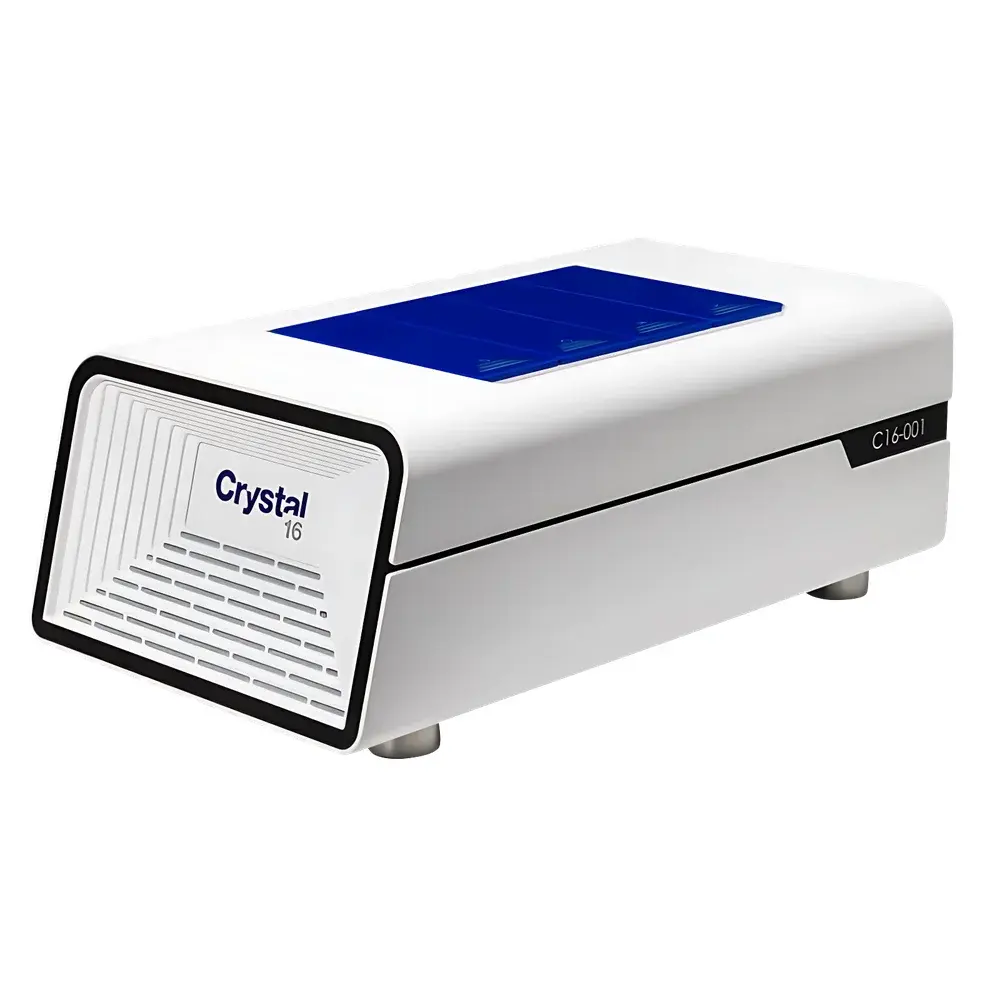
Technobis Crystal16 High-Throughput Parallel Crystallization Platform
| Brand | Technobis |
|---|---|
| Origin | Netherlands |
| Model | Crystal16 |
| Reactor Volume | 0.5–1 mL per channel |
| Number of Channels | 16 |
| Temperature Control Zones | 4 independent modules |
| Stirring Modes | top-mounted overhead stirrer and bottom magnetic stirring |
| In-situ Turbidity Monitoring | non-invasive, channel-specific optical turbidity detection |
| Software | integrated control and analysis suite compliant with GLP data integrity principles |
| Regulatory Alignment | supports 21 CFR Part 11 audit trail requirements for electronic records |
Overview
The Technobis Crystal16 High-Throughput Parallel Crystallization Platform is an engineered solution for solid-state screening and crystallization process development in pharmaceutical, fine chemical, and materials science laboratories. Based on the principle of controlled supersaturation generation coupled with real-time, non-invasive turbidity monitoring, the Crystal16 enables simultaneous execution of 16 independent crystallization experiments under precisely defined thermal and hydrodynamic conditions. Unlike conventional single-vessel systems, its parallel architecture—combined with four thermally isolated temperature zones—allows differentiated experimental protocols (e.g., cooling, antisolvent addition, evaporation) across subsets of reactors without cross-interference. This design directly addresses key challenges in early-stage solid-form selection: sample conservation, statistical robustness, reproducibility across operators, and traceability of critical process parameters (CPPs). The platform operates within a validated framework aligned with ICH Q5A, Q5C, and Q8(R2) guidance, supporting regulatory submissions where crystalline form identity, purity, and batch-to-batch consistency are essential.
Key Features
- 16-channel parallel reactor block with individual 0.5–1 mL reaction vessels—optimized for minimal API consumption during high-value compound screening.
- Four independently controlled temperature modules (±0.1 °C stability), enabling concurrent experiments at distinct thermal profiles (e.g., polymorph screening across 20–80 °C gradients).
- Dual agitation configuration: overhead mechanical stirring for viscous or heterogeneous slurries; bottom-mounted magnetic stirring for low-viscosity solutions—both configurable per channel.
- Non-invasive, fiber-optic-based turbidity measurement integrated into each reactor lid—eliminates probe insertion, prevents nucleation artifacts, and avoids cross-contamination between runs.
- Modular hardware architecture designed for benchtop integration and long-term operational reliability in regulated environments (IP20 rating, CE-compliant electrical safety).
- Pre-calibrated optical path geometry ensures consistent Beer–Lambert-derived relative turbidity values across all 16 channels, facilitating quantitative comparison of nucleation onset and growth kinetics.
Sample Compatibility & Compliance
The Crystal16 accommodates a broad range of organic solvents (including DMF, DMSO, THF, ethanol, water, and chlorinated media), APIs with solubilities spanning 0.1–100 mg/mL, and excipients used in co-crystal or salt formation studies. All wetted parts—including reactor vials, lids, and optical windows—are constructed from chemically inert borosilicate glass and PTFE-coated stainless steel. The system complies with ISO 17025 requirements for method validation in testing laboratories and supports full traceability per FDA 21 CFR Part 11 through electronic signatures, user access levels, and immutable audit trails for all instrument events and data exports. It is routinely deployed in GMP-aligned environments for Phase I–III solid-form qualification and process characterization studies.
Software & Data Management
Crystal16 is operated via CrystalControl™ software—a Windows-based application built on .NET Framework with embedded database (SQL Server Express). The interface provides real-time visualization of turbidity curves, temperature profiles, and stirring status per channel. Experimental methods—including ramp rates, hold times, solvent addition sequences, and endpoint criteria—are programmable and exportable as XML templates. Raw turbidity data (in mV or arbitrary units) and derived metrics (nucleation time, induction period, growth rate slope) are stored with metadata (user ID, timestamp, calibration logs) in encrypted format. Data export options include CSV, PDF reports, and direct import into MATLAB or Python for advanced kinetic modeling (e.g., MSMPR fitting, population balance modeling). All software updates undergo version-controlled release documentation per ALCOA+ principles.
Applications
- Rapid determination of solubility vs. temperature profiles using dynamic cooling protocols.
- Metastable zone width (MSZW) quantification via controlled cooling rate variation.
- Polymorph screening across diverse solvent/antisolvent combinations and thermal histories.
- Cocrystal and salt screening with stoichiometric titration capability.
- Antisolvent crystallization optimization—including addition rate, mixing intensity, and supersaturation trajectory control.
- Chiral resolution studies via preferential crystallization in racemic mixtures.
- Polymer solubility parameter mapping using Hansen solubility space analysis.
- Seeding strategy development based on turbidity-triggered automated seed addition (requires optional accessory module).
FAQ
What is the minimum sample requirement per experiment?
Each reactor accommodates 0.5–1 mL total volume; typical API mass ranges from 1–10 mg depending on solubility and concentration target.
Can the Crystal16 be integrated with automated liquid handlers?
Yes—via RS-232 or TCP/IP communication protocol; compatible with third-party dispensers for antisolvent or seed addition under synchronized timing control.
Is turbidity calibration required before each run?
No—factory calibration is stable over time; users may perform optional verification using standardized latex bead suspensions traceable to NIST SRM 1980.
Does the system support PAT (Process Analytical Technology) frameworks?
Yes—the turbidity signal serves as a primary PAT parameter for real-time crystallization monitoring and can feed into MES or SCADA systems via OPC UA gateway (optional configuration).
How is cleaning and maintenance performed between runs?
Reactor vials and lids are manually removable and autoclavable; optical windows are cleaned with IPA and lint-free wipes; no consumables beyond standard lab-grade vials are required.



