
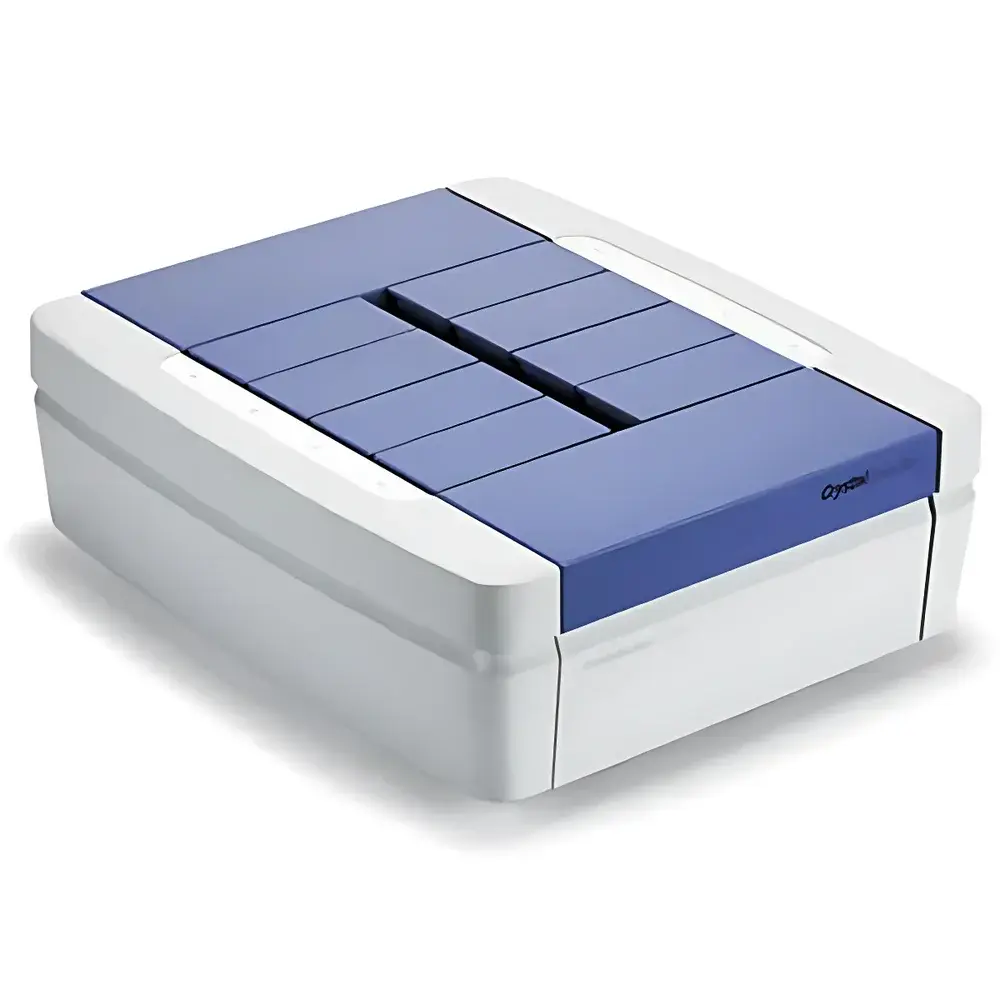
Technobis CrystalBreeder High-Throughput Parallel Crystallization System
| Brand | Technobis |
|---|---|
| Origin | Netherlands |
| Model | CrystalBreeder |
| Reaction Volume per Vial | 0.05–0.2 mL |
| Total Channels | 32 (8 modules × 4 vials) |
| Temperature Control | Programmable, ±0.1 °C accuracy |
| Stirring | Top-mounted paddle and bottom-mounted magnetic stirring (interchangeable) |
| In-situ Monitoring | Non-invasive turbidity detection per channel |
| Optional Modes | Vapor diffusion, evaporation crystallization |
| Compliance | Designed for GLP-compliant early-phase pharmaceutical development |
Overview
The Technobis CrystalBreeder is a benchtop, high-throughput parallel crystallization system engineered for precision solid-form screening in early-stage pharmaceutical development. It operates on the principle of controlled supersaturation generation—via temperature modulation, solvent evaporation, or vapor diffusion—combined with real-time, non-invasive turbidity monitoring to detect nucleation onset, crystal growth, and dissolution events. With a minimal working volume of 0.05–0.2 mL per reaction, the system significantly reduces compound consumption while maintaining thermodynamic relevance and kinetic reproducibility. Its architecture supports systematic exploration of polymorphic landscapes, salt forms, co-crystals, solubility profiles, and crystallization kinetics—critical parameters in ICH Q5A–Q5E and FDA Guidance for Industry on Development and Validation of Analytical Methods for Drug Substances and Products.
Key Features
- 32 independent crystallization channels distributed across eight thermally isolated modules (4 vials/module), each with fully decoupled temperature control and agitation.
- Dual-mode agitation: top-mounted paddle stirrers (with interchangeable geometries for shear-sensitive systems) and bottom-mounted magnetic stir bars—enabling comparative study of mixing intensity effects on nucleation induction time.
- Non-invasive, fiber-optic-based turbidity measurement integrated into each vial lid—eliminating probe-induced nucleation artifacts, surface fouling, or cross-contamination between experiments.
- Programmable thermal profiles with ramp rates from 0.01 to 5 °C/min and stability ≤ ±0.1 °C—suitable for cooling, antisolvent, and isothermal evaporation protocols.
- Modular expansion capability: optional vapor diffusion plates and controlled evaporation lids allow seamless transition between classical and alternative crystallization mechanisms.
- Compact footprint (< 600 mm × 500 mm) with integrated touchscreen interface and Ethernet connectivity for remote monitoring and protocol synchronization.
Sample Compatibility & Compliance
The CrystalBreeder accommodates organic small molecules, peptides, and biologics-compatible excipients across diverse solvent systems—including water, alcohols, esters, ketones, and chlorinated hydrocarbons. All wetted parts are chemically resistant (e.g., PTFE-coated vial caps, borosilicate glass vials), supporting aggressive solvent exposure without leaching. The system is designed to meet requirements for data integrity under 21 CFR Part 11: audit trails log user actions, method changes, and instrument events; electronic signatures are supported via optional LIMS integration. It aligns with ISO 17025 analytical method validation frameworks and supports documentation packages compliant with EMA/CHMP/ICH guidelines for solid-state characterization in regulatory submissions.
Software & Data Management
CrystalBreeder is operated via CrystalControl™ software—a Windows-based platform enabling full experimental design (DoE), real-time turbidity curve visualization, automated event flagging (nucleation, agglomeration, redissolution), and export of time-stamped .csv and .xlsx datasets. Raw turbidity signals (expressed as normalized transmission %) are calibrated against reference standards traceable to NIST SRM 1963. Batch reports include metadata (temperature history, stirring speed, ambient humidity), raw signal plots, derivative analysis (dTurbidity/dt), and customizable pass/fail criteria for crystallization success. Data archives are encrypted and support version-controlled backups compatible with network-attached storage (NAS) and enterprise cloud repositories.
Applications
- Polymorph screening under varied supersaturation trajectories and cooling rates.
- Salt selection studies using counterion libraries with pH-controlled dissolution–crystallization coupling.
- Co-crystal screening via liquid-assisted grinding (LAG) pre-dissolution followed by controlled anti-solvent addition.
- Solubility mapping across temperature and composition space (e.g., ternary phase diagrams).
- Crystal habit assessment through sequential imaging integration (optional camera module).
- Slurry conversion experiments to evaluate solid-form stability and transformation kinetics under dynamic conditions.
FAQ
What is the minimum sample requirement per experiment?
Each vial operates at 0.05–0.2 mL volume, enabling screening with ≤2 mg of active pharmaceutical ingredient (API) when concentration is optimized.
Can the system be used for protein crystallization?
While primarily validated for small-molecule APIs, the non-invasive turbidity detection and low-shear stirring modes have been successfully applied to model proteins (e.g., lysozyme, thaumatin) under buffered aqueous conditions.
Is calibration of turbidity sensors required between runs?
No routine recalibration is needed; factory calibration remains stable for ≥12 months under standard lab conditions (20–25 °C, <60% RH). A daily zero-point check using blank solvent is recommended.
How is data traceability ensured for regulatory submissions?
All instrument logs, method files, and raw data are timestamped, digitally signed, and archived with immutable audit trails—fully compliant with ALCOA+ principles (Attributable, Legible, Contemporaneous, Original, Accurate, Complete, Consistent, Enduring, Available).



