
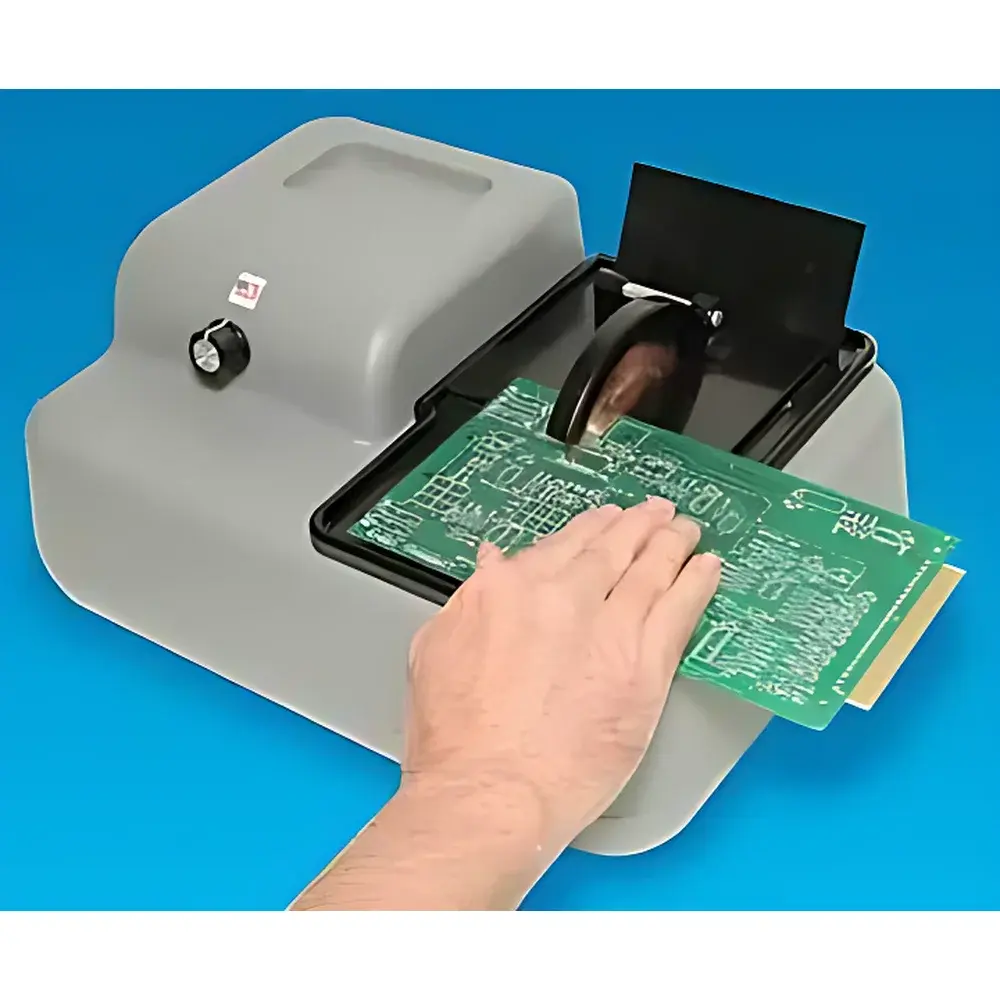
Ted Pella 812-300 Precision Manual Cutting Machine
| Brand | Ted Pella |
|---|---|
| Origin | USA |
| Manufacturer Type | Authorized Distributor |
| Origin Category | Imported |
| Model | 812-300 |
| Instrument Type | Precision Manual Cutting Machine |
| Operating Speed Range | 400–3400 rpm |
| Compatible Blade Sizes | 4" and 5" diamond wafering blades |
| Worktable Dimensions | 6" × 10" (152 mm × 254 mm) |
| Construction Material | Cross-linked polyethylene (corrosion-resistant, high-impact) |
| Standard Accessories | One 4" diamond blade, blade truing block, water-soluble coolant |
Overview
The Ted Pella 812-300 Precision Manual Cutting Machine is an engineered solution for controlled, low-dust sectioning of fragile, hard, or heterogeneous specimens in materials science, electronics, geology, and failure analysis laboratories. Designed around a manually actuated, gravity-fed cutting mechanism with variable-speed motor control, it operates on the principle of abrasive diamond wafering—where material removal occurs via mechanical abrasion between a rotating diamond-impregnated blade and the specimen under applied downward force and continuous coolant flow. Unlike automated systems requiring programming or complex setup, the 812-300 emphasizes operator control, repeatability, and minimal thermal distortion—critical when preparing cross-sections of printed circuit boards (PCBs), ceramic substrates, metal alloys, fiber-reinforced composites, and cylindrical samples such as rods, tubes, and insulated cables. Its rigid cross-linked polyethylene frame eliminates galvanic corrosion risks associated with metal housings, ensuring long-term dimensional stability in humid or chemically active lab environments.
Key Features
- Variable-speed DC motor delivering precise rotational control from 400 to 3400 rpm—enabling optimal blade engagement across diverse hardness profiles (e.g., soft polymers vs. sintered ceramics)
- 6″ × 10″ (152 × 254 mm) reinforced worktable with integrated coolant channels and machined heat-dissipation grooves to prevent localized thermal buildup during extended cuts
- Corrosion-immune structural housing fabricated from high-molecular-weight, cross-linked polyethylene—resistant to acids, bases, and organic solvents commonly used in sample prep workflows
- Tool-free blade mounting system compatible with standard 4″ and 5″ diamond wafering blades (ISO 6432-compliant arbor interface)
- Included accessories: one 4″ diamond blade (bond type optimized for general-purpose conductive/non-conductive materials), precision truing block for blade flatness maintenance, and biodegradable, water-soluble coolant formulated to suppress airborne particulates without leaving residue
Sample Compatibility & Compliance
The 812-300 accommodates planar, cylindrical, and irregular geometries—including PCBs up to 100 mm × 150 mm, ceramic tiles ≤8 mm thick, stainless steel rods (Ø1–12 mm), aluminum tubing (wall thickness ≥0.3 mm), and multi-layer composite laminates. Specimen clamping is achieved via adjustable vise jaws with non-marring elastomeric inserts to prevent surface deformation. While not a GLP/GMP-certified instrument per se, its mechanical design supports traceable, documented manual operation aligned with ASTM E3-22 (Standard Guide for Preparation of Metallographic Specimens) and ISO 148-1:2016 (Metallic materials — Charpy pendulum impact test). Coolant delivery and dust containment practices comply with OSHA 1910.132 (PPE requirements) and ANSI Z9.2 (Laboratory Ventilation Guidelines) when used with appropriate local exhaust ventilation.
Software & Data Management
As a manually operated mechanical instrument, the 812-300 does not incorporate embedded firmware, touchscreen interfaces, or digital data logging. All operational parameters—including speed selection, cut depth, feed rate, and coolant flow—are set and recorded externally by the user. Laboratories integrating this unit into regulated workflows may document settings via standardized paper-based or LIMS-integrated electronic batch records. The absence of microprocessor control ensures immunity to electromagnetic interference (EMI), software obsolescence, or cybersecurity vulnerabilities—making it suitable for classified research facilities or environments where IT validation overhead must be minimized.
Applications
- Cross-sectional analysis of multilayer PCBs for solder joint integrity, via inspection, and delamination assessment
- Sectioning of sintered oxide ceramics (e.g., Al₂O₃, ZrO₂) and nitride substrates prior to SEM/EDS or XRD analysis
- Preparation of tensile test coupons from additively manufactured metal parts (Ti-6Al-4V, Inconel 718)
- Controlled cleaving of optical fibers and semiconductor wafers for edge quality evaluation
- Trimming of encapsulated electronic components for failure root-cause analysis (FRCA)
- Dimensional reduction of geological core samples and mineralogical thin sections
FAQ
What types of diamond blades are compatible with the 812-300?
The unit accepts standard 4″ and 5″ diamond wafering blades with 12.7 mm (½”) arbor holes, including resin-bond, metal-bond, and electroplated variants—selected based on material hardness and required surface finish.
Is coolant circulation mandatory during operation?
Yes. Continuous coolant application is required to dissipate frictional heat, minimize blade wear, suppress respirable dust, and prevent thermal cracking in brittle materials.
Can the 812-300 perform angled or beveled cuts?
No. It is configured exclusively for orthogonal (90°) vertical sectioning. Angular cuts require post-mounting in a separate precision jig or angle vise.
Does Ted Pella provide calibration documentation or service support?
While the 812-300 has no field-calibratable sensors, Ted Pella offers technical documentation, preventive maintenance guidelines, and authorized repair services through its U.S.-based support network.
What safety certifications does the instrument carry?
It complies with UL 61010-1 (Safety Requirements for Electrical Equipment for Measurement, Control, and Laboratory Use) and bears CE marking for EMC Directive 2014/30/EU and Low Voltage Directive 2014/35/EU.



