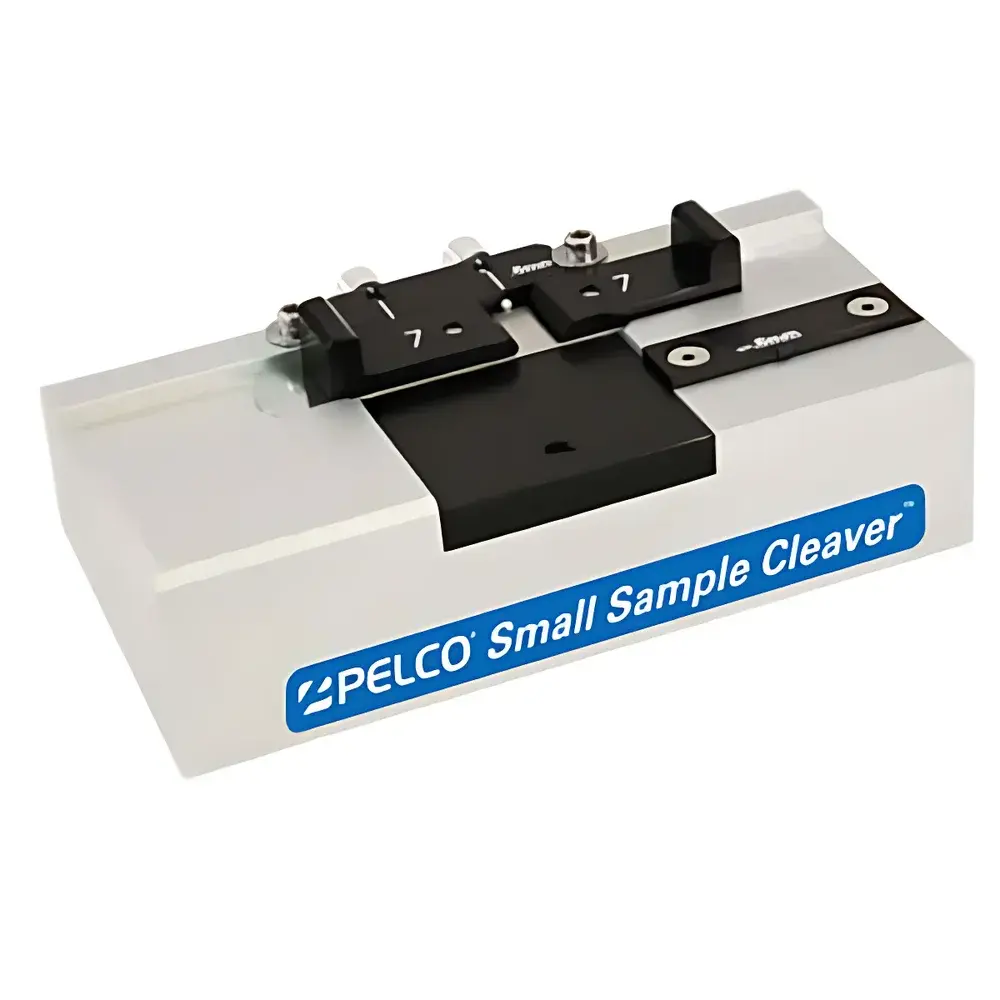
Ted Pella PELCO Small Sample Cleaver
| Brand | Ted Pella |
|---|---|
| Origin | USA |
| Type | Manual Cleaving Instrument |
| Model | Small Sample Cleaver |
| Sample Width Capacity | 3–15 mm |
| Sample Thickness Range | 200–900 µm |
| Cleave Platform Dimensions | ≤2 × 2 mm |
| Indent Length | 0.5 mm |
| Compatibility | Designed for use with PELCO® LatticeAx® (1 mm indent) |
| Mounting | Four magnetic fixation points |
| Portability | Handheld, volume ≈ 100 mm³ |
Overview
The Ted Pella PELCO Small Sample Cleaver is a compact, manually operated cleaving instrument engineered for high-precision mechanical cleavage of brittle semiconductor and crystalline materials. Unlike rotary dicing saws or laser-based systems, this device operates on controlled fracture mechanics—leveraging calibrated mechanical stress concentration at pre-defined indents to initiate clean, crystallographically aligned cleavage planes. Its sub-centimeter footprint (≈100 mm³) enables integration into gloveboxes, FIB-SEM preparation workflows, and cleanroom benchtop environments where space, vibration isolation, and operator control are critical. The cleaver is not a cutting tool but a fracture-initiation platform: it applies localized compressive force perpendicular to an existing micro-indent—typically generated by the PELCO® LatticeAx®—to propagate a low-energy, damage-free cleave along preferred lattice planes. This principle ensures minimal subsurface damage, no thermal alteration, and preservation of native surface chemistry—key requirements for TEM lamella preparation, cross-sectional SEM analysis, and epitaxial layer evaluation.
Key Features
- Ultra-compact handheld design (100 mm³ volume) for seamless integration into confined preparation spaces including inert-atmosphere gloveboxes and focused ion beam (FIB) workstations.
- Four adjustable magnetic fixation points ensure secure, non-destructive clamping across the full specified thickness range (200–900 µm), accommodating wafers, diced dies, and heterostructure stacks without slippage or lateral deformation.
- Engineered cleave platform delivers reproducible fracture initiation within a defined 2 × 2 mm active zone—optimized for single-crystal silicon, GaN, SiC, sapphire, and other anisotropic semiconductors.
- Compatible indentation geometry: accepts 0.5 mm indents generated by the PELCO Small Sample Cleaver itself or serves as a secondary cleaving stage following 1 mm indents from the PELCO® LatticeAx®—enabling staged, hierarchical sample reduction.
- No consumables, no power supply, no cooling requirements: fully manual operation eliminates calibration drift, electrical interference, and maintenance downtime associated with motorized dicing systems.
Sample Compatibility & Compliance
The PELCO Small Sample Cleaver supports samples with widths from 3 mm to 15 mm and thicknesses between 200 µm and 900 µm—covering standard thinned TEM coupons, laser-trimmed sensor dies, and MEMS device arrays. It is routinely deployed in ISO Class 5–7 cleanrooms and complies with general laboratory safety standards for mechanical sample handling (ANSI Z87.1 for eye protection during cleavage). While not certified to specific semiconductor equipment standards (e.g., SEMI S2/S8), its passive, non-contact cleavage mechanism avoids electrostatic discharge (ESD) risk and particulate generation—making it suitable for Class 100 and below environments when used with appropriate gloves and tweezers. No regulatory documentation (e.g., CE, UL) is required due to its Class I, non-powered classification.
Software & Data Management
This instrument operates entirely without embedded electronics or software. All operational parameters—including sample positioning, clamp pressure, and cleave force—are controlled manually via calibrated thumb screws and tactile feedback. Consequently, no firmware, drivers, or data logging interfaces are present. For traceability in GLP/GMP-aligned labs, users integrate cleavage events into electronic lab notebooks (ELNs) or LIMS via manual entry, referencing standardized operating procedures (SOPs) that document sample ID, orientation, indent location, and post-cleavage inspection criteria (e.g., edge roughness per ASTM F2744–18). No FDA 21 CFR Part 11 compliance is applicable, as no electronic records are generated.
Applications
- Preparation of sub-2 mm square specimens for site-specific TEM lift-out using dual-beam FIB-SEM systems.
- Cleavage of compound semiconductor wafers (e.g., InP, GaAs) along {110} or {100} planes prior to cross-sectional imaging or cathodoluminescence mapping.
- Isolation of individual micro-LED chips or photonic integrated circuit (PIC) segments without kerf loss or thermal stress-induced cracking.
- Controlled fragmentation of brittle thin-film stacks (e.g., Al₂O₃/SiO₂/HfO₂) for interfacial failure analysis under SEM/EDS.
- Prototyping cleave protocols for novel 2D material heterostructures (e.g., MoS₂/graphene/h-BN) where laser or mechanical sawing induces interlayer delamination.
FAQ
Is the PELCO Small Sample Cleaver compatible with automated wafer handling systems?
No—it is strictly a manual, benchtop tool designed for discrete, operator-guided cleavage of individual samples or small batches.
Can it cleave materials other than silicon?
Yes—provided the material exhibits sufficient cleavage anisotropy and fracture toughness, including III–V compounds, oxides, nitrides, and layered crystals such as mica or graphite.
What is the typical edge quality after cleavage?
When used with properly placed 0.5 mm indents and aligned crystallographic orientation, cleaved edges exhibit sub-10 nm root-mean-square (RMS) roughness over 10 µm lengths, as verified by atomic force microscopy (AFM).
Does Ted Pella provide application support or SOP templates?
Yes—Ted Pella’s technical support team supplies validated cleavage SOPs, orientation alignment guides, and compatibility matrices for common semiconductor substrates upon request.
How does it interface with the PELCO® LatticeAx®?
The Small Sample Cleaver is intended for final cleavage after LatticeAx® generates a 1 mm indent; alternatively, it may generate its own 0.5 mm indent and perform both indentation and cleavage in a single workflow.