
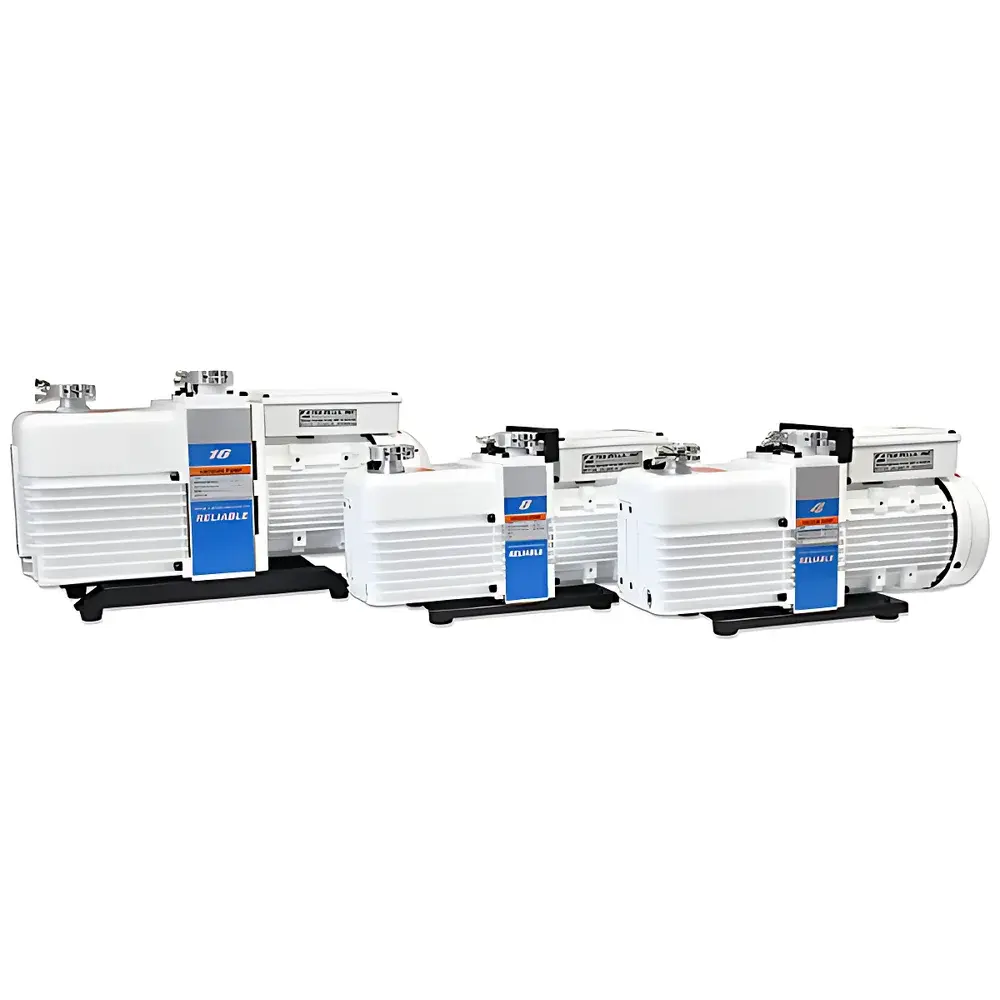
Ted Pella VRP Series Dual-Stage Rotary Vane Vacuum Pump
| Brand | Ted Pella |
|---|---|
| Origin | USA |
| Manufacturer Type | Authorized Distributor |
| Import Status | Imported |
| Model | VRP |
| Instrument Type | Rotary Vane Pump |
| Pumping Speed (m³/h) | 4.1 / 8.0 / 16.0 |
| Ultimate Pressure (mbar) | 5×10⁻⁴ / 5×10⁻⁴ / 4×10⁻⁴ |
| Inlet/Outlet Flange | KF16 / KF25 / KF25 |
| Vacuum Pump Oil | PELCO Ultra 19 |
| Oil Capacity (L) | 0.6–1.0 / 0.6–1.0 / 0.9–1.5 |
| Power Supply | Single-phase 230 V AC |
| Motor Power (kW) | 0.40 / 0.40 / 0.75 |
| Motor Speed (rpm) | 1440 |
| Ambient Operating Temperature (°C) | 5–40 |
| Noise Level (dB(A)) | <56 / <56 / <58 |
| Weight (kg) | 9 / 11 / 17 |
| Dimensions (L×W×H, mm) | 460×144×230 / 460×144×230 / 520×188×272 |
Overview
The Ted Pella VRP Series Dual-Stage Rotary Vane Vacuum Pump is an engineered solution for stable, continuous low-to-medium vacuum generation in demanding laboratory and pilot-scale applications. Based on the proven principles of positive displacement via rotating vanes within an eccentric stator chamber, the VRP series delivers consistent performance across its three standard configurations (VRP-4, VRP-8, VRP-16). Each model operates as a two-stage oil-sealed rotary vane pump, achieving ultimate pressures down to 4×10⁻⁴ mbar while maintaining high volumetric efficiency and long-term operational stability. The dual-stage architecture enables effective compression across a broad pressure range—from atmospheric down to high vacuum thresholds—making it particularly suitable as a forepump for high-vacuum systems such as turbomolecular pumps, diffusion pumps, and cryogenic vacuum systems.
Key Features
- Integrated dual-stage rotary vane design with precision-machined aluminum alloy housing for thermal stability and mechanical rigidity.
- Innovative oil circulation system ensuring uniform lubrication, reduced carbon buildup, and extended oil service life—critical for uninterrupted operation in analytical and coating workflows.
- Automatic anti-backstreaming valve prevents oil migration into vacuum chambers during pump shutdown, safeguarding sensitive samples and instrumentation (e.g., SEM specimen chambers or thin-film deposition chambers).
- Adjustable gas ballast valve (gas flow regulator) allows controlled admission of atmospheric gas to handle condensable vapors—essential when evacuating solvents in freeze-drying or vacuum drying processes.
- KF-standard flanged inlet and outlet ports (KF16 or KF25, depending on model) ensure rapid, leak-tight integration with common vacuum tubing, manifolds, and process chambers.
- Low-noise motor assembly (<58 dB(A)) and vibration-damped mounting facilitate placement in shared laboratory environments without compromising acoustic or mechanical integrity.
Sample Compatibility & Compliance
The VRP series is compatible with a wide range of vacuum-dependent sample preparation and analysis workflows—including electron microscopy specimen drying, sputter coating, plasma cleaning, vacuum desiccation, and solvent removal in lyophilization. Its oil-lubricated architecture requires use of specified high-purity mineral-based vacuum oils (PELCO Ultra 19), which meet ASTM D2889 specifications for oxidation resistance and vapor pressure performance. While not intrinsically rated for explosive or corrosive gas handling, the pump may be operated with appropriate cold traps or scrubbers when processing mildly aggressive vapors. All models comply with IEC 61000-6-3 (EMC emission standards) and IEC 61000-6-2 (immunity), and are CE-marked for use within the European Economic Area. Routine maintenance intervals and oil change protocols align with GLP-aligned laboratory documentation practices.
Software & Data Management
The VRP series operates as a standalone electromechanical device without embedded digital control or data logging capabilities. However, its robust analog interface supports seamless integration into automated vacuum systems via external pressure controllers (e.g., capacitance manometers or Pirani gauges) and programmable logic controllers (PLCs). When deployed in regulated environments—such as ISO 17025-accredited testing labs or GMP-compliant R&D facilities—the pump’s operational status (on/off, thermal cutoff activation) can be monitored through auxiliary dry-contact outputs. Full audit trails for maintenance history, oil replacement logs, and calibration records of connected gauges are maintained externally per FDA 21 CFR Part 11 requirements where applicable.
Applications
- Forepumping for turbomolecular and diffusion pump systems in surface science and UHV research.
- Vacuum drying and dehydration of biological specimens, polymers, and pharmaceutical intermediates.
- Sputter coating and electron beam evaporation in TEM/SEM sample preparation workflows.
- Plasma ashing and reactive ion etching (RIE) system support in microfabrication laboratories.
- Freeze-drying (lyophilization) of heat-sensitive biologics and diagnostic reagents.
- Gas evacuation in vacuum gloveboxes and inert-atmosphere synthesis reactors.
FAQ
What vacuum level can the VRP-16 achieve under optimal conditions?
The VRP-16 reaches a base pressure of ≤4×10⁻⁴ mbar when operated with clean PELCO Ultra 19 oil, at ambient temperature (23°C), and with all valves fully open and no load.
Is the VRP series suitable for pumping corrosive gases such as HCl or Cl₂?
No—standard VRP pumps are not chemically resistant. For such applications, Ted Pella recommends integrating a stainless-steel cold trap or using a dedicated corrosion-resistant dry pump upstream.
How often should the vacuum pump oil be changed?
Under continuous operation with non-condensable loads, oil replacement is recommended every 500 operating hours; for intermittent use with solvent-laden vapors, inspect oil clarity and viscosity every 100 hours and replace if discolored or emulsified.
Can the VRP pump be mounted vertically?
No—these units are designed exclusively for horizontal orientation to ensure proper oil distribution across rotor vanes and stator surfaces.
Does the VRP series include a built-in vacuum gauge?
No—pressure monitoring must be performed externally using a calibrated gauge connected to the inlet port or an integrated manifold.
Related Products



