
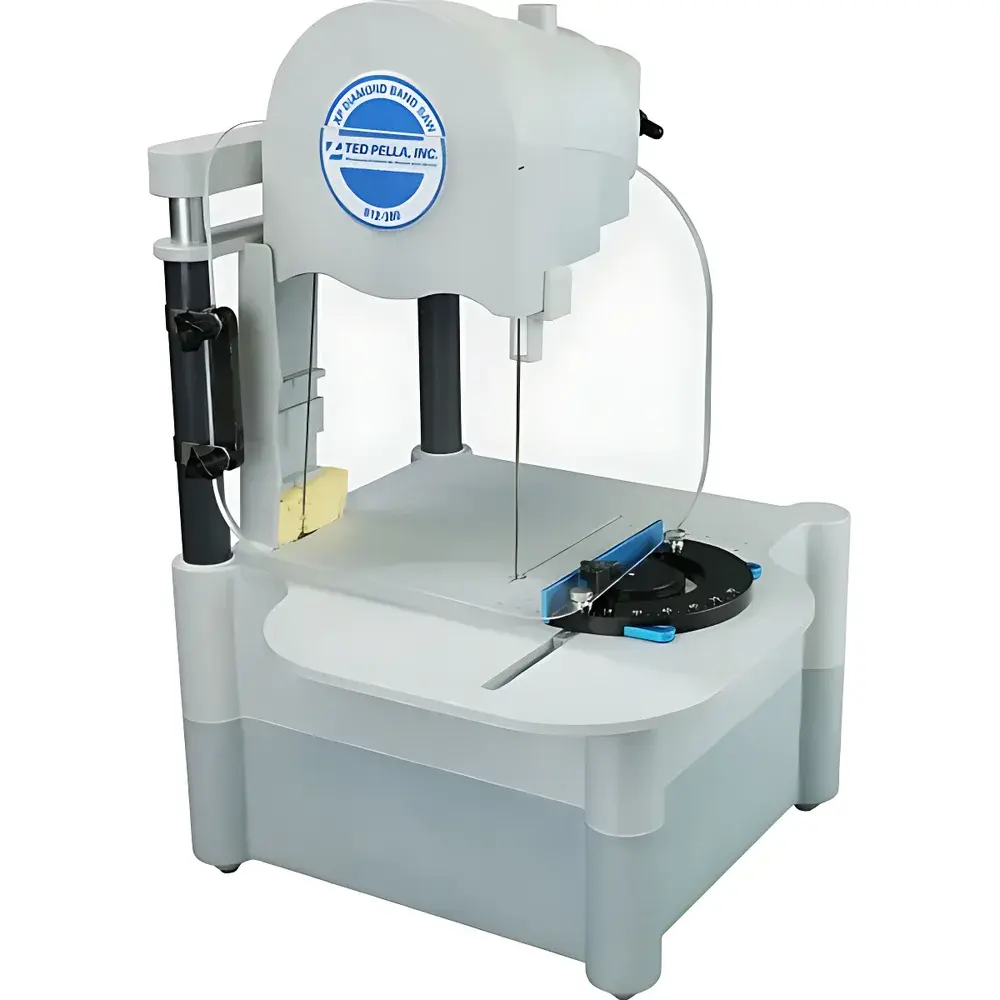
Ted Pella XP Diamond Band Saw
| Brand | Ted Pella |
|---|---|
| Origin | USA |
| Manufacturer Type | Authorized Distributor |
| Origin Category | Imported |
| Model | 812-381 |
| Instrument Type | Metallographic Cutting Machine |
| Drive System | Direct-Drive Motor |
| Worktable Dimensions | 12 × 13 in (300 × 330 mm) |
| Blade Type | Diamond-Coated Steel-Core Band Blade |
| Safety Feature | Shatter-Resistant Splash Guard |
| Cutting Guidance | Adjustable Miter Gauge for Linear and Angular Cuts |
| Coolant System | Integrated Water Reservoir (Water Only Recommended) |
| Blade Mounting | Tool-Free Quick-Release Mechanism |
Overview
The Ted Pella XP Diamond Band Saw (Model 812-381) is a precision-engineered metallographic cutting instrument designed for controlled sectioning of hard, brittle, and heterogeneous materials in research and quality control laboratories. Unlike abrasive cut-off saws or rotary diamond wheels, this band saw operates on a continuous-loop diamond-coated steel band blade, enabling low-stress, low-heat kerf generation through sustained linear motion—ideal for preserving microstructural integrity in sensitive specimens. Its direct-drive motor eliminates belt slippage and torque loss, delivering consistent rotational speed across variable load conditions. Engineered for benchtop deployment, the XP system prioritizes spatial efficiency without compromising mechanical rigidity, making it suitable for ISO/IEC 17025-accredited labs where footprint, repeatability, and operator safety are governed by documented SOPs.
Key Features
- Direct-Drive Motor Architecture: Eliminates timing belts and pulleys, reducing mechanical wear, vibration, and maintenance intervals while ensuring stable power transmission at rated RPM under load.
- Large-Dimension Worktable (300 × 330 mm): Accommodates oversized geological cores, semiconductor wafers, and multi-sample arrays—enabling batch processing without repositioning.
- Adjustable Miter Gauge System: Provides repeatable linear feed and angular alignment (0°–45°) with fine-scale vernier calibration, supporting ASTM E3-22 compliant specimen orientation for metallographic analysis.
- Shatter-Resistant Splash Guard: Constructed from impact-rated polycarbonate with integrated blade access port and coolant containment lip—meets ANSI Z9.2 and OSHA 1910.212 requirements for point-of-operation guarding.
- Diamond-Coated Band Blade: Electroplated diamond grit on high-tensile steel substrate ensures extended service life when cutting SiC, fused quartz, alumina ceramics, granite, and sintered tungsten carbide—without premature glazing or delamination.
- Tool-Free Blade Tensioning & Replacement: Lever-actuated tension mechanism and quick-release blade clamps allow full blade exchange in under 90 seconds—minimizing downtime during high-throughput sample prep workflows.
Sample Compatibility & Compliance
The XP Diamond Band Saw is validated for sectioning materials ranging from Vickers hardness HV 500 (e.g., annealed aluminum alloys) to HV 2500+ (e.g., single-crystal sapphire and borosilicate glass). It routinely processes geologic specimens per ASTM D3282 and ISO 14688-1 protocols, as well as electronic substrates aligned with JEDEC J-STD-020 moisture sensitivity level (MSL) handling guidelines. All structural components comply with RoHS Directive 2011/65/EU. The water-only coolant requirement supports GLP-compliant documentation trails—eliminating solvent disposal records and VOC exposure concerns required under EPA Method 8270D and EU REACH Annex XVII.
Software & Data Management
This is a manually operated, non-CNC instrument with no embedded firmware or digital interface. All operational parameters—including feed rate, cut depth, and miter angle—are set mechanically and recorded via lab notebook or LIMS-integrated worksheet templates. Calibration verification (e.g., miter gauge angular accuracy ±0.3°, table flatness ≤15 µm over 300 mm) is performed using NIST-traceable optical levels and surface plates. Audit-ready documentation aligns with FDA 21 CFR Part 11 principles when paired with electronic signature-capable LIMS platforms such as LabWare LIMS or Thermo Fisher SampleManager.
Applications
- Preparation of cross-sectional slices from fused silica capillaries and microfluidic glass chips for SEM-EDS elemental mapping.
- Sectioning of basalt, granite, and meteorite samples for thin-section petrography per ASTM D5777 standards.
- Trimming of sintered ceramic substrates (Al2O3, ZrO2) prior to HIP densification or thermal cycling validation.
- Controlled diameter reduction of silicon carbide (SiC) power device wafers for gate oxide integrity testing.
- Routine decapsulation of hermetically sealed TO-can packages in failure analysis labs—preserving bond wire geometry and die surface topography.
FAQ
What coolant is compatible with the XP Diamond Band Saw?
Only deionized or distilled water is approved for use. Oil-based, glycol, or alcohol-containing coolants may degrade the polycarbonate guard, compromise blade adhesion, and void the manufacturer’s warranty.
Is the blade pre-installed upon delivery?
No. One diamond band blade is included with shipment but requires user installation using the provided tensioning tool and alignment jig—full procedure detailed in Section 4.2 of the Operation Manual (P/N 812-381-OM Rev. C).
Can the XP saw be used for cutting soft metals like copper or brass?
Yes—when paired with appropriate feed pressure and water flow rate, it achieves clean, burr-free sections without work-hardening or plastic deformation, per ASTM E3-22 Annex A2 recommendations for non-ferrous alloys.
Does the unit meet electromagnetic compatibility (EMC) requirements for EU laboratories?
Yes. Certified to EN 61326-1:2013 for laboratory equipment emissions and immunity, with CE marking affixed to rear panel per Machinery Directive 2006/42/EC.
What is the recommended maintenance interval for the drive motor bearings?
Under normal operation (≤4 hrs/day), grease replenishment is required every 2,000 operating hours; service log entry templates are provided in Appendix B of the Maintenance Guide (P/N 812-381-MG Rev. A).



