
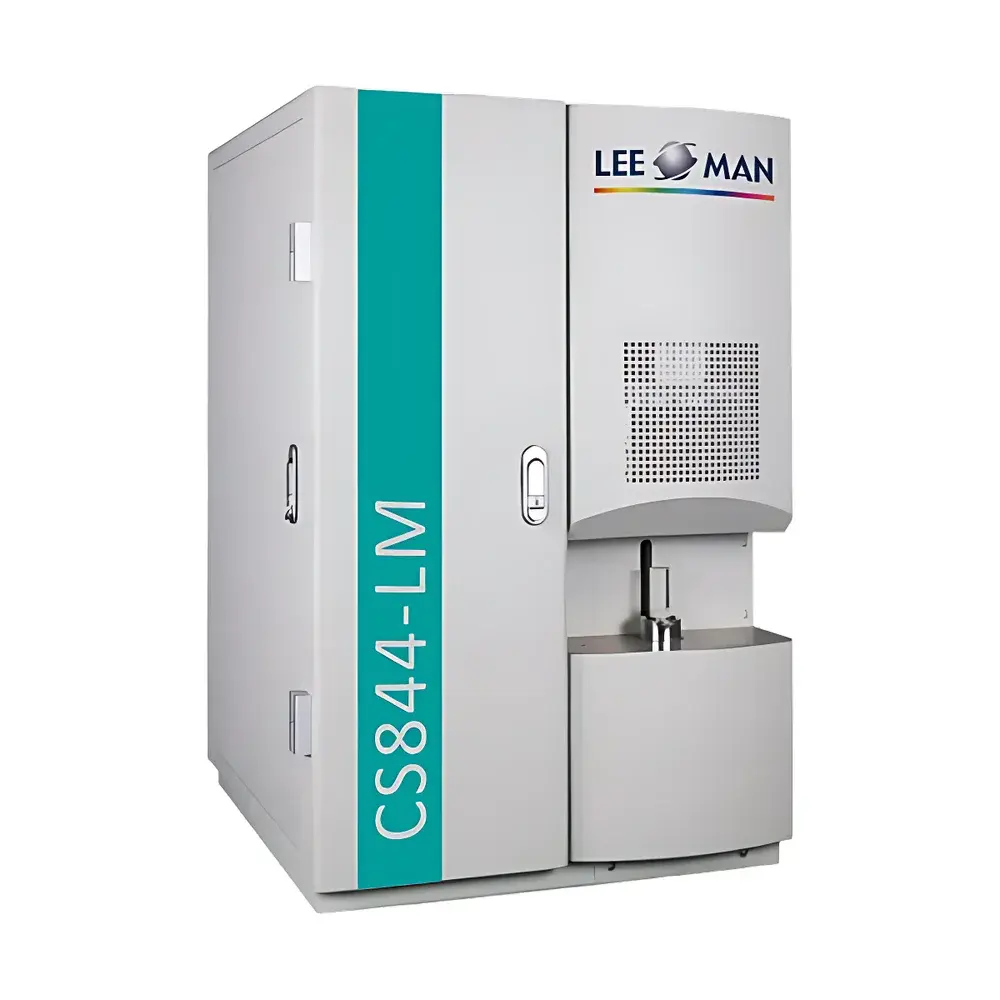
Teledyne Leeman Labs CS844-LM High-Frequency Infrared Carbon-Sulfur Analyzer
| Brand | Teledyne Leeman Labs |
|---|---|
| Origin | Beijing, China |
| Model | CS844-LM |
| Measurement Principle | Infrared Absorption Spectroscopy |
| Heating System | High-Frequency Induction Furnace |
| Carbon Range | 0.0001–6.0 wt% |
| Sulfur Range | 0.0001–3.5 wt% |
| Sensitivity | 0.000001 wt% |
| Precision | ±1 ppm |
| Analysis Time | 20–40 s |
| Furnace Output Power | 3.5 kW |
Overview
The Teledyne Leeman Labs CS844-LM is a high-performance, dual-channel infrared carbon-sulfur analyzer engineered for precise quantitative determination of total carbon (C) and total sulfur (S) in solid inorganic and metallic matrices. It operates on the fundamental principle of non-dispersive infrared (NDIR) absorption spectroscopy: combustion gases—CO2 and SO2—generated from sample oxidation are quantified by their characteristic infrared absorption bands at specific wavelengths (4.26 µm for CO2, 7.35 µm for SO2). The instrument employs a high-frequency induction furnace (3.5 kW output) to achieve rapid, complete combustion under controlled oxygen-rich atmosphere, ensuring stoichiometric conversion of C to CO2 and S to SO2. A catalytic conversion stage (CuO-based) further oxidizes residual CO and SO2 to CO2 and SO3, with SO3 removed via cold trapping prior to final CO2 measurement—eliminating spectral interference and enabling independent, high-fidelity quantification of both elements in a single run.
Key Features
- High-frequency induction furnace with ceramic crucible holder and integrated furnace-head temperature stabilization—enabling immediate analysis without warm-up delay and minimizing thermal drift.
- Dual NDIR detectors with digitally stabilized optical path and frequency-tuned light source—no stepper motor dependency, delivering superior signal-to-noise ratio and long-term baseline stability.
- Electropneumatic gas control system featuring mass flow controllers (MFCs), real-time pressure compensation, and fail-safe O2 supply monitoring—ensuring reproducible carrier gas flow and combustion efficiency across diverse sample types.
- On-board gas standard calibration module supporting span calibration with certified CO2/SO2 gas mixtures—reducing reliance on solid reference materials and improving traceability per ISO/IEC 17025 requirements.
- Programmable furnace temperature ramping profiles with up to 5-stage thermal protocols—optimized for refractory alloys, low-conductivity ceramics, or volatile-rich coal and coke samples.
- Full-range multivariate non-linear calibration algorithm—applies a single continuous polynomial fit across the entire dynamic range (0.0001–6.0% C; 0.0001–3.5% S), eliminating segmentation artifacts and interpolation errors inherent in segmented linear models.
Sample Compatibility & Compliance
The CS844-LM accommodates a broad spectrum of solid, non-volatile, and thermally stable samples—including ferrous and non-ferrous metals, superalloys, rare-earth metals, geological ores, metallurgical slags, cementitious materials, refractory ceramics, and carbonaceous fuels (e.g., coal, coke, limestone). Sample mass ranges from 0.1 to 1.0 g, loaded into high-purity ceramic crucibles. The system complies with ASTM E1019 (Standard Test Methods for Determination of Carbon, Sulfur, Nitrogen, and Oxygen in Steel, Iron, Nickel, and Cobalt Alloys), ISO 15350 (Steel and iron — Determination of total carbon and sulfur content — Infrared absorption method after combustion in an induction furnace), and supports audit-ready data integrity per FDA 21 CFR Part 11 when paired with validated LIMS-integrated software.
Software & Data Management
Instrument operation, method development, calibration management, and report generation are handled through Leeman Analytical Suite (LAS) v4.x—a Windows-based application compliant with GLP/GMP workflows. LAS provides electronic signature support, full audit trail (user actions, parameter changes, calibration events), automated QC flagging (e.g., drift >2σ, peak asymmetry >15%), and export to CSV, PDF, or XML formats compatible with enterprise LIMS platforms. All raw detector voltage traces, gas flow logs, and furnace temperature profiles are archived with timestamped metadata—ensuring full analytical traceability for regulatory review.
Applications
The CS844-LM serves as a primary elemental verification tool in quality control laboratories across aerospace (turbine blade alloy certification), nuclear fuel fabrication (UO2/Zr-alloy impurity screening), defense metallurgy (armor-grade steel C/S specification compliance), cement manufacturing (clinker carbonation control), and academic research (catalyst support characterization, geochemical provenance studies). Its sub-ppm sensitivity and robustness against matrix effects make it particularly suitable for low-carbon stainless steels, ultra-low-sulfur pipeline steels, and rare-earth permanent magnet materials where interstitial C/S levels directly impact magnetic coercivity and corrosion resistance.
FAQ
What sample preparation is required prior to analysis?
Solid samples must be homogenized, dried (if hygroscopic), and weighed to ±0.0001 g accuracy. No acid digestion or solvent extraction is needed—direct solid-state combustion is performed.
Can the CS844-LM analyze liquid or powder suspensions?
No. It is designed exclusively for solid, non-volatile, and combustion-stable specimens. Liquids, oils, or volatile organics require prior ashing or solid-phase conversion.
How often does the instrument require recalibration?
Calibration frequency depends on usage intensity and regulatory requirements; typical intervals range from daily (high-throughput QC labs) to weekly (R&D environments), always verified using certified reference materials traceable to NIST or BAM standards.
Is the system compatible with hazardous gas exhaust protocols?
Yes. The exhaust stream contains only O2, CO2, and inert carrier gas—no CO, SO, or unoxidized hydrocarbons—allowing direct venting to standard laboratory fume hoods or centralized exhaust systems.
Does the analyzer support remote diagnostics and firmware updates?
Yes. Via secure TLS-encrypted Ethernet connection, authorized service engineers can perform real-time performance diagnostics, log file retrieval, and validated firmware upgrades without onsite intervention.






