
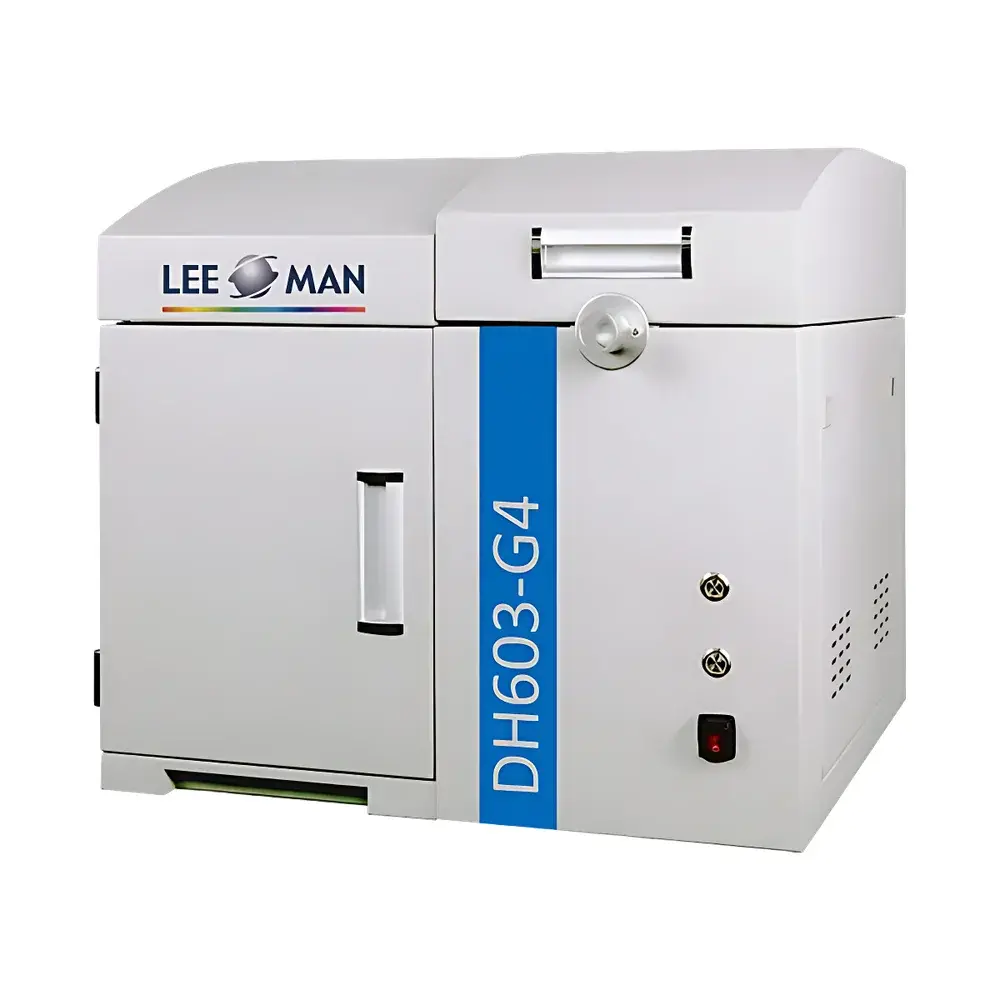
Teledyne Leeman Labs DH603-G4 Diffusion Hydrogen Analyzer
| Brand | Teledyne Leeman Labs |
|---|---|
| Origin | Beijing, China |
| Manufacturer Type | Authorized Distributor |
| Product Category | Domestic |
| Model | DH603-G4 |
| Instrument Type | Diffusion Hydrogen Analyzer |
| Analysis Range | 0.05–3000 mL/100g |
| Analytical Precision | 0.001 mL/100g |
| Sensitivity | ±1% |
| Analysis Time | 3–10 min |
Overview
The Teledyne Leeman Labs DH603-G4 Diffusion Hydrogen Analyzer is a dedicated thermal extraction instrument engineered for quantitative determination of diffusible hydrogen in metallic materials—primarily ferrous alloys including structural steels, pipeline steels, pressure vessel grades, and weld metal deposits. It operates on the principle of inert-gas thermal desorption: solid samples are heated under high-purity argon or nitrogen flow in a precisely controlled infrared furnace, causing trapped atomic hydrogen to recombine into molecular hydrogen (H2) and evolve from the lattice. The liberated H2 is swept through a calibrated gas stream to a high-stability detection system, where concentration is measured in real time. This method conforms to the fundamental physical basis of hydrogen mobility in metals and enables direct correlation between measured H2 volume and diffusible hydrogen content expressed as mL H2/100 g sample—a standardized metric used across metallurgical quality assurance, failure analysis, and welding procedure qualification.
Key Features
- Infrared heating furnace with rapid ramp rates (up to 100 °C/s), stable isothermal control (±0.5 °C), and forced-air cooling for cycle times under 10 minutes;
- Large-diameter quartz reaction tube (Ø30 mm) accommodating specimens up to 200 g—enhancing statistical representativeness and minimizing weighing uncertainty;
- Programmable temperature profiling with non-continuous heating modes, supporting multi-step thermal desorption protocols (e.g., isothermal hold + ramp sequences);
- Configurable detection options: high-sensitivity thermal conductivity detector (TCD) or dual-beam infrared H2-specific detector with background compensation;
- Integrated pneumatic architecture featuring solenoid valves, mass flow controllers (MFCs), and real-time pressure regulation to ensure consistent carrier gas velocity and extraction efficiency;
- Real-time thermal desorption rate analysis: dynamic plotting of d[H2]/dT vs. temperature, enabling kinetic deconvolution of hydrogen trapping states (e.g., lattice vs. dislocation vs. precipitate-bound H);
- Onboard automatic gas calibration using certified H2 or He standards—traceable to NIST-certified reference gases and compliant with ISO/IEC 17025 calibration traceability requirements.
Sample Compatibility & Compliance
The DH603-G4 accepts solid metallic specimens in as-received, machined, or fractured form—including weld beads, heat-affected zones (HAZ), clad layers, and bulk castings. No acid dissolution or chemical pretreatment is required. Its design supports compliance with internationally recognized test standards including ISO 3690 (Welding — Determination of hydrogen in weld metal), AWS A4.3 (Standard Test Methods for Determining the Hydrogen Content of Weld Metal), and GB/T 3965–2012 (Determination of diffusible hydrogen in weld metal). All measurement workflows adhere to GLP principles, with full audit trail logging for instrument parameters, calibration events, and raw signal acquisition—supporting 21 CFR Part 11 readiness when paired with validated LIMS integration.
Software & Data Management
Control and data acquisition are managed via Leeman Analytical Suite v4.x, a Windows-based application providing intuitive method setup, live spectral visualization, and post-run kinetic modeling tools. Each analysis generates timestamped, digitally signed result files (.dxr) containing raw chromatographic traces, integrated peak areas, temperature profiles, and calculated diffusion hydrogen values. Export formats include CSV, PDF reports (with customizable templates), and ASTM E1447-compliant XML for enterprise-level QA/QC systems. Audit logs record operator ID, method version, calibration history, and any parameter overrides—ensuring full data integrity and regulatory defensibility.
Applications
- Hydrogen-induced cracking (HIC) and sulfide stress cracking (SSC) risk assessment in sour service pipelines and offshore structures;
- Weld procedure specification (WPS) validation per ASME Section IX and API RP 582;
- Development and qualification of low-hydrogen consumables (e.g., basic electrodes, flux-cored wires);
- Metallurgical research on hydrogen trapping mechanisms in advanced high-strength steels (AHSS), martensitic stainless steels, and nickel-based superalloys;
- Failure analysis of brittle fractures in aerospace components, naval hull plates, and pressure equipment;
- Educational use in university metallurgy and materials science laboratories for hands-on study of hydrogen embrittlement kinetics.
FAQ
What sample preparation is required prior to analysis?
Minimal preparation is needed: samples must be clean, dry, and free of surface oxides or coatings. Machining to remove scale or mill scale is recommended. No acid etching or vacuum baking is necessary.
Can the DH603-G4 quantify total hydrogen, or only diffusible hydrogen?
The DH603-G4 measures only diffusible (mobile) hydrogen—defined as hydrogen atoms capable of migrating interstitially at ambient temperature. Total hydrogen requires higher-temperature fusion extraction (e.g., inert gas fusion analyzers) and is outside its operational scope.
Is the system compatible with automated sample changers?
Yes—optional XYZ robotic autosampler integration is available for unattended batch processing of up to 24 samples, with barcode-driven method assignment and QC flagging.
How is system performance verified between calibrations?
Daily verification uses certified hydrogen-in-argon standard gas (e.g., 100 ppm H2/Ar) to confirm detector linearity, baseline stability, and gas flow accuracy—documented in the electronic logbook.
Does the software support multi-user permissions and electronic signatures?
Yes—role-based access control (RBAC) enforces separation of duties; electronic signatures comply with FDA 21 CFR Part 11 when configured with time-stamped, non-editable audit trails and secure user authentication.
Related Products





