
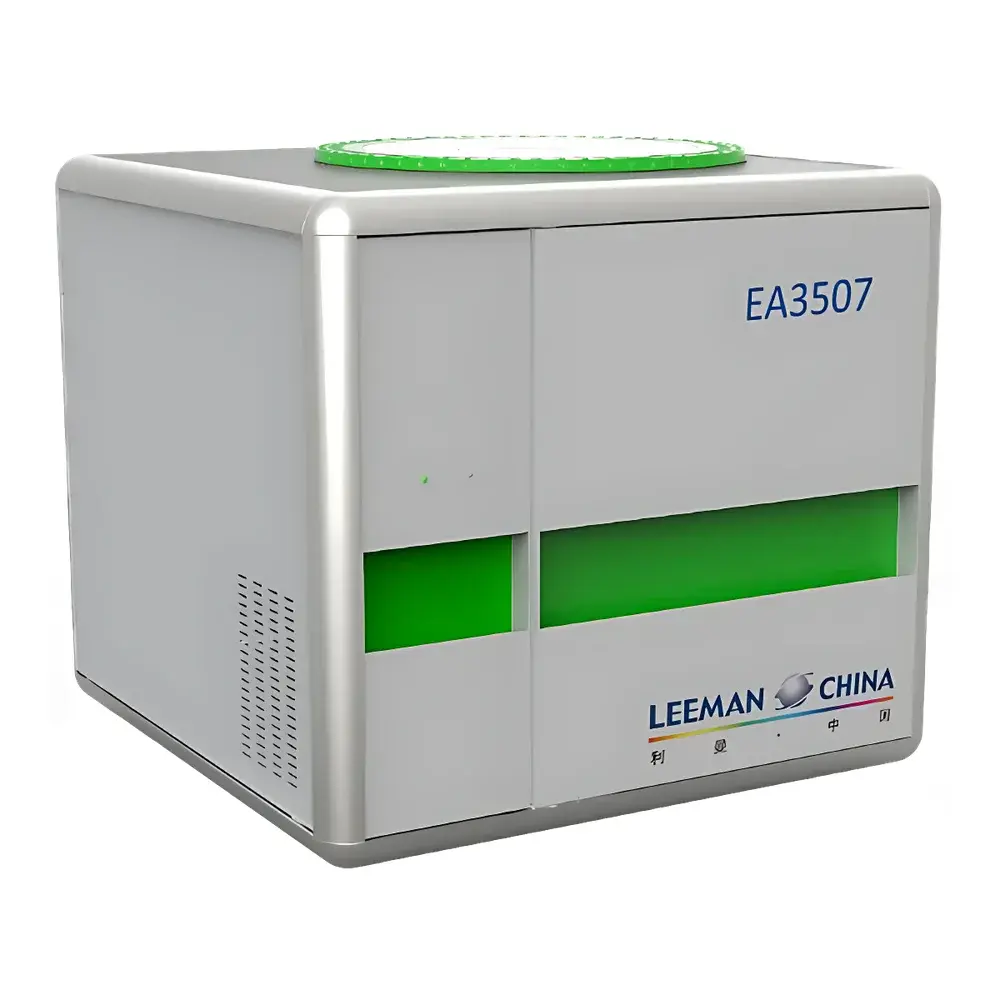
Teledyne Leeman Labs EA3507 Dumas Combustion Nitrogen Determinator
| Brand | Teledyne Leeman Labs |
|---|---|
| Origin | Beijing, China |
| Instrument Type | Dumas Combustion Method |
| Automation Level | Fully Automated |
| Model | EA3507 |
| Compliance | ASTM D515, ISO 14891, AOAC 992.15, EN ISO 16634-1:2021 |
| Detection Principle | Thermal Conductivity Detection (TCD) of N₂ after catalytic combustion and reduction |
| Sample Form | Solid or liquid |
| Typical Analysis Time | < 5 min per sample |
| Nitrogen Range | 0.01–100 mg N |
| Precision | RSD ≤ 0.5% (n = 10, 10 mg N standard) |
Overview
The Teledyne Leeman Labs EA3507 Dumas Combustion Nitrogen Determinator is a fully automated elemental analyzer engineered for rapid, accurate, and reagent-free quantification of total nitrogen—and by extension, protein content—in diverse organic matrices. Based on the Dumas combustion principle, the instrument thermally oxidizes samples in a high-purity oxygen atmosphere at temperatures up to 1,100 °C, followed by catalytic reduction of all nitrogen oxides to molecular nitrogen (N₂). The resulting N₂ gas is separated from CO₂, H₂O, and other combustion byproducts via selective gas purification and quantified using a high-stability thermal conductivity detector (TCD). This method eliminates the need for concentrated sulfuric acid, sodium hydroxide, or toxic catalysts—offering a safer, greener, and significantly faster alternative to Kjeldahl digestion. Designed for routine operation in regulated and high-throughput environments, the EA3507 meets core performance requirements outlined in ASTM D515, ISO 14891, AOAC Official Method 992.15, and EN ISO 16634-1:2021 for food, feed, agricultural, and environmental testing.
Key Features
- Pure oxygen delivery directly to the sample surface, enabling complete oxidation in a two-stage combustion zone (oxidation + reduction) for quantitative nitrogen recovery across heterogeneous matrices.
- Triple-stage water removal system incorporating chemical scrubbers and a visual color-indicating desiccant, ensuring consistent TCD baseline stability and eliminating moisture-related signal drift.
- Dual mass flow controllers (MFCs) independently regulating oxygen and helium carrier gas—providing ±0.5% flow accuracy, real-time monitoring, and optimized gas consumption without manual calibration.
- Integrated electronic leak detection with pressure decay analysis and automatic fault logging; identifies micro-leaks (< 1 × 10⁻⁷ mbar·L/s) during standby and analysis cycles.
- Intelligent shutdown protocol that sequentially terminates gas supply, cools furnace zones to safe temperature thresholds, and powers down detectors—enabling unattended overnight operation while maintaining system integrity and safety compliance.
Sample Compatibility & Compliance
The EA3507 accommodates solid samples (0.1–500 mg) and liquid samples (1–100 µL) encapsulated in tin or aluminum boats. It delivers reliable nitrogen results in complex, high-fat, high-fiber, or high-salt matrices—including cereal grains, oilseeds, dairy powders, meat homogenates, fermented broths, soil extracts, urea-based antifreeze solutions, and industrial fertilizers. All hardware and firmware components are designed to support GLP/GMP-aligned workflows: audit-trail-enabled software logs user actions, method parameters, calibration history, and raw chromatograms; data export complies with FDA 21 CFR Part 11 requirements when paired with validated LIMS integration. Routine verification includes certified reference materials (CRMs) traceable to NIST SRM 1547 (Peach Leaves) and BCR-65 (Wheat Flour).
Software & Data Management
The EA3507 operates under Leeman ElementSuite™ v4.x—a Windows-based platform supporting method creation, sequence scheduling, real-time signal visualization, peak integration, and automated protein conversion (using species-specific nitrogen-to-protein factors: 6.25, 5.70, 6.38, etc.). Data files are stored in vendor-neutral .csv and .xml formats; raw TCD voltage traces retain full temporal resolution (10 Hz sampling). Software supports multi-user role assignment (Administrator, Analyst, Reviewer), electronic signatures, and configurable report templates compliant with ISO/IEC 17025 documentation standards. Optional add-ons include remote diagnostics, predictive maintenance alerts, and integration with Thermo Fisher SampleManager LIMS or LabVantage.
Applications
- Food & Feed Quality Control: Rapid validation of crude protein in soybean meal, fishmeal, pet food, and infant formula per AOAC and Codex Alimentarius protocols.
- Agricultural Testing: Quantitative nitrogen profiling in compost, manure, biochar, and mineral fertilizers to support nutrient management planning.
- Regulatory Compliance: Screening of adulteration (e.g., melamine spiking) in dairy products and plant-based proteins through nitrogen mass balance deviation analysis.
- Environmental Monitoring: Total Kjeldahl Nitrogen (TKN)-equivalent determination in wastewater sludge and sediment without acid digestion hazards.
- Research Laboratories: High-throughput screening of nitrogen fixation efficiency in legume rhizobia studies or metabolic nitrogen flux in bioreactor cultures.
FAQ
What sample preparation is required prior to analysis?
Minimal preparation: solids are ground to ≤ 0.5 mm particle size and homogenized; liquids are mixed thoroughly and loaded directly into sample boats. No acid digestion, catalyst addition, or distillation is needed.
Can the EA3507 analyze volatile or low-boiling nitrogen compounds?
Yes—the sealed combustion tube and rapid oxygen flush prevent volatilization loss; compounds such as ammonium carbonate, urea, and nitrate salts are fully recovered as N₂ under optimized temperature ramp profiles.
Is method validation support available for regulatory submissions?
Yes—Leeman provides IQ/OQ documentation packages, system suitability test protocols, and application notes aligned with ICH Q2(R2) guidelines for method verification in pharmaceutical excipient and dietary supplement testing.
How often must the combustion catalyst be replaced?
Under normal operation (≤ 50 samples/day), the dual-bed catalyst (CuO + Cr₂O₃) maintains activity for ≥ 10,000 analyses; onboard catalyst health monitoring triggers alerts when conversion efficiency drops below 99.5%.
Does the instrument support isotopic nitrogen (¹⁵N) analysis?
No—the EA3507 is configured for total nitrogen quantification only. Isotopic ratio measurement requires coupling to an isotope-ratio mass spectrometer (IRMS), which is outside its design scope.





