
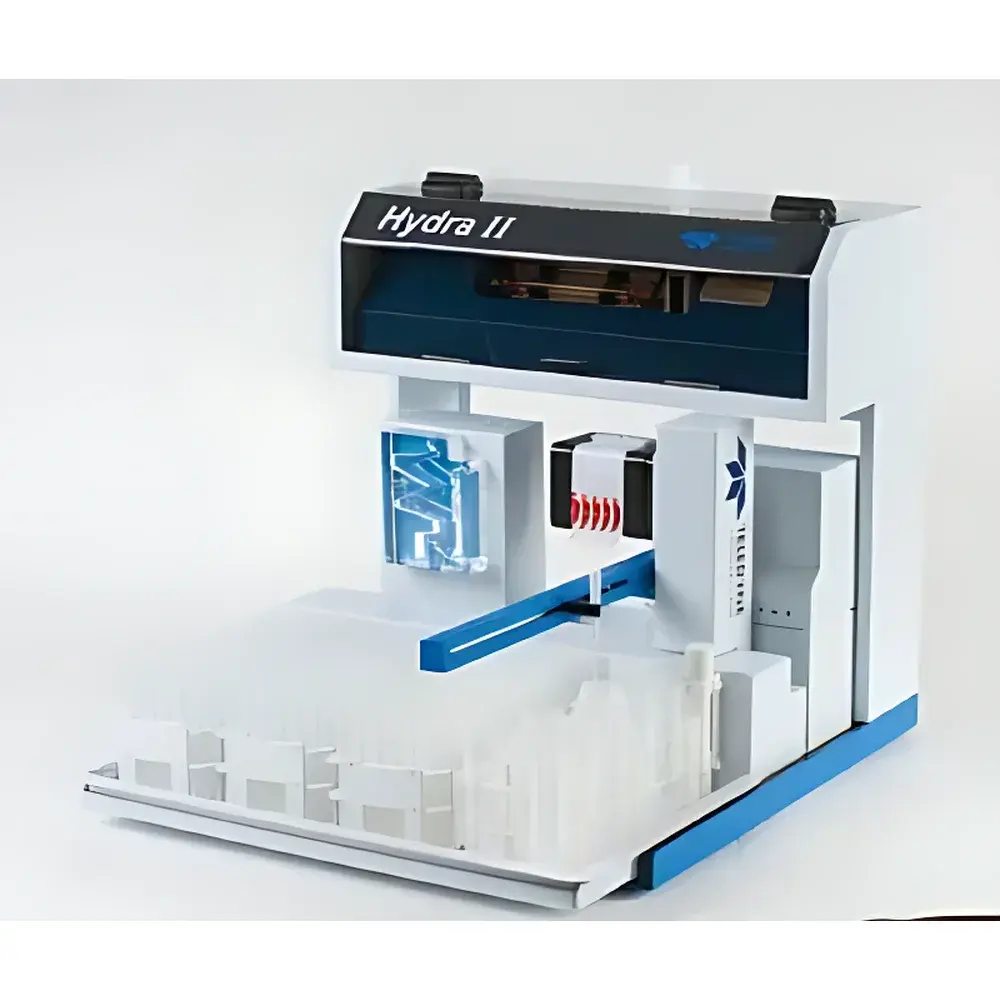
Teledyne Leeman Labs Hydra II AA Mercury Analyzer
| Brand | Teledyne Leeman Labs |
|---|---|
| Origin | Imported |
| Model | Hydra II AA |
| Instrument Type | Benchtop Laboratory Analyzer |
| Measurement Principle | Cold Vapor Atomic Absorption Spectrometry (CVAAS) |
| Compliance | EPA Methods 245.1, 245.5, 245.6, 7470A, 7471B |
Overview
The Teledyne Leeman Labs Hydra II AA Mercury Analyzer is a fifth-generation benchtop atomic absorption spectrometer engineered exclusively for trace and ultra-trace mercury quantification in environmental, clinical, food safety, and industrial compliance laboratories. It employs Cold Vapor Atomic Absorption Spectrometry (CVAAS), a reference-grade technique standardized by regulatory bodies worldwide for its high specificity, low detection limits, and robust matrix tolerance. In CVAAS, mercury is chemically reduced to elemental vapor (Hg⁰) in solution or after thermal decomposition of solid matrices, then swept into a quartz absorption cell where it absorbs light at 253.7 nm. The Hydra II AA integrates optimized vapor generation, dual-beam optical compensation, and intelligent sample handling to deliver sub-part-per-trillion (sub-pg/mL) detection capability with exceptional reproducibility across liquid, digested solid, and semi-solid samples.
Key Features
- Modular sample introduction architecture supporting seamless switching between aqueous, acid-digested solid, and slurry analysis modes without hardware reconfiguration.
- Dual-beam optical path design with real-time reference beam correction, minimizing baseline drift caused by lamp instability, ambient temperature fluctuations, or optical component aging.
- Dedicated high-mercury protection system that automatically diverts and traps excess mercury vapor prior to the absorption cell—preventing optical surface contamination and extending cell lifetime beyond 10,000 analyses.
- Proprietary long-life desiccant drying tube with integrated moisture sensor feedback, reducing maintenance frequency and eliminating manual regeneration cycles typical of conventional systems.
- Integrated pneumatic sample introduction with programmable rinse, purge, and calibration sequence control—ensuring carryover < 0.1% and inter-sample memory effects below method detection limit (MDL).
- Robust mechanical platform compliant with IEC 61000-4 electromagnetic immunity standards and designed for continuous operation in ISO/IEC 17025-accredited laboratories.
Sample Compatibility & Compliance
The Hydra II AA accommodates diverse sample types—including water, soil, sediment, biological tissue (fish, hair, blood), coal, fly ash, pharmaceutical excipients, and food matrices—following standardized digestion protocols (e.g., EPA 3050B, 3051A, 3052). Its analytical performance meets or exceeds requirements of major international regulatory frameworks: EPA Methods 245.1 (water), 245.5 (soil/sediment), 245.6 (biological tissue), 7470A (total mercury), and 7471B (methylmercury after derivatization); EN 1483 (water) and EN 13806 (food); ISO 12846 (water and wastewater); as well as Chinese national standards HJ 543–2009 (exhaust gas), HJ 597–2011 (water), and GB 5009.17–2014 (food safety). All methods are preloaded in software with audit-trail-enabled execution logs aligned with FDA 21 CFR Part 11 and GLP/GMP data integrity requirements.
Software & Data Management
Control and data acquisition are managed via HydraSoft v5.x—a validated, Windows-based application supporting full instrument automation, method sequencing, QC tracking (blanks, spikes, duplicates, CRM verification), and customizable reporting. The software includes electronic signature support, user role-based access control (RBAC), and immutable audit trails compliant with ISO/IEC 17025 Clause 7.7 and ALCOA+ principles. Raw absorbance data, peak integration parameters, and calibration history are stored in encrypted SQLite databases with optional export to LIMS via ASTM E1384-compliant XML or CSV formats. Remote diagnostics and firmware updates are supported over secure TLS 1.2 connections.
Applications
The Hydra II AA serves as a primary measurement tool in environmental monitoring labs performing wastewater discharge compliance (e.g., NPDES permits), landfill leachate screening, and sediment toxicity assessment. In food safety programs, it supports routine testing of fish fillets, rice, infant formula, and dietary supplements per FDA’s Total Diet Study and EFSA’s CONTAM Panel guidance. Clinical toxicology labs use it for occupational exposure assessment (e.g., dental amalgam workers) and biomonitoring studies. Industrial QA/QC applications include catalyst residue analysis in petrochemical refining and mercury speciation validation in chlorine-alkali production facilities.
FAQ
What sample preparation methods are recommended for solid matrices?
EPA 3052 microwave-assisted acid digestion using HNO₃/HCl/HF mixtures is the default protocol; alternative closed-vessel digestions per ISO 12846 Annex B are also validated.
Does the system support methylmercury analysis?
Yes—when coupled with EPA 1630/1631 derivatization and GC separation, the Hydra II AA can quantify methylmercury after ethylation and cold vapor generation.
Is the instrument compliant with 21 CFR Part 11 for electronic records?
Yes—HydraSoft v5.x includes full Part 11 functionality: electronic signatures, audit trail review, and secure user authentication.
What is the typical detection limit for aqueous samples?
Method detection limit (MDL) is 0.003 ng/mL (3 pg/mL) for direct aqueous injection under EPA 245.1 conditions, verified per 40 CFR Part 136.
Can the system be integrated into an existing LIMS environment?
Yes—via configurable ODBC drivers and ASTM E1384-compliant data export modules supporting automated result transfer and status synchronization.





