
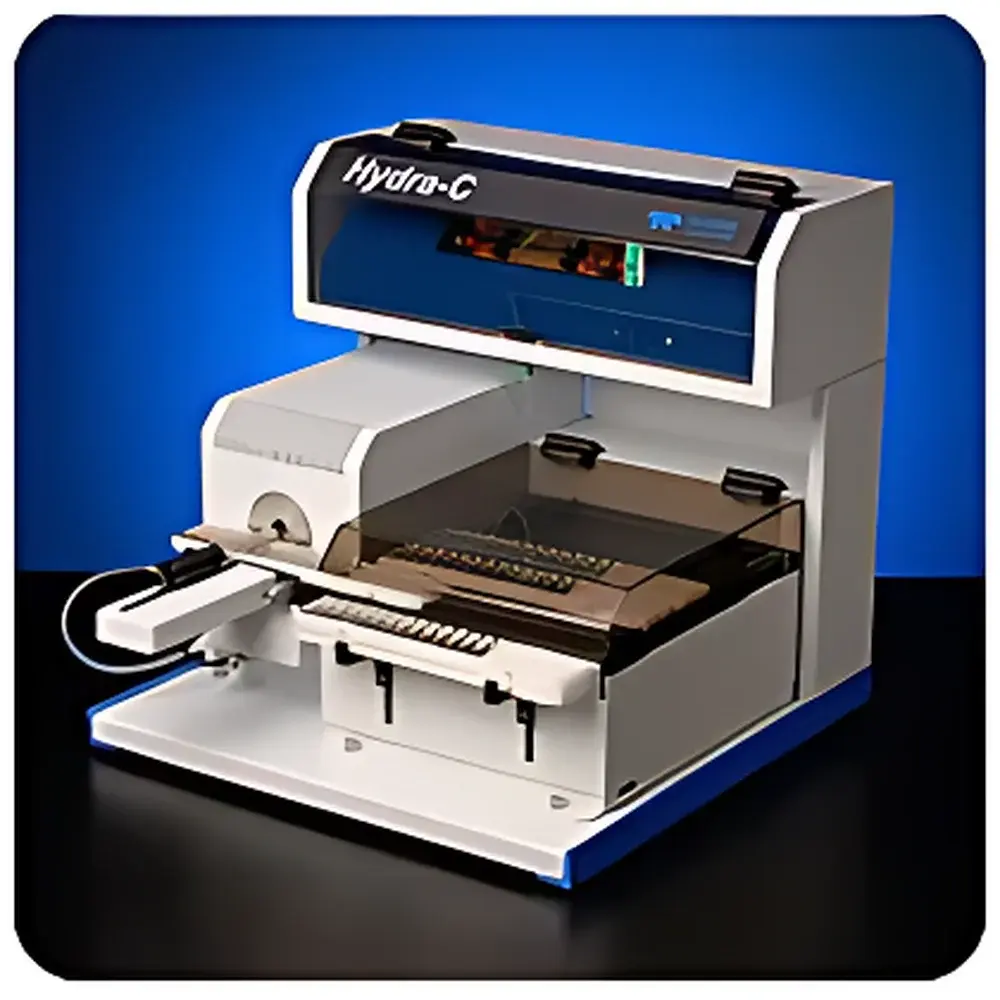
Teledyne Leeman Labs Hydra II C Automated Mercury Analyzer
| Brand | Teledyne Leeman Labs |
|---|---|
| Origin | Imported |
| Model | Hydra II C |
| Instrument Type | Benchtop Laboratory Analyzer |
| Measurement Principle | Cold Vapor Atomic Absorption Spectrometry (CVAAS) |
| Compliance | EPA Method 7473, SN/T 3511–2013, HJ 910–2017, HJ 917–2017, HJ 923–2017, Cosmetics Safety Technical Specifications (2015 Edition) |
| Sample Introduction | Direct Solid/Liquid Injection Without Prior Digestion |
| Optical Design | Dual-Beam, Dual-Cell Configuration with Real-Time Baseline Monitoring |
| Moisture Management | Integrated Desiccant Drying Tube |
| Operational Readiness | Ambient-Temperature Operation, No Preheating Required |
Overview
The Teledyne Leeman Labs Hydra II C Automated Mercury Analyzer is a benchtop cold vapor atomic absorption spectrometer engineered for trace-level mercury quantification in solid, liquid, and gaseous matrices without acid digestion or chemical reduction pretreatment. Based on the well-established principle of cold vapor atomic absorption spectrometry (CVAAS), the instrument thermally decomposes samples in a controlled quartz furnace, reduces liberated mercury species to elemental Hg⁰ vapor via catalytic hydrogenation, and transports the vapor into a dual-beam optical cell where absorbance at 253.65 nm is measured against a stable reference beam. This architecture eliminates matrix-induced baseline drift and enables high reproducibility across heterogeneous sample types—critical for regulatory compliance in environmental monitoring, food safety, clinical toxicology, and materials certification.
Key Features
- Direct solid/liquid injection capability: Enables analysis of soils, sediments, biological tissues, cosmetics, fuels, and aqueous standards without microwave digestion, hydride generation, or wet chemistry steps.
- Dual-beam, dual-optical-cell design: Continuously monitors and corrects for lamp intensity fluctuations and optical path variations, ensuring long-term baseline stability and measurement robustness over extended run sequences.
- Integrated desiccant drying tube: Removes water vapor prior to atomic absorption detection, eliminating spectral interference from OH bands and condensation artifacts—no external cooling traps or temperature-controlled gas lines required.
- Ambient-temperature operation: The system achieves operational readiness within 15 minutes of power-on; no furnace preheat cycles or optical alignment procedures are necessary before analysis.
- Modular thermal decomposition module: Configurable catalyst beds and optimized carrier gas flow profiles support method adaptation for volatile organomercurials, inorganic salts, and refractory-bound mercury species.
Sample Compatibility & Compliance
The Hydra II C accommodates sample masses ranging from 0.01 g (high-sensitivity solids) to 2.0 mL (aqueous standards), with programmable pyrolysis ramps up to 950 °C. It meets the performance criteria defined in U.S. EPA Method 7473 for total mercury determination in solids and liquids, and is validated for use under Chinese national standards including SN/T 3511–2013 (direct solid sampling for mineral mercury), HJ 923–2017 (soil and sediment analysis), HJ 910–2017 (ambient air gaseous mercury via gold film preconcentration), and HJ 917–2017 (stack emission monitoring using activated carbon trapping). Its design supports GLP-compliant workflows through hardware-based audit trails, user-access-level controls, and electronic signature-ready data logging per FDA 21 CFR Part 11 requirements when integrated with compliant LIMS environments.
Software & Data Management
Instrument control, method development, calibration management, and report generation are handled via the HydraControl™ software suite—a Windows-based application supporting ISO/IEC 17025-aligned validation protocols. Calibration curves accommodate linear, quadratic, and weighted least-squares regression models with forced-zero intercept options. All raw absorbance signals, furnace temperature profiles, carrier gas pressure logs, and diagnostic flags are timestamped and stored in vendor-neutral .CSV and .XML formats. Software modules include automated QC check routines (e.g., bracketing standard verification, duplicate spike recovery tracking), customizable pass/fail criteria per analyte, and export templates aligned with CNAS and CMA reporting frameworks.
Applications
The Hydra II C serves as a primary measurement platform in accredited environmental testing laboratories conducting soil and sediment surveys under China’s GB 15618–2018; in customs inspection agencies performing rapid screening of imported cosmetics per the 2015 Cosmetics Safety Technical Specifications; in coal-fired power plant stack testing per HJ 917–2017; and in university research labs investigating mercury speciation kinetics in anaerobic digesters or sediment porewater systems. Its direct injection capability significantly reduces labor cost and contamination risk compared to traditional wet-digestion–based ICP-MS or CV-AFS approaches—particularly valuable in high-throughput QA/QC settings requiring >50 samples per day.
FAQ
Does the Hydra II C require routine lamp alignment or optical recalibration?
No. The dual-beam architecture and factory-aligned quartz optical path eliminate user-performed alignment; only annual intensity verification using NIST-traceable mercury standards is recommended.
Can the system analyze mercury in high-salt or high-fat matrices such as fish tissue or crude oil?
Yes—method optimization with oxygen-enriched carrier gas and modified catalyst composition has been documented for such matrices in peer-reviewed validation studies (e.g., J. Anal. At. Spectrom., 2021, 36, 1422–1431).
Is method transfer supported between Hydra II C units across different laboratories?
Yes. Firmware version consistency, standardized calibration kits, and shared HydraControl™ method templates ensure inter-laboratory comparability when operated under identical gas flow, temperature, and purge parameters.
What maintenance intervals are specified for the drying tube and catalyst cartridge?
The desiccant tube requires replacement after 200–300 analyses depending on sample moisture content; the catalyst cartridge is rated for ≥1,000 runs under typical environmental soil analysis conditions.
How does the instrument handle memory effects from ultra-trace mercury standards?
Automated high-purity argon purge cycles between injections, combined with a heated gold-coated quartz trap, reduce carryover to <0.5% for 10 ng Hg injections—verified per EPA 7473 Section 8.5.





