
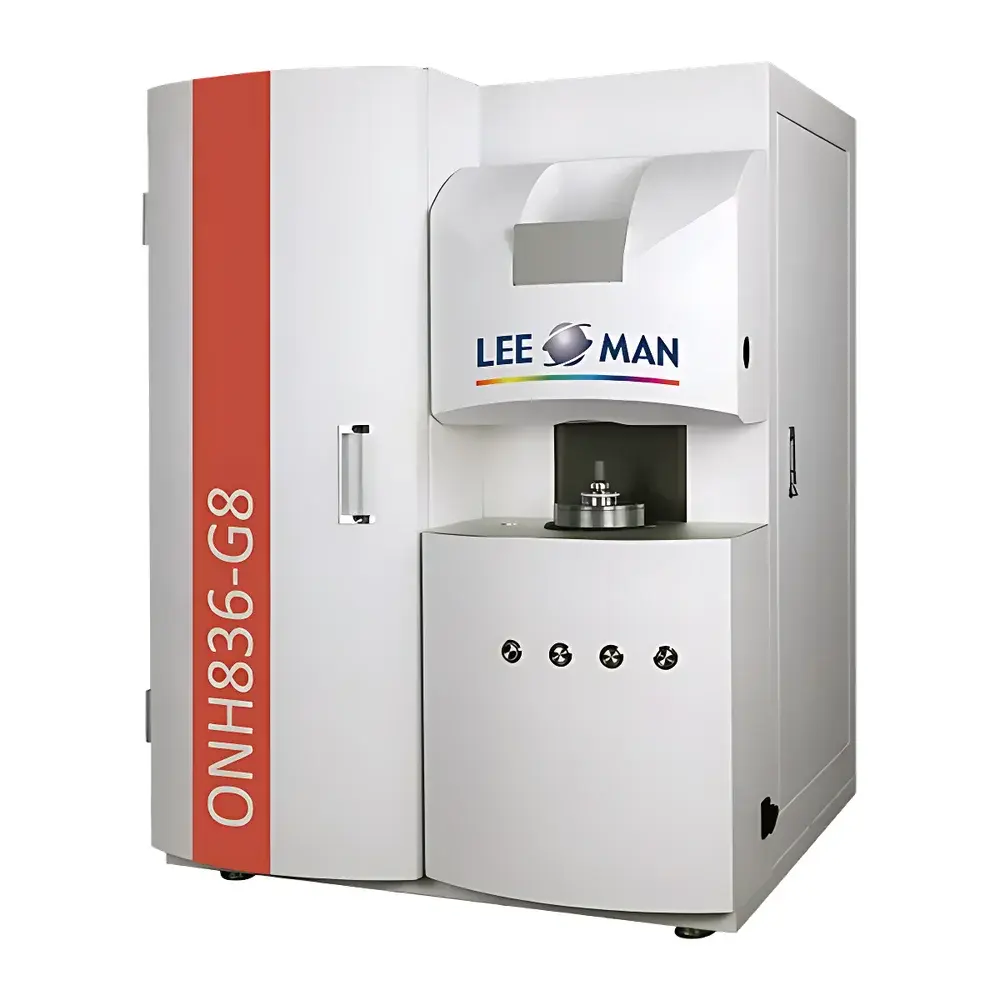
Teledyne Leeman Labs ONH836-G8 Oxygen-Nitrogen-Hydrogen Elemental Analyzer
| Brand | Teledyne Leeman Labs |
|---|---|
| Origin | Beijing, China |
| Model | ONH836-G8 |
| Analysis Range | O: 0.01 ppm–5 wt% |
| N | 0.01 ppm–3 wt% |
| H | 0.01 ppm–0.3 wt% |
| Analytical Precision | O/N: ±0.25 ppm |
| H | ±0.5 ppm |
| Detection Limit | 0.001 ppm |
| Analysis Time | 90 s |
| Pulse Furnace Power | 10 kW |
Overview
The Teledyne Leeman Labs ONH836-G8 is a high-performance inert gas fusion elemental analyzer engineered for quantitative determination of oxygen (O), nitrogen (N), and hydrogen (H) in solid inorganic materials. It operates on the principle of inert gas fusion coupled with dual detection methodologies: non-dispersive infrared (NDIR) absorption for CO₂ (derived from oxygen) and H₂O (from hydrogen), and thermal conductivity detection (TCD) for molecular nitrogen. Samples are thermally decomposed under high-purity helium (or argon for oxygen-only analysis) in a graphite crucible within a water-cooled, 10 kW pulse-heated furnace capable of exceeding 3500 °C. During fusion, oxygen reacts with graphite to form CO; hydrogen is released as H₂; and nitrogen evolves as N₂. The evolved gases are swept through a catalytic converter where CO is oxidized to CO₂, while N₂ remains chemically inert. Subsequent detection employs dedicated infrared cells for CO₂ and H₂O, followed by a high-stability TCD cell for N₂ quantification—enabling simultaneous, independent measurement of all three elements in a single 90-second analysis cycle.
Key Features
- High-temperature pulse furnace with closed-loop temperature control, rated to >3500 °C, integrated automatic crucible cleaning and synchronized particulate filtration;
- Flexible thermal programming: supports gradient ramping, linear heating, segmented temperature profiles, and constant-power modes for optimized decomposition across diverse matrix types;
- Stabilized NDIR detection system featuring chopper-modulated infrared sources with long-term frequency stability and low-drift signal processing;
- High-sensitivity, low-drift TCD cell with extended dynamic range (ppm to percent-level), engineered for robust nitrogen quantification without cross-interference;
- Electropneumatic gas handling architecture with mass flow controllers, real-time pressure compensation, and helium/argon purity monitoring;
- Integrated gas-standard calibration system enabling traceable, matrix-independent calibration using certified gas mixtures—reducing dependency on solid reference materials;
- Triple-element simultaneous analysis with method-specific detection paths: infrared absorption for O (as CO₂) and H (as H₂O), and thermal conductivity for N (as N₂);
- Full-range linearization algorithm with auto-ranging selection—dynamically switches between high-sensitivity and high-capacity detector gain settings based on analyte concentration;
- Comprehensive calibration suite including blank correction, single-point, two-point, multi-point, and linear regression modes—fully configurable per application or regulatory requirement.
Sample Compatibility & Compliance
The ONH836-G8 accommodates a broad spectrum of solid inorganic samples, including ferrous and non-ferrous metals, superalloys, magnetic materials (e.g., NdFeB), rare-earth compounds, silicon wafers, technical ceramics, refractory oxides, and carbides. Sample mass ranges from 0.1 to 1.0 g, with optional micro-crucibles supporting sub-100 mg loads for high-value or limited-availability specimens. Instrument design adheres to ISO 14733 (metallic materials — determination of oxygen, nitrogen and hydrogen), ASTM E1019 (standard test methods for determination of carbon, sulfur, nitrogen, and oxygen in steel, iron, nickel, and cobalt alloys), and JIS G 1211 (steel — determination of oxygen, nitrogen and hydrogen). Data integrity features support GLP/GMP environments, including audit-trail-enabled software logging, user-access controls, and electronic signature capability compliant with FDA 21 CFR Part 11 when deployed with validated LIMS integration.
Software & Data Management
The instrument is controlled via Leeman Labs’ proprietary ONH-Studio software, a Windows-based platform designed for analytical reproducibility and regulatory compliance. It provides real-time gas chromatogram visualization, peak integration with baseline correction algorithms, automated calibration curve generation, and uncertainty estimation per IUPAC guidelines. All raw signals, method parameters, calibration history, and operator metadata are stored in an encrypted SQLite database with immutable timestamping. Export options include CSV, PDF analytical reports, and XML-compatible structured data for enterprise-level LIMS or ELN systems. Software validation documentation (IQ/OQ/PQ protocols) is available upon request for regulated laboratories.
Applications
The ONH836-G8 serves critical quality control and R&D functions across multiple industrial sectors: in aerospace manufacturing, it verifies hydrogen embrittlement risk in titanium and nickel-based turbine alloys; in electric vehicle battery material production, it monitors oxygen stoichiometry in cathode precursors (e.g., NMC, LFP); in nuclear-grade zirconium alloy certification, it ensures hydrogen content remains below 10 ppm to prevent hydride precipitation; in silicon wafer fabrication, it detects interstitial oxygen at sub-ppm levels affecting crystal lattice integrity; and in academic metallurgy research, it enables kinetic studies of deoxidation reactions during vacuum arc remelting. Its ability to deliver trace-level hydrogen data with ±0.5 ppm precision makes it particularly suited for failure analysis of high-strength steels and additive-manufactured components.
FAQ
What inert gases are required for operation?
Helium is the primary carrier and purge gas; argon may be substituted for oxygen-only analysis.
Can the instrument analyze powders or irregularly shaped samples?
Yes—powders are loaded into graphite crucibles with appropriate fluxing agents; irregular solids are machined to fit standard crucible dimensions (typically Ø12 mm × 12 mm height).
Is solid reference material mandatory for calibration?
No—the built-in gas-standard calibration system allows full calibration using certified CO, N₂, and H₂ gas mixtures, reducing reliance on costly and matrix-matched solid standards.
How is furnace contamination managed during high-throughput analysis?
An automated mechanical scraper and vacuum-assisted ash removal system activates after each run, minimizing carryover and extending crucible lifetime.
Does the software support multi-user environments with role-based access?
Yes—ONH-Studio includes configurable user accounts with privilege tiers (operator, supervisor, administrator), password policies, and session timeout enforcement.
Related Products




