
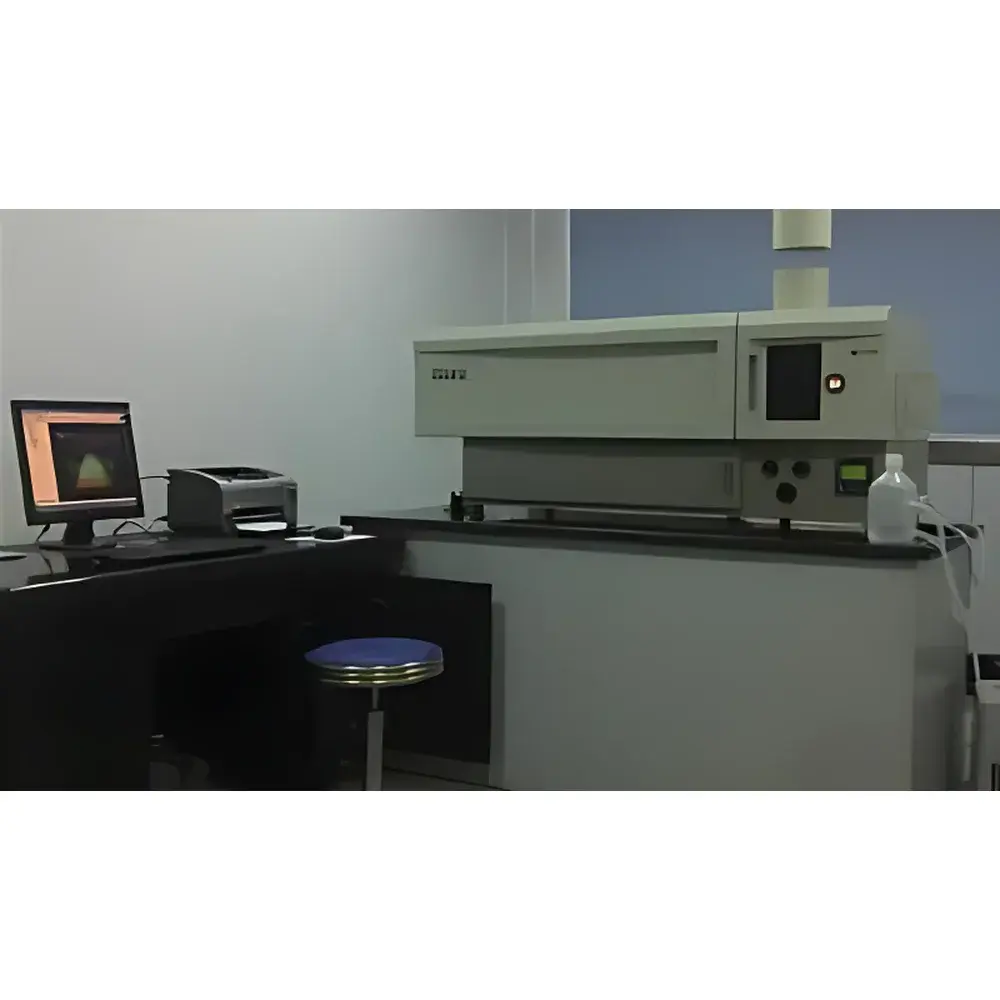
Teledyne Leeman Labs Prodigy DC Arc Direct-Current Arc Optical Emission Spectrometer
| Brand | Teledyne Leeman Labs |
|---|---|
| Origin | USA |
| Manufacturer Type | Authorized Distributor |
| Origin Category | Imported |
| Model | Prodigy DC Arc |
| Instrument Type | Full-Spectrum Direct-Reading |
| Detection Limit | 0.1 ppm |
| Repeatability | ≤1.5% RSD |
| Stability | ≤2% RSD |
| Wavelength Range | 175–900 nm |
| Optical Resolution | ≤0.005 nm (at 200 nm) |
Overview
The Teledyne Leeman Labs Prodigy DC Arc Optical Emission Spectrometer is a high-performance, full-spectrum direct-reading instrument engineered for elemental analysis of refractory, non-conductive, and highly heterogeneous solid materials without chemical dissolution. It employs direct-current arc excitation—a robust, matrix-tolerant plasma source—coupled with a high-resolution echelle optical system to generate intense, stable atomic emission spectra. Unlike inductively coupled plasma (ICP) techniques requiring complete sample digestion, the DC arc method preserves sample integrity while enabling rapid qualitative and quantitative analysis of insulating or ultra-refractory matrices. This makes the Prodigy DC Arc uniquely suited for laboratories engaged in advanced materials R&D, nuclear fuel characterization, geological surveying, and high-purity metal certification where conventional wet chemistry or ICP-OES approaches are impractical or destructive.
Key Features
- Long-Focal-Length Echelle Optics: Incorporates a precision-aligned, high-dispersion echelle grating with cross-disperser and optimized imaging optics, delivering sub-0.005 nm resolution at 200 nm—enabling clear separation of closely spaced spectral lines (e.g., Fe II 238.204 nm / Cr II 238.206 nm) and minimizing inter-element interference.
- L-PAD Detector Architecture: Utilizes a large-area, back-illuminated, deep-depletion CCD detector with four times the active pixel area of conventional photomultiplier tube (PMT) arrays. This provides simultaneous acquisition across the full 175–900 nm range with uniform quantum efficiency and low read noise, supporting true full-spectrum recording in a single exposure.
- DC Arc Excitation Source: Features a regulated, low-noise, high-stability graphite electrode arc system with programmable current ramping and arc stabilization algorithms. Optimized for reproducible ablation of powders, pellets, and pressed briquettes—including SiC, UO2, PuO2, borides, nitrides, and graphite—without binder-induced contamination.
- Single-Step Analysis Workflow: Delivers quantitative multi-element results for up to 70+ elements within 60 seconds per sample—eliminating sequential wavelength scanning and enabling high-throughput screening of batched geological, ceramic, or nuclear feedstock samples.
- Advanced Spectral Processing: Includes real-time, pixel-level background correction using adjacent continuum regions; internal standard normalization (e.g., using C I 247.86 nm or Mg II 279.55 nm); and weighted mean line integration across multiple analyte lines—enhancing accuracy for both major and trace constituents.
Sample Compatibility & Compliance
The Prodigy DC Arc accepts solid samples in powder, pellet, or fused bead form—with no requirement for acid digestion, fusion, or dilution. Certified reference materials (CRMs) including NIST SRM 679 (glass), GBW 07103 (soil), and IRMM-037 (uranium oxide) are routinely analyzed under validated methods compliant with ASTM E1019 (Standard Test Methods for Determination of Carbon, Sulfur, Nitrogen, and Oxygen in Steel, Iron, Nickel, and Cobalt Alloys) and ISO 11885 (Water Quality — Determination of Selected Elements by Inductively Coupled Plasma Optical Emission Spectrometry). While the DC arc technique itself falls outside ICP-specific regulatory frameworks, data integrity is ensured via GLP-compliant audit trails, electronic signature support, and 21 CFR Part 11–ready software configuration options available upon request.
Software & Data Management
Controlled by WinLab32 v7.x software, the system supports method development with customizable calibration curves (linear, quadratic, or spline-fit), automated QC checks (drift correction, blank monitoring, recovery verification), and export to LIMS-compatible formats (ASTM E1382, .csv, .xlsx). All raw spectra are archived with full metadata (arc current, integration time, electrode condition, ambient humidity/temperature), enabling retrospective reprocessing and spectral library building. The software includes built-in spectral interference tables aligned with NIST Atomic Spectra Database (ASD) v2023, facilitating rapid identification of overlapping transitions during method validation.
Applications
- Quantitative analysis of rare-earth oxides and nuclear-grade UO2/PuO2 for isotopic purity assessment and impurity profiling
- Routine quality control of technical ceramics (Al2O3, ZrO2, Si3N4) and refractory carbides (TiC, WC)
- Trace metal screening in coal ash, fly ash, and contaminated soils per EPA Method 6010D workflows
- Direct analysis of precious metal alloys (Pt, Pd, Rh) and high-purity sputtering targets without acid leaching
- Geochemical fingerprinting of silicate minerals and lunar regolith simulants using multi-line ratio calibration
FAQ
Can the Prodigy DC Arc analyze liquid samples?
No—the instrument is specifically designed for solid-phase analysis using DC arc excitation. Liquids require nebulization and plasma ionization (e.g., ICP-OES), which this system does not support.
Is spectral calibration traceable to NIST standards?
Yes—wavelength calibration is performed using Hg/Ar/Ne hollow cathode lamps traceable to NIST SRM 2034, with daily auto-calibration routines verifying pixel-to-wavelength mapping stability.
What sample preparation is required for geological powders?
Powders are typically mixed with high-purity graphite powder (1:1 w/w) and pressed into 32-mm diameter electrodes using 10–15 ton hydraulic pressure—no fluxes, binders, or fusion agents are needed.
Does the system support automated sample changers?
Yes—an optional XYZ robotic autosampler (Model ASC-24) enables unattended analysis of up to 24 electrodes with integrated arc gap optimization and electrode rotation for uniform ablation.
How is detection limit validation performed?
Method detection limits (MDLs) are determined per EPA 40 CFR Part 136 Appendix B using 7 replicate analyses of a reagent blank, with MDL = t0.99 × standard deviation; typical values of 0.1 ppm reflect performance on certified silica sand matrices under optimized arc conditions.




