
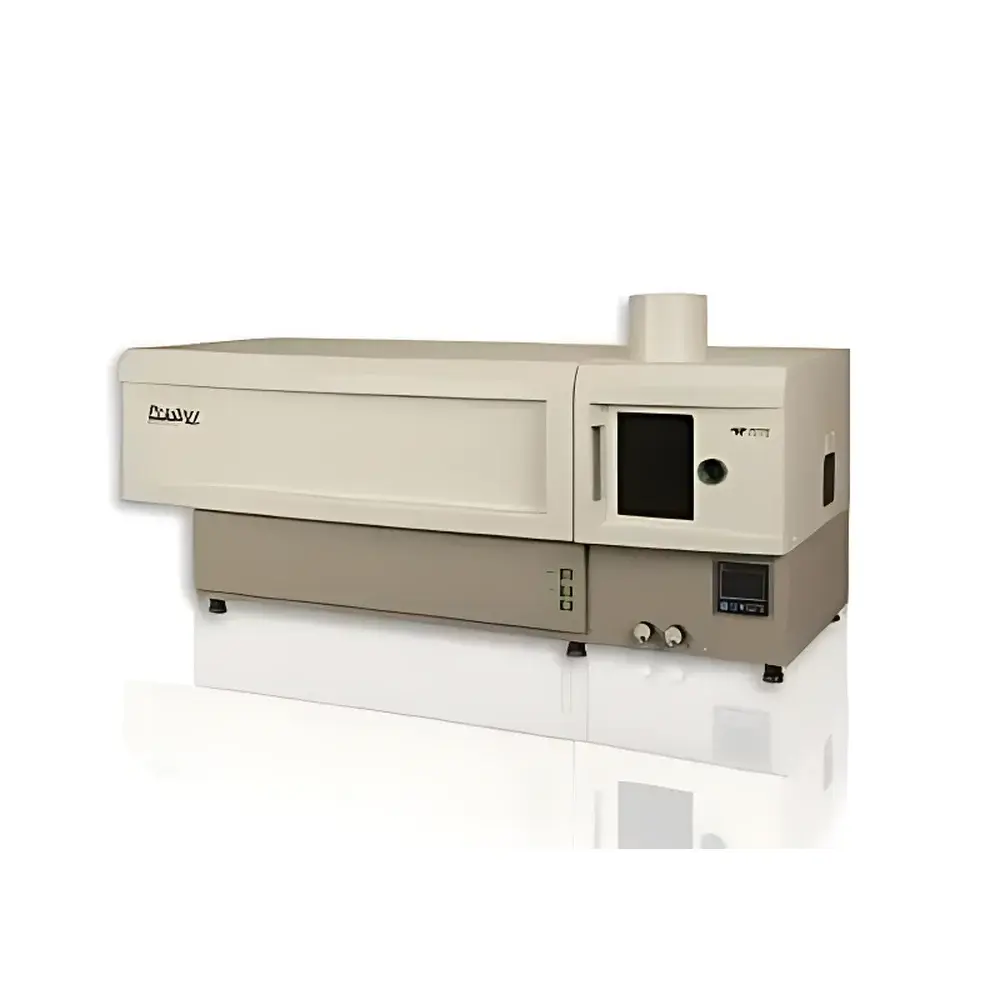
Teledyne Leeman Labs Prodigy DC Arc Optical Emission Spectrometer
| Brand | Teledyne Leeman Labs |
|---|---|
| Origin | USA |
| Manufacturer Type | Authorized Distributor |
| Origin Category | Imported |
| Model | Prodigy |
| Instrument Type | Full-Spectrum Direct-Reading |
| Detection Limit | 0.1 ppm |
| Precision (RSD) | ≤1.5% |
| Stability (Drift) | ≤2% |
| Wavelength Range | 175–900 nm |
| Optical Resolution | ≤0.005 nm @ 200 nm |
Overview
The Teledyne Leeman Labs Prodigy DC Arc Optical Emission Spectrometer is a high-performance, full-spectrum direct-reading instrument engineered for qualitative and quantitative elemental analysis of refractory, non-conductive, and highly heterogeneous solid materials—without requiring acid digestion or fusion sample preparation. It operates on the principle of direct-current arc excitation, where a controlled high-current arc (typically 8–12 A) volatilizes and atomizes solid samples in situ, generating excited atomic and ionic species whose characteristic emission lines are dispersed and resolved by a high-fidelity echelle optical system. This technique is especially suited for materials with low volatility, high melting points, or complex matrices—including ceramics, glasses, metal oxides, carbides, borides, nitrides, SiC powders, noble metals, nuclear-grade UO₂/PuO₂, geological samples, coal ash, soils, sludges, and graphite-based materials. Unlike ICP-OES systems—which require solution nebulization—the Prodigy preserves sample integrity and avoids dilution-related errors or analyte loss during dissolution, delivering superior accuracy for trace and major element determination in challenging solid-phase applications.
Key Features
- Long focal length echelle spectrometer with optimized cross-dispersion optics, enabling simultaneous detection across the full 175–900 nm spectral range without order overlap or mechanical scanning.
- L-PAD (Large-area Photodiode Array Detector) with four times the active surface area of conventional CCD/CMOS detectors, providing enhanced photon collection efficiency, improved signal-to-noise ratio, and intrinsic resistance to pixel saturation during intense line emissions.
- True full-spectrum acquisition: all elements measured concurrently within a single 60-second arc burn; no sequential wavelength selection or dwell-time optimization required.
- High optical resolution of ≤0.005 nm at 200 nm ensures minimal spectral interference—even between closely spaced lines such as Fe II 238.204 nm and Cr II 238.207 nm—critical for accurate quantification in multi-element matrices.
- Integrated real-time background correction using adjacent pixel interpolation, combined with robust internal standard normalization (e.g., using Al, Si, or C lines), minimizes matrix-induced intensity drift and improves long-term reproducibility.
- User-configurable method development environment supporting custom calibration curves, line-ratio algorithms, and statistical averaging of multiple emission lines per element—including weak and strong transitions—for enhanced dynamic range and accuracy.
Sample Compatibility & Compliance
The Prodigy is validated for direct analysis of pressed powder pellets, electrodes, and sintered discs—compatible with ASTM E1019 (Standard Test Methods for Determination of Carbon, Sulfur, Nitrogen, and Oxygen in Steel, Iron, Nickel, and Cobalt Alloys), ISO 11576 (Metallic materials — Determination of oxygen content — Inert gas fusion-infrared absorption method), and USP guidelines for elemental impurities in pharmaceutical excipients where solid sampling is permitted. Its arc source design complies with IEC 61000-4-3 (EMC immunity) and meets Class I laser safety requirements per ANSI Z136.1 for enclosed optical paths. Data integrity conforms to FDA 21 CFR Part 11 when operated with Leeman’s certified SpectraSmart™ software, supporting electronic signatures, audit trails, and role-based access control for GLP/GMP-regulated laboratories.
Software & Data Management
SpectraSmart™ v5.x serves as the instrument’s native acquisition and processing platform. It provides automated arc parameter optimization (current ramping, pre-burn stabilization, integration timing), spectral library matching against NIST Atomic Spectra Database (ASD) v2023, and customizable reporting templates compliant with ISO/IEC 17025 documentation requirements. Raw spectral data (.spc) and processed results (.csv, .pdf) are stored in a timestamped, version-controlled repository with built-in backup scheduling and optional network-attached storage (NAS) integration. All analytical sequences retain full metadata—including electrode history, ambient humidity/temperature logs, and detector gain settings—to support retrospective method validation and regulatory audits.
Applications
- Quality control of advanced ceramics and refractory composites in aerospace and electronics manufacturing.
- Trace impurity profiling (e.g., Na, K, Ca, Fe, Cu) in high-purity graphite anodes for lithium-ion battery production.
- Nuclear fuel cycle analysis: rapid assay of U/Pu isotopic ratios via emission line intensity ratios in oxide powders.
- Geochemical exploration: multi-element fingerprinting of soil and sediment samples for environmental baseline studies.
- Metallurgical R&D: in-process monitoring of alloy composition shifts during sintering or additive manufacturing feedstock qualification.
- Forensic materials analysis: discrimination of paint layers, glass fragments, or metallurgical evidence based on elemental signature patterns.
FAQ
Does the Prodigy require sample dissolution prior to analysis?
No—solid samples are analyzed directly as pressed pellets or electrodes; no acid digestion, flux fusion, or liquid introduction is necessary.
Can the instrument quantify both major and trace elements in the same run?
Yes—full-spectrum acquisition enables simultaneous measurement of concentration ranges from 0.1 ppm to >10 wt%, using appropriate line selection and internal standardization.
Is the DC arc source compatible with conductive and non-conductive materials?
Yes—the dual-electrode configuration supports both self-supported conductive samples (e.g., Cu rods) and insulating powders mixed with graphite or silver binder.
How does the Prodigy handle spectral interferences from complex matrices?
Through high-resolution echelle dispersion, L-PAD detector linearity, and software-based interference correction algorithms including peak deconvolution and multi-line regression fitting.
What maintenance is required for long-term operational stability?
Routine electrode cleaning, argon purge line inspection, and annual optical alignment verification—no lamp replacement or grating recalibration is needed due to sealed, fixed-optics architecture.







