
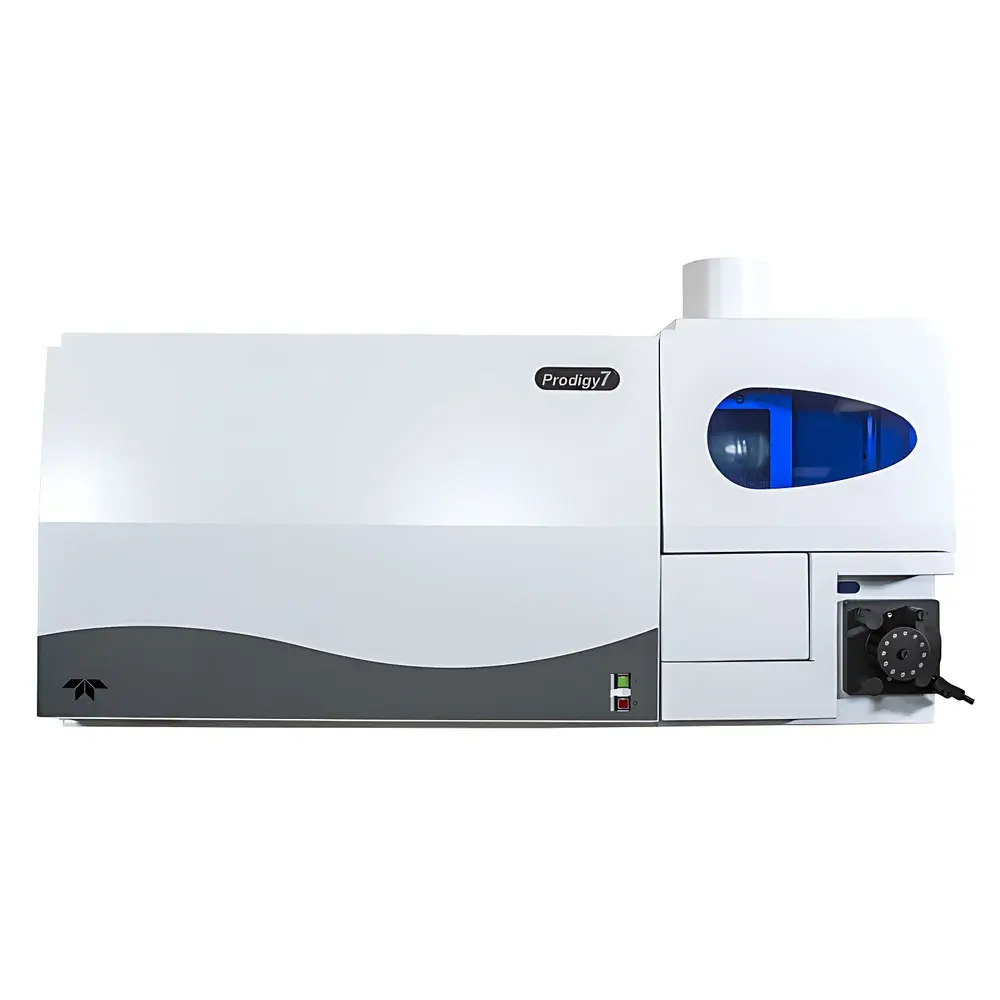
Teledyne Leeman Labs Prodigy7 Inductively Coupled Plasma Optical Emission Spectrometer
| Brand | Teledyne Leeman Labs |
|---|---|
| Origin | USA |
| Model | Prodigy7 |
| Instrument Type | Full-Spectrum Direct-Reading ICP-OES |
| Detection Limit (Zn at 213.856 nm) | <0.1 µg/L |
| Precision (RSD) | ≤1.0% |
| Stability (RSD over 4 hours) | ≤1.0% |
| Wavelength Range | 165–1100 nm |
| Optical Resolution | ≤0.007 nm @ 200 nm |
Overview
The Teledyne Leeman Labs Prodigy7 is a full-spectrum direct-reading inductively coupled plasma optical emission spectrometer (ICP-OES) engineered for high-throughput, multi-element trace metal analysis in demanding laboratory environments. Operating on the fundamental principle of atomic emission spectroscopy, the instrument atomizes and excites liquid samples in a high-temperature argon plasma (~6,000–10,000 K), causing elemental atoms and ions to emit characteristic photons across the ultraviolet–visible–near-infrared spectrum. The Prodigy7 captures the entire emitted spectrum simultaneously using a custom-designed CMOS solid-state detector—eliminating sequential wavelength scanning and enabling true simultaneous multi-element quantification with inherent spectral fidelity.
Unlike legacy CCD-based systems, the Prodigy7’s CMOS detector delivers >10× faster readout speed and >10× wider linear dynamic range (up to 9 orders of magnitude), significantly reducing dwell time per element while preserving calibration integrity across concentration gradients. Its integrated optical architecture features a high-efficiency Czerny–Turner monochromator with thermally stabilized optics, ensuring long-term wavelength accuracy and minimal thermal drift. The system achieves rapid plasma ignition (<3 minutes cold start) and stable analytical conditions within 15 minutes—optimized for routine QC/QA workflows in environmental, clinical, pharmaceutical, and geochemical laboratories.
Key Features
- Full-spectrum acquisition in a single exposure: All wavelengths from 165 nm to 1100 nm captured simultaneously without mechanical scanning or grating movement.
- Custom CMOS detector with USB 3.0 direct interface: Replaces legacy Ethernet-based addressing, minimizing latency and enabling real-time spectral streaming at frame rates exceeding 100 Hz.
- Thermally stabilized optical bench: Minimizes wavelength shift and intensity drift; supports compliance with ISO/IEC 17025 method validation requirements.
- Low-power, low-argon-consumption plasma torch design: Reduces operational cost and improves sustainability—argon flow optimized to ≤12 L/min during analysis and ≤5 L/min in standby.
- Automated, tool-free sample introduction: Self-aligning nebulizer and spray chamber with quick-lock coupling; compatible with standard concentric, cross-flow, and microconcentric nebulizers.
- Modular hardware architecture: Detector, spectrometer, and RF generator are independently serviceable—reducing mean time to repair (MTTR) and supporting GLP-mandated maintenance logging.
Sample Compatibility & Compliance
The Prodigy7 accommodates aqueous solutions, diluted acids (HNO₃, HCl, HF up to 5%), organic solvents (with oxygen ashing), and digested biological/environmental matrices (e.g., EPA Method 200.7, 200.8, ISO 11885). Its wide spectral coverage enables detection of all regulated elements—including As, Cd, Cr, Pb, Hg, Se, U, and rare earths—with sub-pptr detection limits validated per ASTM D5673 and USP . The instrument meets electromagnetic compatibility (EMC) standards per IEC 61326-1 and safety requirements per IEC 61010-1. Data integrity controls—including user authentication, audit trails, electronic signatures, and secure data export—support adherence to FDA 21 CFR Part 11 and EU Annex 11 for regulated environments.
Software & Data Management
Prodigy7 operates under WinSpectra™ v7.5 software—a Windows-based platform compliant with ISO/IEC 17025 documentation standards. It provides automated background correction, multi-line integration, internal standard normalization, and matrix-matched calibration with drift correction. All raw spectra are stored in vendor-neutral HDF5 format, enabling third-party reprocessing and spectral library matching. Software modules include method validation wizards (per ICH Q2(R2)), uncertainty estimation tools (GUM-compliant), and seamless integration with LIMS via ASTM E1384-compliant XML export. Audit trails record every parameter change, calibration event, and report generation—retained for ≥10 years with tamper-evident hashing.
Applications
- Environmental testing: Quantification of heavy metals in drinking water (EPA 200.7), wastewater (EPA 200.8), soils (EPA 6010D), and airborne particulates (NIOSH 7300).
- Pharmaceutical quality control: Elemental impurity screening per ICH Q3D guidelines—especially Co, Ni, V, Mo, and Pt-group metals in APIs and excipients.
- Geochemical exploration: Multi-element profiling of rock digests, brines, and leachates with robustness against high TDS (>25% w/v) and suspended solids.
- Clinical and nutritional labs: Trace element analysis in serum, urine, and tissue homogenates (e.g., Zn, Cu, Mg, Ca, Fe) with certified reference material traceability (NIST SRM 1640a, 1643e).
- Materials science: Compositional verification of catalysts, battery cathode materials (Li, Ni, Co, Mn), and semiconductor-grade chemicals (SEMI F57).
FAQ
What plasma gas consumption does the Prodigy7 require during analysis?
Typical argon consumption is 12 L/min during plasma operation and reduces to 5 L/min in standby mode—achieving ~30% lower gas usage than previous-generation ICP-OES systems.
Is the CMOS detector field-replaceable without optical realignment?
Yes—the detector module is factory-aligned and secured with precision kinematic mounts; replacement requires no user recalibration or wavelength validation.
Does the system support hydride generation or laser ablation interfaces?
The Prodigy7 is compatible with optional HG-3 hydride generation accessories and NWR laser ablation systems (via external synchronization trigger and spectral delay compensation).
How is spectral interference corrected in complex matrices?
WinSpectra software applies multivariate interference correction using >100 reference lines per element, including peak deconvolution algorithms and background-equivalent concentration (BEC) modeling.
What regulatory documentation is provided for 21 CFR Part 11 compliance?
A complete validation package—including IQ/OQ/PQ protocols, risk assessment (ICH Q9), and electronic signature configuration guides—is supplied with each instrument shipment.






