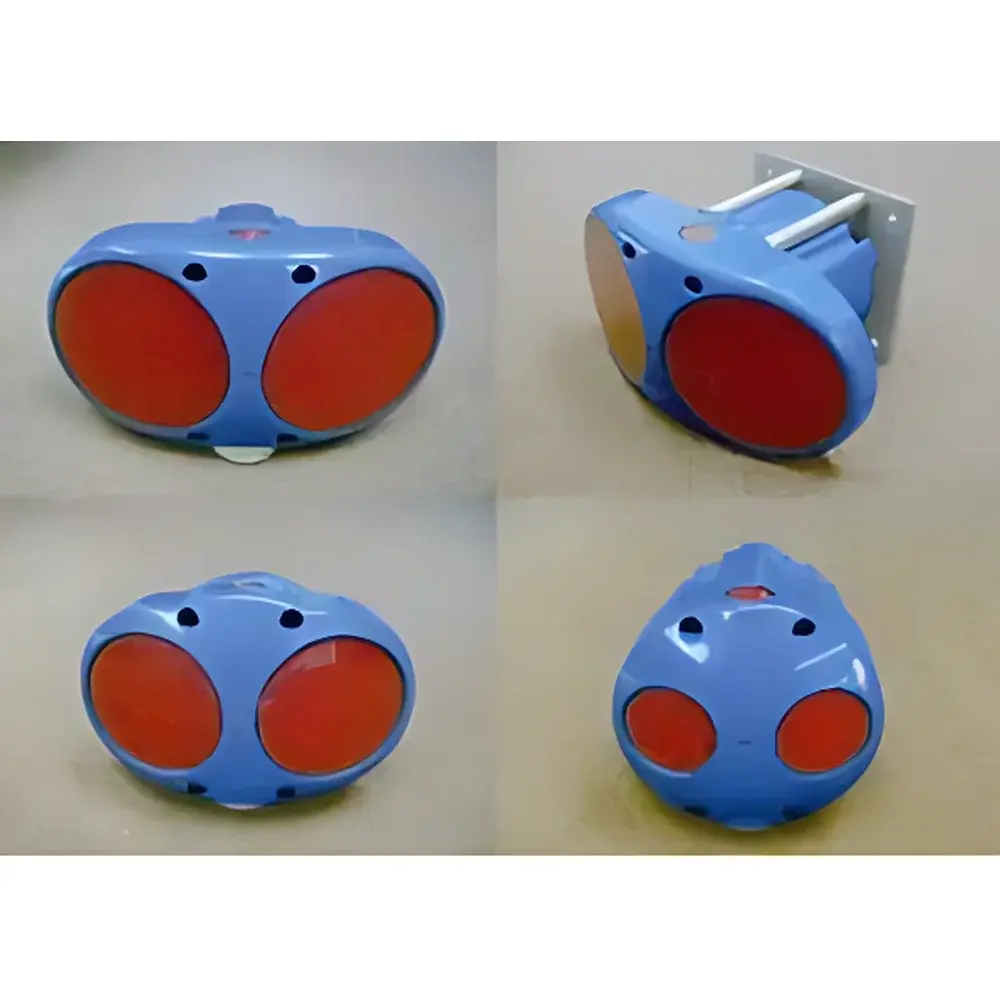
Teledyne RDI ChannelMaster H-ADCP Horizontal Acoustic Doppler Current Profiler
| Brand | Teledyne RDI |
|---|---|
| Origin | USA |
| Model | H-ADCP |
| Frequency Options | 300 kHz, 600 kHz, 1200 kHz |
| Velocity Range | ±10 m/s (configurable) |
| Velocity Resolution | 0.1 mm/s |
| Depth Cell Size | 0.1–2.0 m (user-selectable, up to 128 cells) |
| Water Level Sensors | Ultrasonic (0.1–10 m, ±0.25% accuracy, 0.01 cm resolution) & Pressure-based (0.1–10 m, ±0.5% accuracy, 0.1 cm resolution) |
| Temperature Sensor | –4°C to 40°C, ±0.2°C, 0.01°C resolution |
| Tilt Sensors | Dual-axis, ±10° range, ±0.2° @ 0°, ±0.5° @ 10°, 0.01° resolution |
| Communication | RS-232, RS-422, SDI-12 v1.3 |
| Data Storage | 4 MB internal memory |
| Power Supply | 10–18 VDC |
| Typical Power Consumption | 0.13–0.16 W (operational), 0.00025 W (standby) |
| Housing | Polyurethane encapsulated transducer array with titanium fasteners and stainless steel mounting frame |
Overview
The Teledyne RDI ChannelMaster H-ADCP is a horizontally mounted Acoustic Doppler Current Profiler engineered for continuous, high-fidelity flow monitoring in open-channel environments—including rivers, irrigation canals, drainage channels, and estuarine zones. Unlike conventional point-velocity meters or stage-discharge rating curve–dependent systems, the H-ADCP applies broadband pulse-to-pulse coherent Doppler processing to resolve vertical velocity profiles across the entire water column—from bank to bank—without requiring cross-sectional calibration or empirical rating tables. Its horizontal beam configuration enables non-intrusive installation on stable riverbanks or bridge piers, transmitting acoustic pulses laterally across the channel to measure velocity vectors at discrete depth cells. This architecture delivers true volumetric flow rates derived from spatially distributed, time-synchronized velocity measurements—making it suitable for unsteady, low-velocity, and highly variable flow regimes where traditional methods exhibit significant uncertainty.
Key Features
- Broadband ADCP technology licensed from Teledyne RDI, providing enhanced signal-to-noise ratio, reduced velocity bias, and improved measurement reproducibility under turbulent or low-SNR conditions.
- Three operational frequency options (300 kHz, 600 kHz, 1200 kHz) allow optimization for depth range, resolution, and sediment tolerance—e.g., 1200 kHz for shallow, high-resolution profiling; 300 kHz for deeper channels with suspended sediment interference mitigation.
- Integrated multi-sensor suite: factory-calibrated ultrasonic and pressure-based water level sensors, dual-axis tilt compensation (roll/pitch), and thermistor-based temperature monitoring—enabling real-time correction of sound speed and beam geometry.
- Configurable profiling grid: up to 128 user-defined depth cells with adjustable cell size (0.1–2.0 m), enabling adaptive resolution in near-surface, mid-column, and near-bed regions.
- Low-power embedded architecture: operational power draw ≤0.16 W (model-dependent), with ultra-low standby consumption (250 µW), supporting long-term solar-battery deployments in remote hydrological networks.
- Ruggedized mechanical design: polyurethane-encapsulated transducer array, titanium alloy mounting hardware, and stainless-steel structural frame rated for continuous submersion and exposure to abrasive sediments and biofouling-prone environments.
Sample Compatibility & Compliance
The ChannelMaster H-ADCP is validated for deployment in natural and engineered open channels with hydraulic depths ≥0.3 m and surface widths ≥2 m. It complies with standard practices for open-channel flow measurement outlined in ASTM D5766 / ISO 748 for velocity-area method validation, and supports traceable data acquisition aligned with USGS Water Resources Mission Area protocols. The instrument’s SDI-12 v1.3 interface ensures interoperability with industry-standard RTUs and telemetry platforms used in national hydrometric networks (e.g., USGS NWIS, Environment Canada HYDAT). All firmware and data logging routines adhere to GLP principles, including timestamped metadata, sensor health diagnostics, and immutable audit logs required for regulatory reporting under EPA Clean Water Act Section 303(d) or EU Water Framework Directive compliance frameworks.
Software & Data Management
The system ships with WinH-ADCP—a Windows-based configuration, real-time visualization, and diagnostic utility supporting full parameterization of ping rate, cell mapping, coordinate transformation, and QA/QC flagging. For operational integration, the “FlowCom-H” software package provides automated discharge computation using ISO 1070–2 compliant algorithms, including vertical velocity integration, side-edge correction, and uncertainty propagation per ISO/IEC Guide 98-3 (GUM). Raw binary data (PD0 format) and processed ASCII outputs (CSV, JSON) are exportable with embedded NMEA-0183 timestamps and sensor metadata. Internal 4 MB flash memory retains >30 days of high-frequency profile data (at 15-min intervals) without external storage. Data retrieval supports both direct serial interrogation and scheduled SDI-12 polling—ensuring compatibility with SCADA architectures and cloud-based hydrologic data management systems (e.g., HydroShare, CUAHSI HIS).
Applications
- Real-time discharge monitoring at USGS, NOAA, and national hydrometric service gauging stations—especially in flashy, braided, or ice-affected rivers where stage-discharge relationships degrade.
- Regulatory wastewater effluent monitoring at NPDES-permitted outfalls, supporting mass loading calculations for TMDL compliance and permit renewal reporting.
- Hydrodynamic model calibration and validation in riverine and estuarine numerical simulations (e.g., TELEMAC, Delft3D, HEC-RAS 2D), supplying spatially resolved boundary condition datasets.
- Navigation safety support in ports and harbors—providing real-time lateral current vectors for vessel traffic management systems and berth planning tools.
- Climate resilience infrastructure assessment—quantifying changes in baseflow, peak discharge timing, and floodplain conveyance capacity over multi-year deployments.
FAQ
How does the H-ADCP differ from vertical-beam ADCPs in open-channel applications?
Unlike downward-looking ADCPs that require bathymetric interpolation and assume uniform velocity distribution across the channel width, the H-ADCP directly measures lateral velocity profiles across the full channel cross-section—eliminating assumptions about flow symmetry and enabling accurate discharge calculation even in highly asymmetric or partially obstructed flows.
Can the H-ADCP operate reliably in high-turbidity or vegetation-rich channels?
Yes—the broadband signal processing and selectable lower-frequency transducers (e.g., 300 kHz) maintain coherence in acoustically attenuating environments; however, optimal performance requires unobstructed acoustic paths between transducer and opposite bank, necessitating site-specific path clearance verification during installation.
Is the system compliant with FDA 21 CFR Part 11 or similar electronic record requirements?
While not designed for pharmaceutical process control, the H-ADCP’s firmware-enforced audit trail, write-protected memory partitions, and deterministic timestamping meet foundational ALCOA+ data integrity criteria; full Part 11 compliance requires integration-level validation within the host SCADA or LIMS environment.
What maintenance intervals are recommended for long-term unattended operation?
Biannual visual inspection and transducer face cleaning are advised; ultrasonic water level sensor drift should be verified annually against a calibrated staff gauge; pressure sensor zero-offset checks are recommended after seasonal thermal cycling or flood events.
Does the system support remote firmware updates or reconfiguration via telemetry?
Yes—WinH-ADCP supports over-the-air (OTA) parameter updates and diagnostic command execution through serial-over-IP gateways when deployed with compatible cellular or satellite RTUs.