
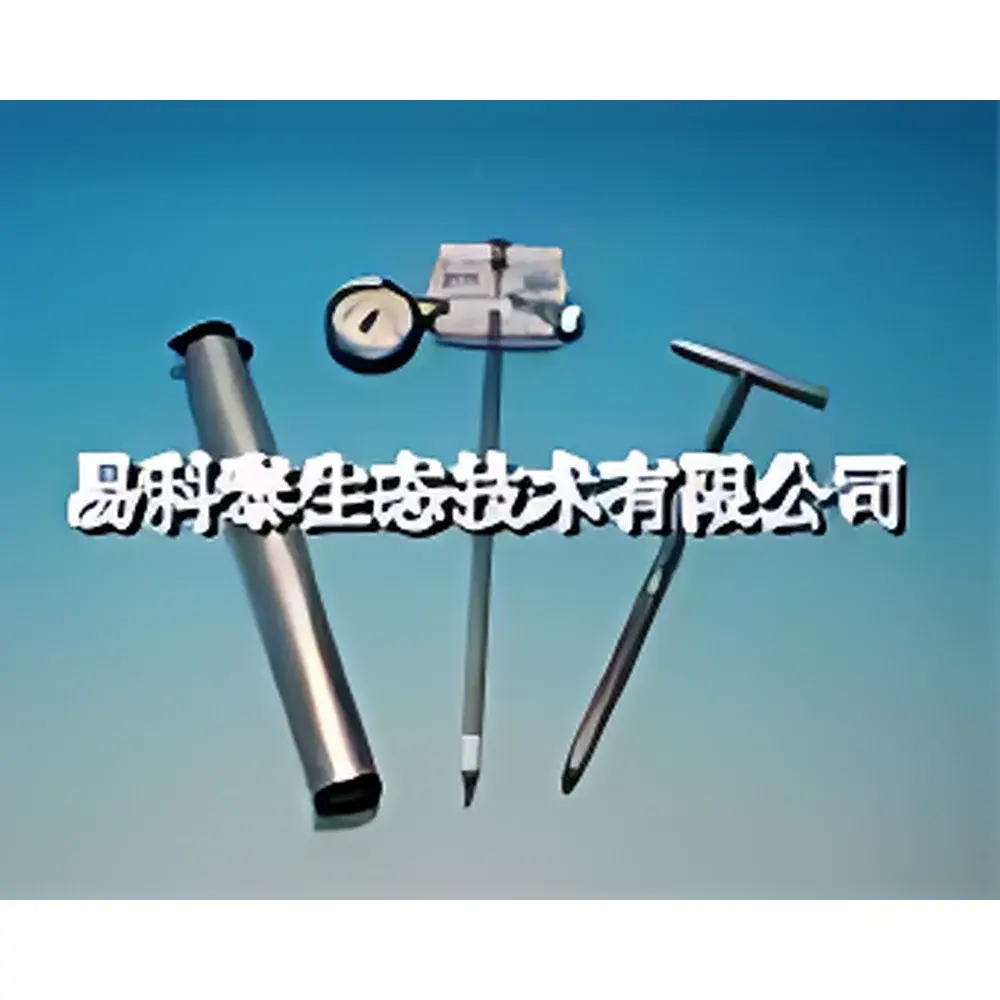
Tensio100 Field-Portable Soil Tensiometer
| Origin | Germany |
|---|---|
| Manufacturer Type | Authorized Distributor |
| Origin Category | Imported |
| Model | Tensio100 |
| Pricing | Available Upon Request |
Overview
The Tensio100 Field-Portable Soil Tensiometer is an engineered solution for direct, in-situ measurement of soil water potential (matric potential) under field conditions. It operates on the fundamental principle of hydrostatic equilibrium between a saturated ceramic cup and the surrounding soil matrix. When the porous ceramic tip (SKA 100 FF, 10 mm diameter × 24 mm height) is inserted into undisturbed soil, water moves across the ceramic interface until hydraulic equilibrium is reached — at which point the negative pressure (tension) measured by the calibrated vacuum gauge corresponds directly to the soil water potential in kilopascals (kPa). Designed for agricultural research, irrigation scheduling, and environmental monitoring, the Tensio100 delivers reliable, real-time data without requiring electrical power or complex calibration procedures. Its mechanical analog design ensures operational robustness in remote locations, high humidity, or variable temperature environments typical of open-field deployment.
Key Features
- High-precision analog vacuum gauge (63 mm diameter) with linear scale calibrated from 0 to –85 kPa, enabling rapid visual interpretation of soil moisture status
- Durable acrylic glass tensiometer head backed by polycarbonate protective film to resist UV degradation and mechanical abrasion
- Pressure pre-regulator valve integrated into the brass mounting bracket for efficient air removal and accelerated equilibration
- Corrosion-resistant V2A stainless steel vertical tube (10 mm OD) and conical tip for consistent soil penetration and minimal disturbance during installation
- Interchangeable ceramic cups compliant with ISO 11277:2023 (soil physical properties — determination of particle size distribution) and ASTM D4318 (liquid limit and plasticity index of soils)
- Three standard stem lengths available (30 cm, 60 cm, and 90 cm) to accommodate varying soil depth requirements and crop root zone profiling
Sample Compatibility & Compliance
The Tensio100 is compatible with mineral soils ranging from sandy loam to clay loam textures (USDA texture classes), provided the ceramic tip maintains full saturation and hydraulic contact with the soil matrix. It is not suitable for highly saline soils (>4 dS/m EC) or organic substrates (e.g., peat, compost) due to altered pore-water chemistry and potential ceramic clogging. The device conforms to GLP-compliant field measurement protocols when used in conjunction with documented installation procedures, regular zero-checks, and maintenance logs. All metallic components meet EN 10088-1:2014 standards for corrosion-resistant stainless steels. Ceramic elements are manufactured to DIN 4094 specifications for porous materials used in geotechnical instrumentation.
Software & Data Management
As a fully mechanical, non-electronic instrument, the Tensio100 does not require firmware, drivers, or proprietary software. Readings are recorded manually or integrated into external digital workflows via standardized field data sheets or mobile data capture platforms (e.g., Fulcrum, Survey123). For traceability in regulated studies (e.g., EU Common Agricultural Policy monitoring, USDA NRCS soil health assessments), users are advised to log installation date/time, GPS coordinates, soil depth, ceramic saturation status, and ambient temperature alongside each reading. While the device itself lacks electronic audit trails, its analog operation supports compliance with 21 CFR Part 11 principles when paired with validated paper-based or electronic lab notebooks meeting ALCOA+ criteria (Attributable, Legible, Contemporaneous, Original, Accurate, Complete, Consistent, Enduring, Available).
Applications
- Irrigation management decision support — triggering watering events based on crop-specific soil water potential thresholds (e.g., –30 kPa for maize, –60 kPa for vineyards)
- Soil hydraulic property characterization — supporting van Genuchten parameter estimation in unsaturated zone modeling
- Long-term field monitoring networks — deployed in eddy covariance sites, flux towers, and LTER (Long Term Ecological Research) plots
- Educational field labs — demonstrating fundamental concepts of soil physics, plant-available water, and capillary rise
- Validation of remote sensing soil moisture products (e.g., Sentinel-1 SAR, SMAP L-band radiometry) through ground-truthing campaigns
FAQ
How often should the ceramic tip be replaced?
Under normal field use and proper hydration maintenance, SKA 100 FF ceramic tips typically last 12–24 months. Replacement is recommended if readings become erratic, response time exceeds 5 minutes, or visible microfractures appear.
Can the Tensio100 be used in frozen soil?
No. Operation is restricted to 0 °C to +40 °C per specification. Ice formation within the ceramic pores or water column invalidates hydraulic continuity and may cause irreversible damage.
What type of water must be used for refilling?
Deionized or distilled water (conductivity < 5 µS/cm) is mandatory to prevent mineral precipitation that could occlude the ceramic micropores or corrode internal brass components.
Is calibration required before each use?
Zero calibration is performed by submerging the ceramic tip in water and verifying the gauge reads 0 kPa; this should be confirmed prior to initial deployment and after extended storage.
How deep should the ceramic tip be installed?
Installation depth must match the target root zone — generally 15–30 cm for shallow-rooted crops and up to 60 cm for perennial systems. Avoid placing near macropores, stones, or recent tillage zones to ensure representative measurement.







