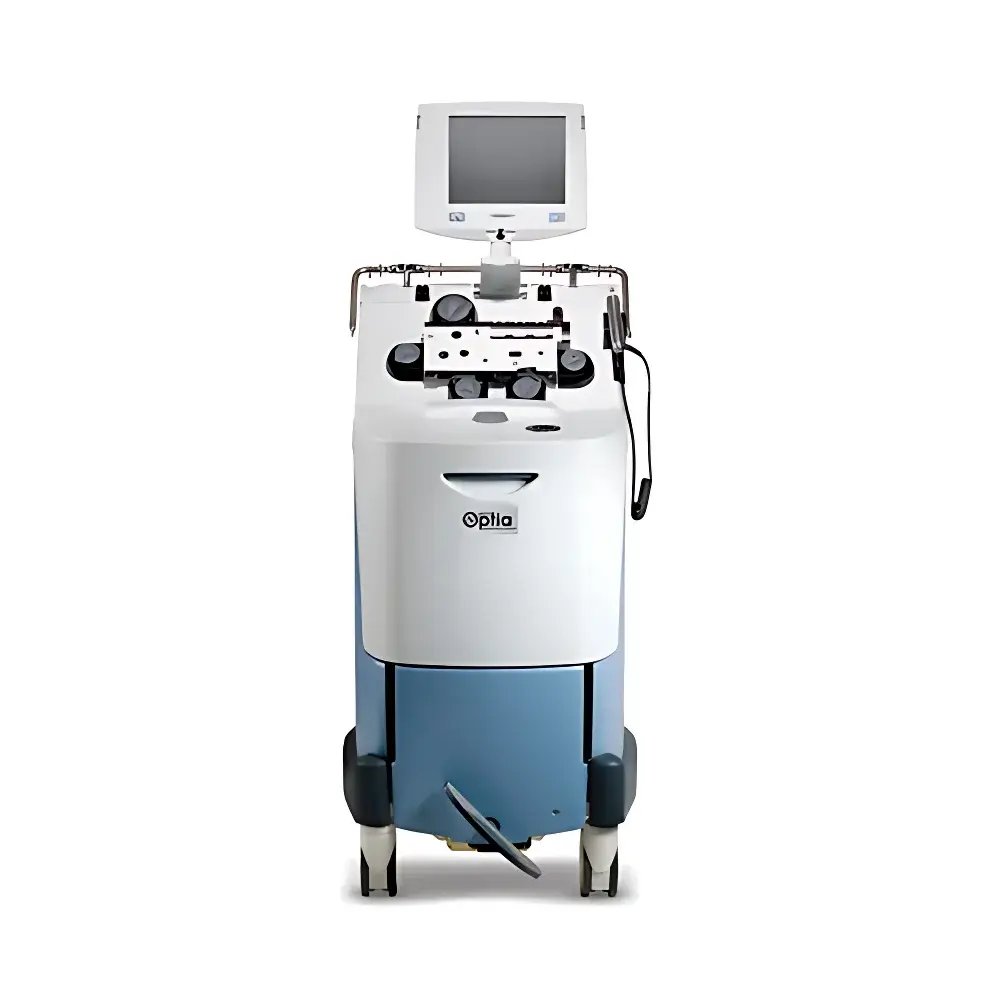
Terumo BCT Spectra Optia® Apheresis System
| Brand | Terumo BCT |
|---|---|
| Origin | USA |
| Model | Spectra Optia® |
| Device Type | Automated Blood Separation and Cell Processing Platform |
| Regulatory Classification | FDA-cleared Class II Medical Device (510(k) K122936, K151487, etc.) |
| Weight | 90 kg |
| Extracorporeal Volume | ≥110 mL |
| Patient Weight Range | 2–227 kg |
| Data Storage Capacity | 100 patient sessions |
| Integrated Tube Sealer | Yes |
| Power Failure Memory | Yes |
| User Interface | Color Touchscreen GUI with Multilingual Support (including Simplified Chinese) |
Overview
The Terumo BCT Spectra Optia® Apheresis System is a CE-marked and FDA-cleared, fully automated, continuous-flow centrifugal blood separation platform designed for therapeutic apheresis, donor blood component collection, and clinical cell processing. It operates on the principle of density-gradient centrifugation under precisely controlled flow dynamics, coupled with real-time optical interface detection to monitor plasma–buffy coat–red blood cell layer boundaries during separation. This enables high-fidelity, operator-independent fractionation of whole blood into discrete components—including red blood cells (RBCs), white blood cells (WBCs), platelets (PLTs), and plasma—without reliance on fixed-volume batch processing. The system is engineered for precision, reproducibility, and adaptability across diverse clinical settings: blood centers performing component manufacturing per AABB and ISO 20366 standards; hospitals delivering therapeutic procedures under institutional protocols aligned with ASFA guidelines; and academic or biopharma laboratories supporting GMP-compliant cell therapy workflows.
Key Features
- Automated Interface Management (AIM) algorithm with embedded microprocessor control, enabling dynamic adjustment of centrifuge speed and flow rates to maintain optimal interface position—achieving RBC contamination <3.1% in mononuclear cell (MNC) products and platelet loss <1% during PLT-sparing procedures.
- Low extracorporeal volume design (≥110 mL) validated for safe use in pediatric patients down to 2 kg body weight and total blood volume as low as 300 mL, while simultaneously supporting adult patients up to 227 kg.
- Intuitive color touchscreen GUI with context-sensitive prompts, step-by-step procedural guidance, and structured alarm diagnostics—including root-cause categorization (e.g., “Clamp Fault,” “Air Detection,” “Interface Drift”) to accelerate operator response and reduce procedural interruptions.
- Modular, single-use disposable sets (cassettes) with color-coded tubing segments and pre-assembled connectors—minimizing setup errors and eliminating manual priming steps. Three standardized set configurations support all six core procedures without hardware reconfiguration.
- Integrated thermal tube sealer for sterile product line segmentation post-procedure, compliant with AABB Standard 5.10.2 for closed-system processing.
- Robust power failure recovery protocol that preserves current procedure state, fluid volumes, and parameter settings—ensuring continuity and data integrity during unexpected outages.
Sample Compatibility & Compliance
The Spectra Optia® platform processes anticoagulated whole blood (citrate-phosphate-dextrose or acid-citrate-dextrose formulations) and supports both peripheral and central venous access. All disposable sets are sterilized by gamma irradiation and certified pyrogen-free per USP <85>. The system complies with IEC 62304 (medical device software lifecycle), IEC 60601-1 (general safety), and IEC 60601-2-49 (particular requirements for apheresis equipment). Clinical validation studies referenced in FDA 510(k) clearances demonstrate conformance with ASTM F2670 for leukapheresis efficiency and ISO 20366:2017 for blood component quality metrics. For regulated environments, audit trails, user authentication, and electronic signature capabilities align with FDA 21 CFR Part 11 requirements when used with compatible hospital information systems.
Software & Data Management
The onboard operating system stores up to 100 complete session records—including time-stamped procedural parameters (flow rates, centrifuge RPM, interface position, anticoagulant ratios), real-time graphical logs, and final product volumes/compositions. Data export is supported via USB 2.0 to CSV or XML formats for integration into LIS/HIS platforms. Software versioning follows strict change control per ISO 13485, with firmware updates distributed only through authorized Terumo BCT service channels. Optional network connectivity modules enable remote monitoring and predictive maintenance alerts—subject to local IT security policy review and HIPAA-compliant configuration.
Applications
- Therapeutic Apheresis: Performing evidence-based procedures including therapeutic plasma exchange (TPE), red blood cell exchange (RBCX), leukocyte reduction (WBCD), and platelet reduction (PLTD) per ASFA Category I–IV indications.
- Donor Collections: Automated collection of platelets, RBCs, and MNCs—including continuous mononuclear cell (CMNC) harvest for hematopoietic stem cell mobilization and lymphocyte enrichment.
- Cell Therapy Manufacturing: Pre-clinical and clinical-scale isolation of mononuclear cells, dendritic cells, and T-cell subsets under controlled, traceable conditions suitable for IND-enabling studies and early-phase GMP production.
- Blood Center Operations: Efficient, standardized preparation of pathogen-reduced plasma, washed RBCs, and buffy-coat-derived platelets—meeting national transfusion medicine specifications.
FAQ
Is the Spectra Optia® system compatible with citrate anticoagulation protocols used in pediatric apheresis?
Yes—the system’s low extracorporeal volume and adjustable anticoagulant-to-blood ratio algorithm have been clinically validated for use with standard citrate infusion regimens in patients weighing ≥2 kg.
Does the device support electronic data interchange with hospital EMR systems?
Direct HL7 v2.x or ASTM E1384 interfaces are not built-in; however, exported session data files (CSV/XML) can be ingested via middleware solutions compliant with IHE PCD-01 profiles.
What regulatory documentation is provided for quality system integration?
Terumo BCT supplies Design History File (DHF) summaries, Risk Management Files (per ISO 14971), and Software Validation Reports upon request to qualified quality assurance personnel.
Can the same disposable set be reused across multiple patients?
No—all cassettes are single-use, sterile, and labeled for one-time patient application in accordance with FDA labeling and AABB Standard 5.3.1.
How frequently does the system require preventive maintenance?
Scheduled maintenance is recommended every 12 months or after 1,000 procedure hours—whichever occurs first—per the manufacturer’s Service Manual Rev. 4.2.