
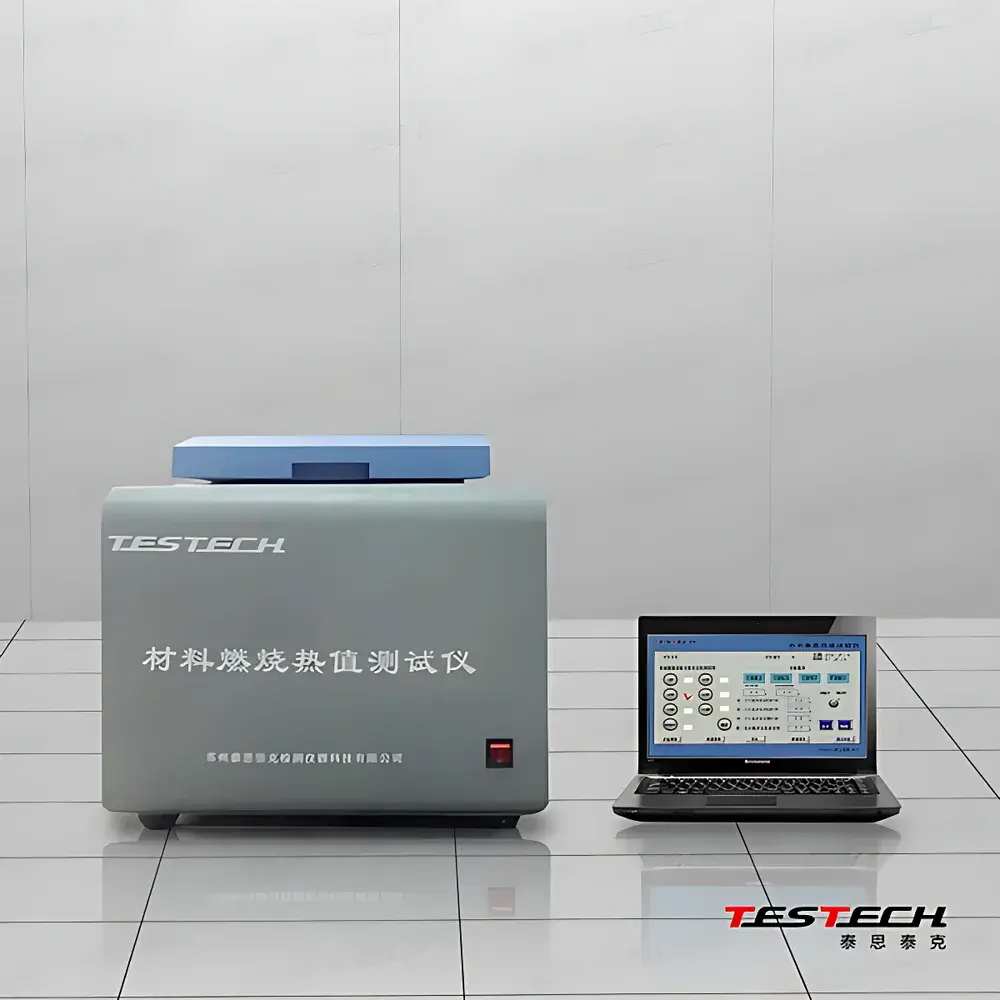
TESTech TTech-GBT14402 Oxygen Bomb Calorimeter for Building Material Combustion Heat Value Testing
| Brand | TESTech |
|---|---|
| Origin | Jiangsu, China |
| Manufacturer Type | Direct Manufacturer |
| Model | TTech-GBT14402 |
| Standard Compliance | GB/T 14402-2007, GB 8624-2012, ISO 1716:2002 |
| Oxygen Bomb Capacity | (300 ± 50) mL |
| Maximum Oxygen Pressure | 3.5 MPa |
| Burst Pressure Rating | 21 MPa |
| Crucible Dimensions | Φ25 mm × (14–19) mm (stainless steel, 1 mm wall thickness) |
| Stirring Power | 3 W |
| Stirring Speed | 375 rpm (inner bucket) |
| Temperature Measurement Range | 4.5–50 °C |
| Temperature Resolution | 0.0001 °C (PT100 sensor) |
| Inner Bucket Volume | 2000 mL |
| Calorimeter Heat Capacity | ~10,000 J/K |
| Heat Capacity Repeatability Error | ≤0.2% |
| Timer Accuracy | ±0.5 s |
| Operating Ambient | 10–35 °C, RH ≤80% |
| Max Power Consumption | 0.5 kW |
| Power Supply | AC 220 V ±10%, 50 Hz |
Overview
The TESTech TTech-GBT14402 Oxygen Bomb Calorimeter is a precision-engineered instrument designed for the quantitative determination of gross calorific value (higher heating value, HHV) of building materials in accordance with GB/T 14402–2007, GB 8624–2012, and ISO 1716:2002. It operates on the principle of adiabatic or near-adiabatic bomb calorimetry: a representative sample is combusted quantitatively under high-purity oxygen pressure within a sealed stainless-steel oxygen bomb immersed in a thermally stabilized water jacket. The resulting temperature rise in the surrounding water medium—measured with sub-millikelvin resolution via calibrated PT100 sensors—is directly proportional to the energy released. This measurement forms the foundational thermal input for fire hazard assessment, including fire load calculation, material classification per combustion performance tiers (A1, A2, B, C, etc.), and regulatory compliance documentation required by national construction codes and fire safety authorities.
Key Features
- Robust stainless-steel construction throughout internal components—including crucible (Φ25 mm, 14–19 mm height, 1 mm wall thickness), oxygen bomb body, and inner bucket—ensures long-term corrosion resistance and ease of cleaning after repeated high-temperature combustion cycles.
- High-integrity oxygen bomb rated for 21 MPa burst pressure and validated for leak-free operation at operational charging pressures of 2.5–3.5 MPa, conforming to ISO 1716 mechanical safety requirements.
- Microprocessor-controlled ignition system with automatic fuse-wire break detection and fail-safe auto-ignition sequence; integrated acoustic alarm triggers upon abnormal pressure rise, temperature deviation, or incomplete combustion events.
- Real-time thermal monitoring using high-stability PT100 platinum resistance thermometers with 0.0001 °C resolution and traceable calibration; temperature data acquisition synchronized with precise 0.5-second timer resolution.
- Dual-mode operation support: manual mode for method validation and training; automated mode for routine testing with full digital logging, curve visualization, and post-run thermal equilibrium verification.
- Modular interface architecture featuring RS232 and USB ports enables seamless integration with external laboratory PCs running Windows-based TESTech CalorSoft™—a GLP-compliant application supporting audit trails, user access levels, and electronic signature capability per FDA 21 CFR Part 11 guidelines.
Sample Compatibility & Compliance
The TTech-GBT14402 accommodates solid, non-volatile, and low-moisture-content building material specimens—including mineral wool, rigid foam insulation, fiber-cement boards, gypsum composites, and fire-retardant treated wood products—as defined in Clause 6 of GB/T 14402–2007. Sample mass is determined gravimetrically prior to loading into the stainless crucible, ensuring stoichiometric oxygen sufficiency during combustion. All test procedures align with mandatory verification protocols outlined in GB 8624–2012 Annex A for Class A1 and A2 non-combustibility certification. Instrument validation includes heat capacity calibration using certified benzoic acid reference material (NIST SRM 39j or equivalent), with repeatability confirmed at ≤0.2% RSD across ≥5 consecutive runs—meeting ISO/IEC 17025 metrological requirements for accredited testing laboratories.
Software & Data Management
TESTech CalorSoft™ v4.2 provides full lifecycle data governance: from test setup (sample ID, operator, ambient conditions) through real-time thermogram display and automatic baseline correction, to final HHV calculation per ASTM D240 / ISO 1928 algorithms. Raw sensor outputs, intermediate corrections (fuse wire, nitric acid formation, cooling correction), and final reports are stored in encrypted binary + CSV dual format. Audit logs record all user actions—including parameter edits, calibration events, and report exports—with timestamps and operator IDs. Export modules support direct integration into LIMS platforms via ODBC and generate PDF reports compliant with CNAS-CL01:2018 documentation standards.
Applications
- Determination of gross calorific value for classification of construction products under GB 8624–2012 fire performance categories.
- Quality control of flame-retardant additives and intumescent coatings during industrial manufacturing.
- Research and development of low-fire-load insulation systems for passive fire protection engineering.
- Third-party certification testing for CE marking (EN 13501-1) and CCC fire safety accreditation in China.
- Validation of thermal decomposition energetics in fire modeling simulations (e.g., CFAST, FDS inputs).
FAQ
What standards does the TTech-GBT14402 fully support?
GB/T 14402–2007, GB 8624–2012, ISO 1716:2002, and technically aligned with ASTM D240 and ISO 1928 for calorific value methodology.
Is the instrument suitable for accredited testing laboratories?
Yes—it meets metrological traceability requirements for ISO/IEC 17025:2017 when operated with NIST-traceable reference materials and documented calibration procedures.
Can test data be exported for regulatory submission?
Yes—CalorSoft™ generates audit-ready PDF reports with embedded digital signatures, metadata, and full raw-data archives compliant with CNAS and provincial fire inspection bureau requirements.
What maintenance is required for long-term accuracy?
Annual recalibration of PT100 sensors and heat capacity verification using certified benzoic acid; biannual inspection of O-ring integrity and oxygen valve sealing performance.
Does the system support remote diagnostics or firmware updates?
Yes—via secure HTTPS-enabled service portal with authenticated technician access; firmware updates preserve all historical calibration constants and user configurations.



