
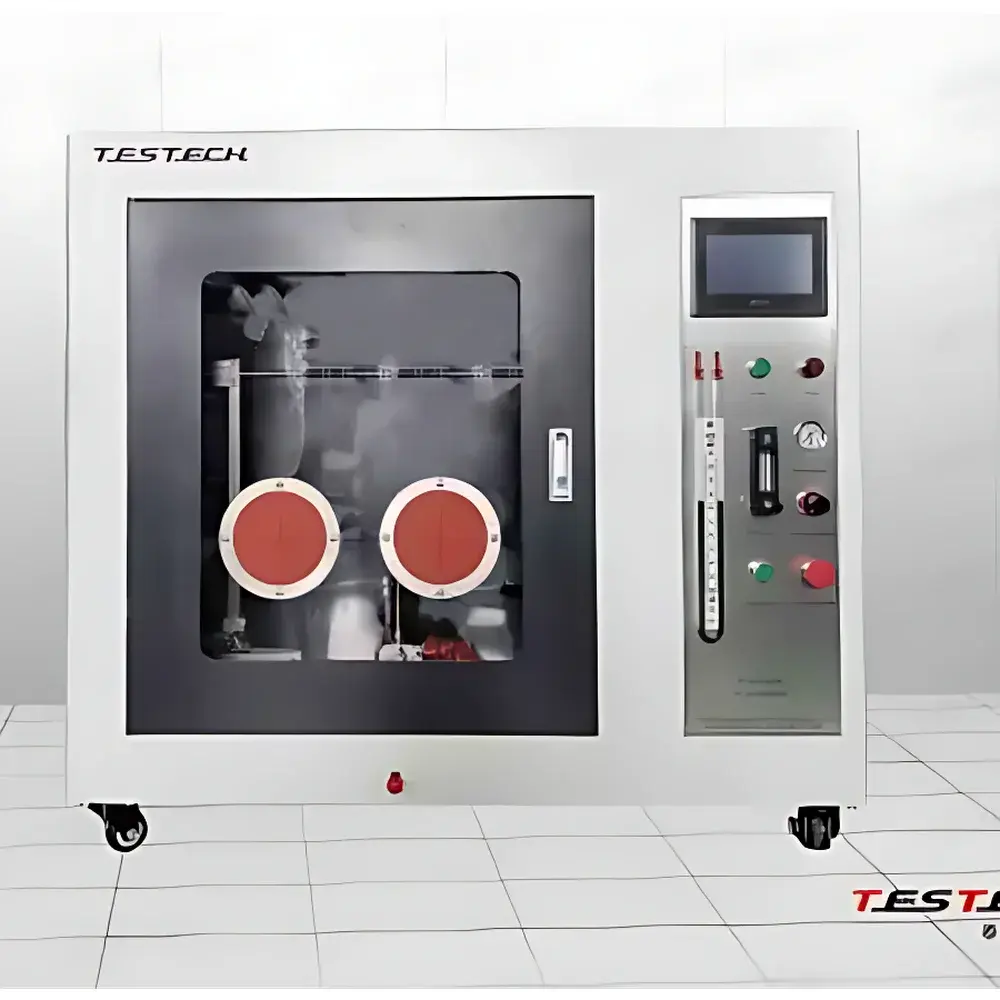
TESTech TTech-UL94 Battery Separator Flame Retardancy Tester
| Brand | TESTech |
|---|---|
| Origin | Jiangsu, China |
| Manufacturer Type | Direct Manufacturer |
| Country of Origin | China |
| Model | TTech-UL94 |
| Price Range | USD 150–300 (FOB) |
| Standards Compliance | UL 94, IEC 60695-11-10, IEC 60707, GB/T 2408, GB 9493, GB/T 8332–2008, ISO 9772, ISO 1210 |
| Chamber Dimensions | 1200 mm (L) × 600 mm (W) × 1300 mm (H) |
| Burner | US-sourced Bunsen burner, tube length 100 ± 10 mm, inner diameter 9.5 ± 0.3 mm |
| Flame Height Adjustment | Stainless steel scale with 304 SS sample holder |
| Gas Flow Control | Precision needle valve + rotameter |
| Air Intake | Adjustable air inlet on burner body |
| Pressure Regulation | High-accuracy pressure regulator and gauge (0–0.4 MPa) |
| Control System | 7-inch programmable touchscreen HMI with PLC logic |
| Calculated Output | Linear burning rate (V), auto-computed and logged |
| Power Supply | 220 V AC, 50/60 Hz |
Overview
The TESTech TTech-UL94 Battery Separator Flame Retardancy Tester is a purpose-built vertical/horizontal combustion test system engineered for precise evaluation of flame propagation behavior in lithium-ion battery components—specifically thermal barrier films, separator membranes, encapsulation plastics, and housing polymers. It operates on the fundamental principle of controlled small-flame ignition under standardized thermal stress conditions, adhering strictly to the dimensional, procedural, and pass/fail criteria defined in UL 94 (2022 edition), IEC 60695-11-10, and GB/T 2408. The instrument replicates real-world fault scenarios—such as localized thermal runaway propagation—by subjecting specimens to calibrated methane or propane flames delivered via a traceable Bunsen burner assembly. Combustion response is quantified through objective metrics: afterflame time (t₁), afterglow time (t₂), drip ignition of surgical cotton indicator, and linear burning rate (V, mm/min)—all automatically derived by embedded PLC logic and displayed in real time.
Key Features
- UL 94-compliant dual orientation capability: supports both vertical (V-0, V-1, V-2) and horizontal (HB) test configurations per specimen mounting geometry and standard requirement.
- US-sourced precision Bunsen burner with certified dimensional tolerances (tube length: 100 ± 10 mm; ID: 9.5 ± 0.3 mm), ensuring repeatable flame geometry and thermal flux profile.
- Independent gas flow and air entrainment control: integrated rotameter and fine-tuning needle valve enable stable stoichiometric adjustment across varying fuel types (CH₄ or C₃H₈).
- Traceable pressure regulation: high-stability 0–0.4 MPa pressure regulator and calibrated gauge meet ISO/IEC 17025 metrological traceability prerequisites for accredited lab use.
- Stainless steel (AISI 304) test chamber interior and sample fixtures—resistant to thermal degradation, corrosion, and residue accumulation over extended testing cycles.
- 7-inch industrial-grade touchscreen HMI with embedded PLC: stores test logs, calculates linear burning rate (V = 60 × L / t, where L = burned length in mm, t = afterflame time in seconds), and exports timestamped CSV reports compliant with GLP audit trails.
Sample Compatibility & Compliance
The TTech-UL94 accommodates rigid and flexible specimens up to 125 mm × 13 mm × ≤13 mm (vertical) or 125 mm × 13 mm × any thickness (horizontal), including microporous polyolefin separators, ceramic-coated films, flame-retardant PET/PEN laminates, and thermoplastic battery housings. All mechanical and operational parameters align with Clause 8 of UL 94 and Annex A of IEC 60695-11-10. The system supports full documentation for regulatory submissions under UN 38.3 Section 3.3.1.2 (thermal abuse simulation), ISO 12405-4 (electric vehicle battery safety), and China’s GB 38031–2020 requirements for electric vehicle traction battery fire resistance. Calibration certificates for burner dimensions, pressure gauges, and timer accuracy are provided upon delivery.
Software & Data Management
The embedded control firmware implements deterministic real-time logic for flame-on timing (±0.1 s accuracy), automatic t₁/t₂ measurement via optical flame detection, and linear burning rate computation per ASTM D635–21 methodology. Test records include operator ID, specimen ID, orientation, flame duration, observed drips, cotton ignition status, and calculated V-value—all stored locally with optional USB export. Audit-ready data fields comply with FDA 21 CFR Part 11 requirements when paired with user-defined electronic signatures and role-based access control (available via optional firmware upgrade). Raw data files are structured in plain-text CSV format for seamless integration into LIMS or QMS platforms.
Applications
- Qualification of ceramic-coated polyethylene separators for V-0 rating under UL 94 V-0 at 1.6 mm thickness.
- Comparative screening of intumescent additives in battery module encapsulation resins.
- Process validation for extruded flame-retardant TPU films used in pouch cell barriers.
- Supplier qualification testing per OEM technical specifications (e.g., CATL, BYD, LG Energy Solution Tier-1 material release protocols).
- Internal R&D assessment of novel cellulose nanofiber-reinforced composites for thermal runaway mitigation.
FAQ
Does the TTech-UL94 support both methane and propane fuel sources?
Yes—the gas train includes interchangeable fittings and calibrated flow settings for both CH₄ and C₃H₈ per UL 94 Section 7.1.2.
Is the instrument suitable for testing ultra-thin (<25 µm) battery separator films?
Yes, with optional micro-fixtures and low-tension clamping to prevent deformation during vertical mounting.
Can test data be exported in formats compatible with ISO/IEC 17025 accredited reporting?
Yes—CSV output includes measurement uncertainty estimates for timer and ruler calibration, satisfying ISO/IEC 17025 Clause 7.7.2.
What maintenance intervals are recommended for the Bunsen burner and pressure regulator?
Burner tip cleaning every 50 tests; pressure regulator recalibration annually or per ISO 9001 internal audit schedule.
Is remote diagnostics supported?
Standard Ethernet port enables Modbus TCP communication for SCADA integration; remote firmware updates require secure VPN access.





