testo 0560 9055 Penetration Thermometer with Extended Range
| Brand | testo |
|---|---|
| Origin | Germany |
| Model | 0560 9055 |
| Temperature Measurement Principle | K-type Thermocouple |
| Measurement Method | Contact |
| Temperature Range | −50 to +350 °C (short-term up to +500 °C) |
| Resolution | 0.1 °C |
| Accuracy | ±1 °C (−50 to +99.9 °C), ±1 % of reading (remaining range) |
| Stability | ±1 °C (−50 to +99.9 °C), ±1 % of reading (remaining range) |
| Response Time (t₉₉) | 10 s in water |
| Weight | 80 g |
| Dimensions (L×W×H) | 270 × 40 × 70 mm |
| Probe Sheath Length | 200 mm |
| Probe Tip Length | 4 mm |
| Probe Rod Diameter | 3 mm |
| Display | Single-line LCD |
| Operating Temperature | 0 to +40 °C |
| Storage Temperature | −20 to +70 °C |
| Housing Material | ABS |
| Power Supply | 3 × AAA batteries (rechargeable) |
| Battery Life | Up to 1000 h |
| CE Marking | 2014/30/EU |
Overview
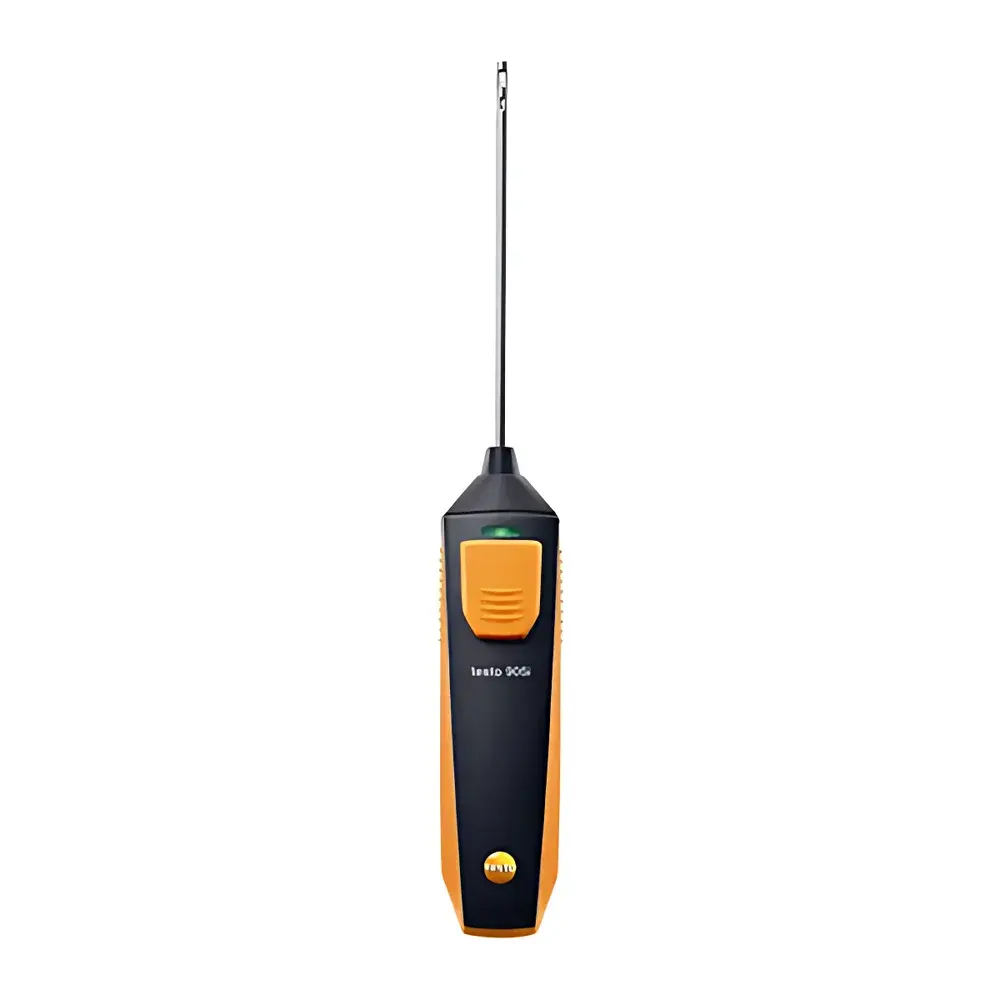
The testo 0560 9055 is a high-performance penetration thermometer engineered for precision contact temperature measurement across demanding industrial, laboratory, and quality assurance environments. Built upon a calibrated K-type thermocouple sensing element, it operates on the Seebeck principle—generating a voltage proportional to the temperature gradient between the probe tip and reference junction—to deliver traceable, repeatable thermal readings. Its extended operational range of −50 to +350 °C—with short-term capability up to +500 °C for transient process monitoring—makes it suitable for applications where thermal extremes are encountered, including sterilization validation, thermal profiling of ovens and furnaces, and high-temperature food safety checks. The instrument’s compact, ergonomic design, combined with a rotatable LCD display and robust ABS housing, ensures reliable field use under variable ambient conditions (0 to +40 °C operating range). With a t₉₉ response time of just 10 seconds in water, the device meets ISO 80601-2-56 requirements for clinical thermometers and aligns with ASTM E74–22 for thermocouple calibration verification protocols.
Key Features
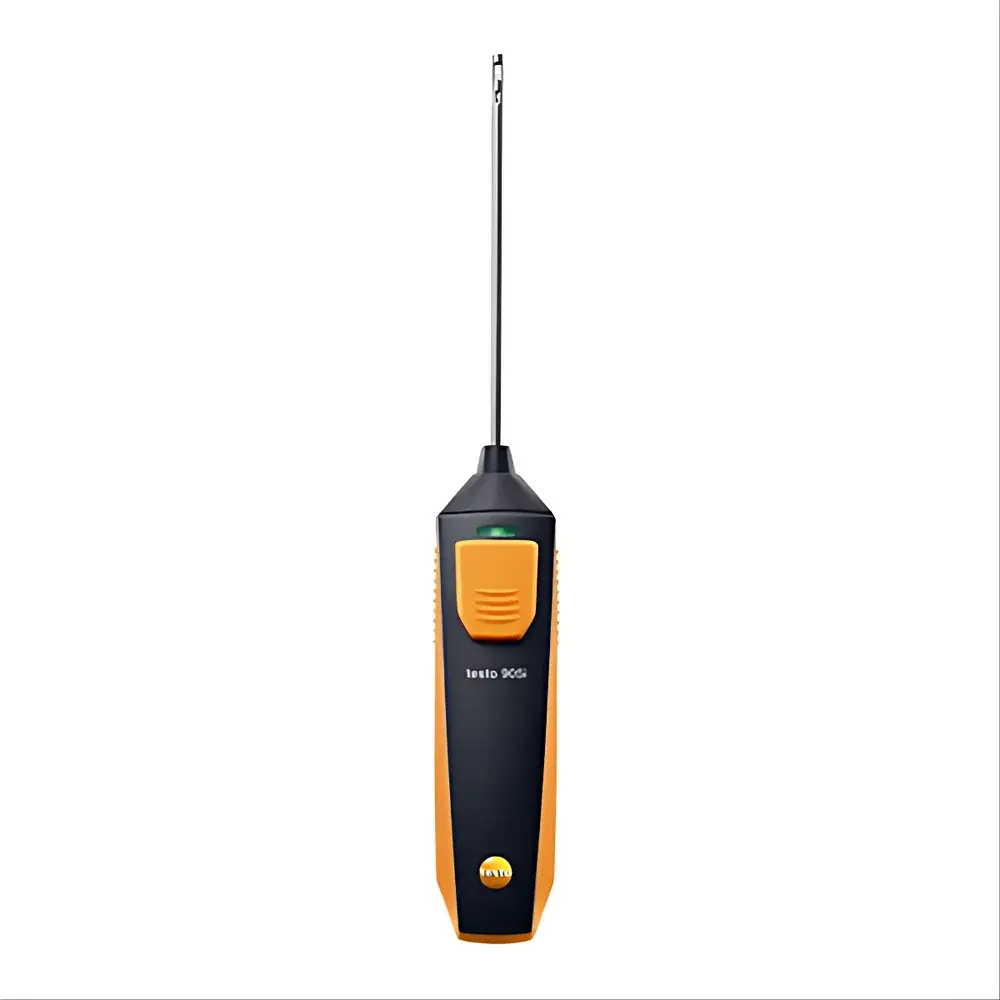
- K-type thermocouple probe with 200 mm stainless steel sheath (3 mm diameter, 4 mm active tip length) optimized for rapid thermal equilibration in liquids, semi-solids, powders, and air streams
- Rotatable single-line LCD display enabling optimal viewing from multiple angles—critical for overhead duct measurements or confined workspaces
- High-resolution readout at 0.1 °C across full scale, supporting fine-grained process control and deviation tracking
- Extended-range capability validated per IEC 60584-1:2013 for K-type thermocouples, with documented short-term tolerance up to +500 °C (≤120 s)
- Lightweight construction (80 g) and integrated clip for hands-free mounting on lab benches, pipework, or packaging lines
- Long-life power system: 3 × AAA rechargeable batteries delivering up to 1000 hours of continuous operation—minimizing downtime in regulated environments
Sample Compatibility & Compliance
The testo 0560 9055 is validated for direct insertion into heterogeneous media including aqueous solutions, viscous food matrices (e.g., sauces, doughs), pharmaceutical suspensions, HVAC duct airflow, and surface-contact thermal mapping. Its probe geometry complies with EN 13485:2019 for medical device validation and supports GLP/GMP-compliant temperature verification workflows. The device carries CE marking under Directive 2014/30/EU (EMC Directive), confirming electromagnetic compatibility in shared laboratory instrumentation environments. While not intrinsically safe, its non-sparking ABS enclosure and low-voltage circuitry meet general-purpose industrial safety expectations per IEC 61010-1:2010. Calibration certificates traceable to national standards (e.g., PTB, NIST) can be issued upon request for audit-ready documentation.
Software & Data Management
The testo 0560 9055 operates as a standalone instrument with no embedded data logging or Bluetooth connectivity; however, it is fully compatible with external validation systems used in regulated settings. Users may manually record values into electronic lab notebooks (ELNs) compliant with FDA 21 CFR Part 11 when paired with audit-trail-enabled software platforms. For routine calibration management, the device supports periodic verification using certified dry-block calibrators (e.g., Fluke 914x series) or ice-point reference baths per ISO/IEC 17025:2017 requirements. Its stable baseline performance—±1 °C drift over 12 months under typical usage—reduces recalibration frequency without compromising measurement integrity.
Applications
- Food safety: Core temperature monitoring during cooking, chilling, and reheating per HACCP critical control points
- Pharmaceutical manufacturing: In-process temperature verification of lyophilizers, autoclaves, and mixing vessels
- Chemical R&D: Reaction mixture profiling in jacketed reactors and distillation columns
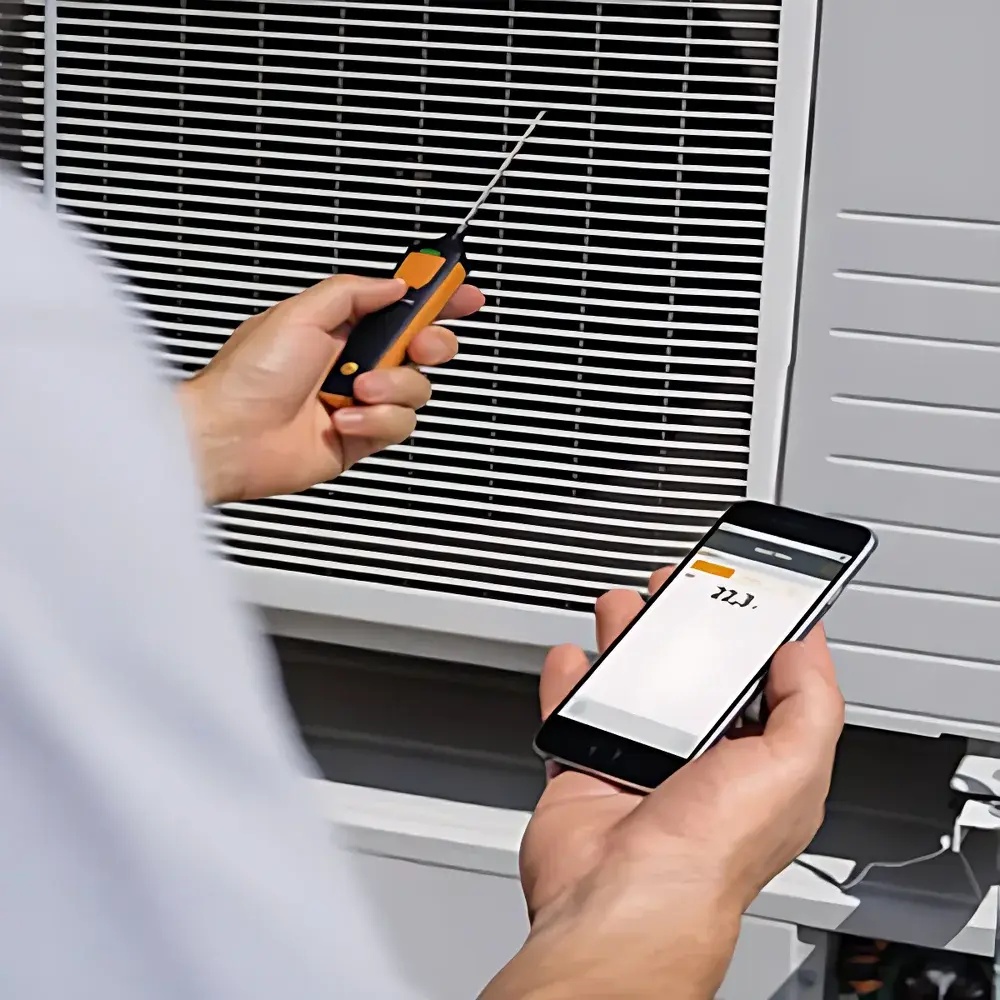
- HVAC commissioning: Air temperature sampling in supply/return ducts and coil surfaces
- Materials testing: Thermal stability assessment of polymers, adhesives, and composites during curing cycles
- Academic labs: Teaching thermocouple fundamentals and transient heat transfer experiments
FAQ
What is the maximum allowable immersion depth for the probe?
The 200 mm probe sheath is rated for full immersion in non-corrosive liquids; however, prolonged exposure above +350 °C is limited to ≤2 minutes to preserve thermocouple wire integrity.
Can this thermometer be used for surface temperature measurements?
It is not designed for surface contact; the conical tip requires penetration into the medium for accurate thermal coupling—use testo 805i or 835-H1 for non-invasive surface thermography.
Is the battery replaceable in the field?
Yes—three standard AAA rechargeable cells are user-accessible via a screwless battery compartment cover, requiring no tools for replacement.
Does the device support external probe interchangeability?
No—the K-type thermocouple is permanently integrated into the probe assembly; interchangeable probes are available only in testo’s modular 112/175 series loggers.
How often should calibration be performed?
Annual calibration is recommended for GxP environments; more frequent checks (e.g., pre- and post-shift) are advised when used in critical thermal processes governed by ISO 13485 or USP .