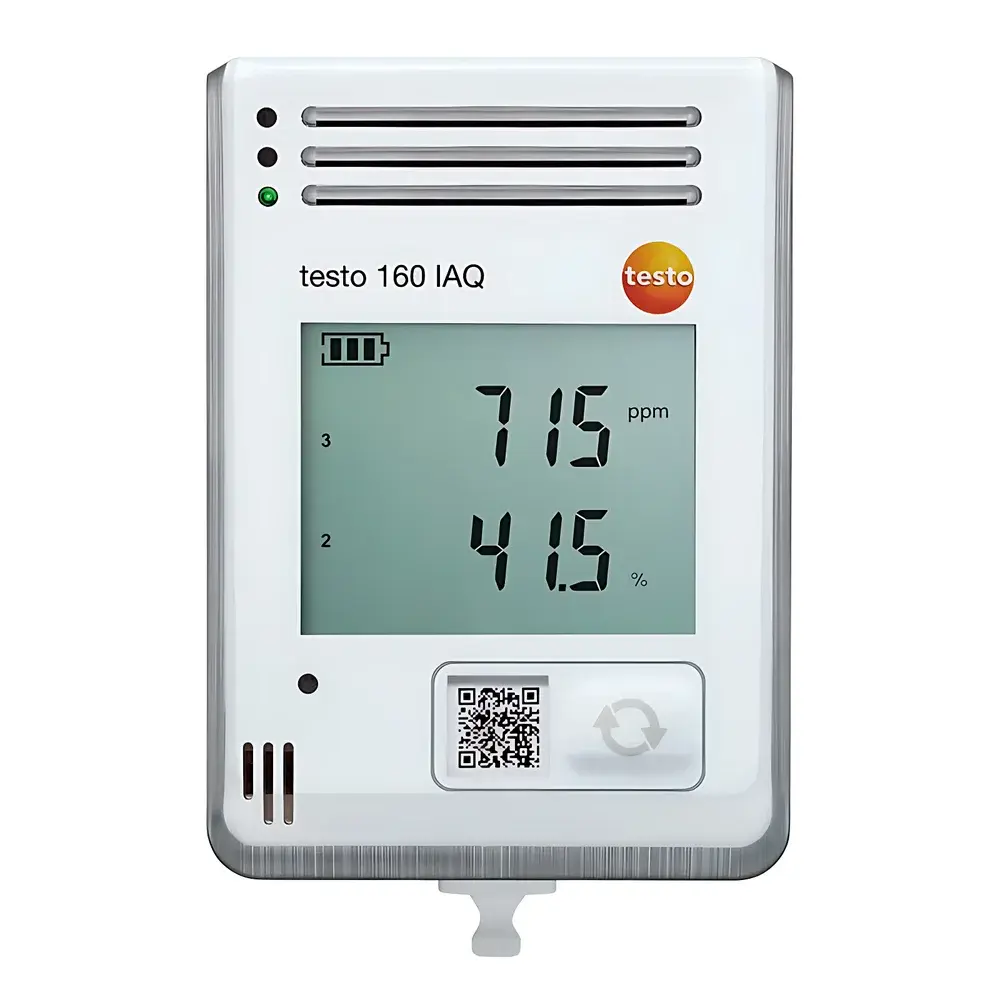
testo 160 IAQ Wireless Indoor Air Quality Monitoring System
| Brand | testo |
|---|---|
| Origin | Germany |
| Model | 0572 2014 |
| Channel Count | Multi-channel |
| Communication Protocol | IEEE 802.11 b/g/n, IEEE 802.1X (WPA2-Enterprise & WPA2-Personal) |
| Measurement Parameters | Temperature (0–50 °C, ±0.5 °C), Relative Humidity (0–100 %RH, ±2.0 %RH @ 20–80 %RH), CO₂ (0–5000 ppm, ±(50 ppm + 3 % of reading)), Barometric Pressure (600–1100 mbar, ±3 mbar) |
| Data Logging Interval | 1 min to 24 h (license-dependent) |
| Onboard Storage | 32,000 readings |
| Battery Life | Up to 12 months (4 × AA alkaline) |
| Enclosure | PC-ABS, IP20 |
| Dimensions | 117 × 82 × 32 mm (L×W×H) |
| Weight | 269 g |
Overview
The testo 160 IAQ Wireless Indoor Air Quality Monitoring System is an engineered solution for continuous, unattended environmental monitoring in non-industrial indoor spaces where human occupancy, comfort, and long-term preservation of sensitive assets are critical. Designed around a multi-sensor architecture compliant with ISO 7726 (Ergonomics of the thermal environment) and aligned with ASHRAE Standard 62.1 (Ventilation for Acceptable Indoor Air Quality), the system measures four core parameters—temperature, relative humidity, carbon dioxide concentration, and barometric pressure—to quantify thermal comfort, ventilation adequacy, and air stability. Its operation relies on calibrated electrochemical CO₂ sensing (NDIR principle), capacitive humidity measurement, platinum resistance temperature detection (Pt1000-class accuracy), and piezoresistive absolute pressure transduction. All sensors are factory-calibrated and traceable to national standards, with documented annual drift specifications supporting long-term data integrity. The device operates autonomously via internal alkaline batteries or optional USB power, transmitting encrypted measurement data directly to the testo Cloud via secure WLAN—eliminating the need for local gateways or proprietary hardware infrastructure.
Key Features
- Four-parameter simultaneous monitoring: temperature, RH, CO₂, and barometric pressure—each with metrologically validated accuracy and documented uncertainty budgets.
- Real-time visual feedback via tri-color LED indicator (traffic-light logic) configurable per CO₂ threshold; LED automatically deactivates during battery operation to preserve runtime.
- Cloud-native architecture: all measurements stored redundantly on ISO/IEC 27001-certified servers; no local SD card or PC dependency required for data persistence.
- Flexible sampling and transmission intervals: 1 minute to 24 hours, adjustable per license tier (Basic or Advanced), enabling optimization between temporal resolution and battery longevity.
- IP20-rated, low-profile enclosure (117 × 82 × 32 mm) with optional custom decorative faceplates—designed for discreet integration into heritage-sensitive environments including museums, archives, galleries, and historic buildings.
- Comprehensive security stack: WPA2-Enterprise support with EAP-TLS, EAP-PEAP, and EAP-TTLS authentication; TLS 1.2+ encryption for all cloud communications; role-based user access control in Advanced license mode.
Sample Compatibility & Compliance
The testo 160 IAQ is validated for deployment in occupied indoor environments ranging from open-plan offices and educational facilities (classrooms, lecture halls, kindergartens) to climate-critical cultural institutions (museums, libraries, archival storage rooms). It complies with DIN EN 13779 (Ventilation for non-residential buildings), supports GLP-aligned data governance through audit-trail-enabled cloud logging, and meets essential requirements of the EU’s Energy Performance of Buildings Directive (EPBD) Annex I for IAQ verification. While not certified for hazardous locations or medical-grade applications, its sensor performance aligns with ISO 16814 (Indoor air quality — Guidelines for the assessment) and provides traceable inputs for LEED v4.1 EQ Credit: Indoor Air Quality Assessment and BREEAM Hea02 compliance reporting. Calibration certificates (included) conform to ISO/IEC 17025 principles and reference NIST-traceable standards.
Software & Data Management
Data acquisition, configuration, and analysis occur exclusively via the testo Cloud web platform (accessible from any HTML5-compliant browser). The Basic license includes unlimited device registration, real-time dashboards, historical trend visualization, export to CSV/PDF, and email alerting on parameter excursions. The Advanced license adds SMS notifications, multi-user account management (up to 10 roles), custom alarm logic (e.g., sustained CO₂ > 1000 ppm for >15 min), and extended retention policies. All data entries include embedded timestamps, device ID, sensor status flags, and cryptographic hash signatures—enabling forensic reconstruction and regulatory readiness for FDA 21 CFR Part 11 (electronic records/signatures) and EU Annex 11 (Computerized Systems) assessments when deployed under formal QA/QC protocols. No local software installation or database administration is required.
Applications
- Facility & HVAC Optimization: Continuous validation of ventilation rates via CO₂ decay analysis; identification of thermal stratification and humidity gradients across zones.
- Cultural Heritage Preservation: Monitoring microclimatic stability in display cases and storage vaults to prevent hygrothermal stress on organic artifacts (textiles, parchment, wood).
- Occupant Health & Productivity: Correlating IAQ metrics with absenteeism or cognitive performance indicators in schools and corporate campuses per WHO and CIBSE TM44 guidance.
- Post-Occupancy Evaluation (POE): Objective benchmarking of building performance against design intent, supporting ISO 52000-1 energy management system certification.
- Regulatory Documentation: Generating auditable records for ISO 9001 (clause 7.1.5.2), ISO 14001 (clause 9.1.1), and ISO 45001 (clause 9.1.1) environmental and occupational health surveillance requirements.
FAQ
Is the testo 160 IAQ suitable for outdoor or industrial environments?
No. It is rated IP20 and specified for indoor use only, within 0–50 °C and non-condensing humidity conditions. It is not designed for explosive atmospheres, high particulate loads, or corrosive chemical exposure.
Can measurement data be exported for third-party analysis (e.g., MATLAB, Python, or SQL databases)?
Yes. Raw time-series data can be downloaded in CSV format with UTC timestamps, sensor metadata, and quality flags—enabling integration into statistical modeling pipelines or enterprise BI tools.
Does the device support local data retrieval without internet connectivity?
No. The testo 160 IAQ lacks USB mass storage or Bluetooth; it requires active WLAN to transmit data to the cloud. Local readout is limited to basic values on the LCD screen (CO₂ + temperature during battery operation; CO₂ + temperature + RH during USB power).
How is calibration maintained over time?
Factory calibration is performed using traceable reference standards. Annual recalibration is recommended per ISO/IEC 17025 guidelines; testo offers accredited recalibration services with full uncertainty reporting. Humidity sensor drift is specified as ≤ ±1.0 %RH/year.
What happens if the WLAN connection is interrupted?
Measurements continue locally and are buffered in the 32,000-entry memory. Once connectivity resumes, the device synchronizes all pending data chronologically—preserving temporal continuity without interpolation or gap-filling.