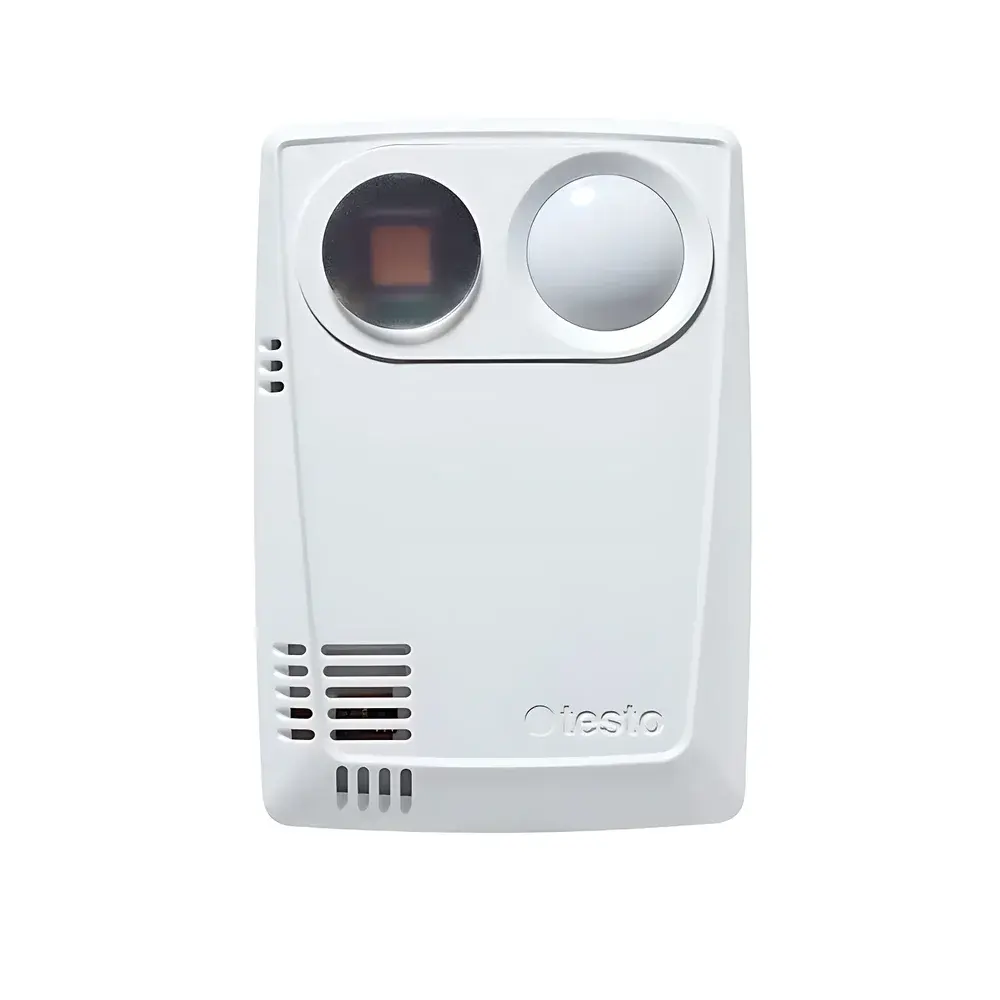
testo 160 THL Wireless Environmental Monitoring System
| Brand | testo |
|---|---|
| Origin | Germany |
| Model | 0572 2024 |
| Channel Count | Multi-channel |
| IP Rating | IP20 |
| Dimensions | 92 × 64 × 24 mm |
| Weight | 113 g |
| Operating Temperature | −10 to +50 °C |
| Humidity Range | 0–100 %RH (non-condensing) |
| Temp Range | −10 to +50 °C |
| Illuminance Range | 0–20,000 lux |
| UV Range | 0–10,000 mW/m² |
| Memory Capacity | 40,000 measurements |
| Battery Life | Up to 18 months (4 × AAA alkaline) |
| Communication | IEEE 802.11 b/g/n, WPA2-Enterprise & WPA2-Personal (AES/TKIP/WEP), EAP-TLS/TTLS/PEAP variants |
| Sampling Interval | 1 min – 24 h (cloud-tier dependent) |
| Compliance | DIN 5032-7 Class C (illuminance), ISO 11783-12 (wireless data integrity), GLP/GMP-aligned audit trail via testo Cloud |
Overview
The testo 160 THL Wireless Environmental Monitoring System is a purpose-built, multi-sensor data logger engineered for continuous, unattended monitoring of environmental parameters critical to the preservation of sensitive cultural heritage assets. Designed specifically for museums, archives, galleries, and conservation laboratories, the system integrates four high-fidelity sensors—capacitive humidity, precision thermistor-based temperature, silicon photodiode illuminance, and broadband UV radiometric—within a single compact, low-profile housing (92 × 64 × 24 mm). Its measurement architecture adheres to metrological principles defined in DIN 5032-7 Class C for luminous flux quantification and follows traceable calibration protocols aligned with ISO/IEC 17025-accredited reference standards. Unlike generic loggers, the testo 160 THL operates as a node within a cloud-managed ecosystem, enabling real-time validation of environmental stability against predefined conservation thresholds—essential for compliance with ICOM-CC guidelines, PAS 198:2012, and BS EN 16893:2018 for preventive conservation.
Key Features
- Quadruple-sensor fusion: Simultaneous acquisition of temperature (−10 to +50 °C, ±0.5 °C accuracy), relative humidity (0–100 %RH, ±2.0 %RH at 20–80 %RH), illuminance (0–20,000 lux, Class C compliant), and UV irradiance (0–10,000 mW/m², ±5 mW/m² absolute or ±5 % relative error)
- IP20-rated enclosure with modular decorative faceplates—enabling seamless visual integration into exhibition cases, vitrines, or wall-mounted display environments without compromising aesthetic integrity
- 40,000-measurement internal memory with timestamped, channel-specific storage; data retention remains intact during WLAN outages and resumes synchronization automatically upon reconnection
- Flexible power architecture: Operates on four AAA alkaline cells (rated for up to 18 months under typical 15-min sampling), or optionally via USB-powered operation using an external 5 V DC supply (accessory sold separately)
- Robust wireless security stack supporting IEEE 802.1X authentication with EAP-TLS, PEAP, TTLS, and legacy WPA/WPA2-PSK modes—ensuring encrypted, enterprise-grade transmission compliant with institutional IT policies
- Configurable sampling intervals from 1 minute (Advanced Cloud tier) to 24 hours (Basic tier), with granular control over alarm hysteresis, delay timers, and escalation paths
Sample Compatibility & Compliance
The testo 160 THL is validated for long-term deployment in climate-sensitive microenvironments—including sealed display cases, archival storage rooms, transport crates, and conservation workspaces. Its non-condensing RH range (0–100 %RH) and stable thermistor response across −10 to +50 °C ensure reliable operation under fluctuating ambient conditions common in historic buildings. All sensor calibrations are traceable to national metrology institutes (e.g., PTB, NPL), and each unit ships with a factory-issued calibration certificate referencing ISO/IEC 17025 requirements. The system supports audit-ready documentation workflows: all configuration changes, alarm events, and user logins are immutably logged in testo Cloud with time-stamped, cryptographically signed entries—meeting GLP and GMP documentation expectations per FDA 21 CFR Part 11 Annex 11 principles. It complies with DIN 5032-7 for photometric accuracy and aligns with CEN/TS 16103:2010 for UV exposure assessment in cultural property contexts.
Software & Data Management
Data acquisition, visualization, and reporting are centralized through testo Cloud—a secure, ISO 27001-certified SaaS platform hosted in EU-based data centers. Users access real-time dashboards, historical trend charts, and statistical summaries (min/max/mean/deviation) via any HTML5-compliant browser or the official testo Cloud mobile app. The platform supports role-based access control (RBAC), enabling administrators to assign read-only or full-config privileges across up to 10 users (Advanced tier). Alarm notifications are configurable per parameter and threshold—triggering email alerts immediately upon deviation, with optional SMS delivery (requires Advanced subscription and carrier gateway integration). All raw measurement files are exportable in CSV and PDF formats, including embedded metadata (sensor ID, firmware version, calibration date). Audit logs retain full provenance for every data point, satisfying ISO 9001 clause 8.5.2 and museum accreditation reporting requirements.
Applications
- Preventive conservation monitoring of paintings, manuscripts, textiles, and organic artifacts in permanent and temporary exhibitions
- Validation of HVAC performance and microclimate stability inside museum display cases and archival cabinets
- UV dose accumulation tracking for light-sensitive materials (e.g., fugitive dyes, cellulose acetate film)
- Compliance verification for loan agreements requiring documented environmental histories (e.g., Getty Conservation Institute lending protocols)
- Baseline environmental profiling during building retrofit projects or gallery reconfiguration
- Long-term trend analysis for climate resilience planning in heritage institutions
FAQ
Does the testo 160 THL require manual firmware updates?
No—firmware updates are delivered automatically over-the-air via testo Cloud when connected to a configured WLAN network.
Can multiple testo 160 THL units be managed under a single cloud account?
Yes—each testo Cloud account supports unlimited device registration; the Advanced tier enables centralized alarm routing and cross-device correlation analysis.
Is the UV sensor calibrated for UVA, UVB, or broad-spectrum irradiance?
The integrated UV sensor measures total broadband UV irradiance (280–400 nm) in mW/m², optimized for conservation-relevant spectral weighting and traceable to NIST-traceable reference sources.
What happens if the WLAN connection is lost during operation?
All measurements continue locally with full timestamping and are queued for automatic upload once connectivity is restored—no data loss occurs.
Can historical data be exported for third-party analysis or institutional archiving?
Yes—CSV exports include ISO 8601 timestamps, sensor channel identifiers, and measurement units; PDF reports embed digital signatures for archival authenticity.