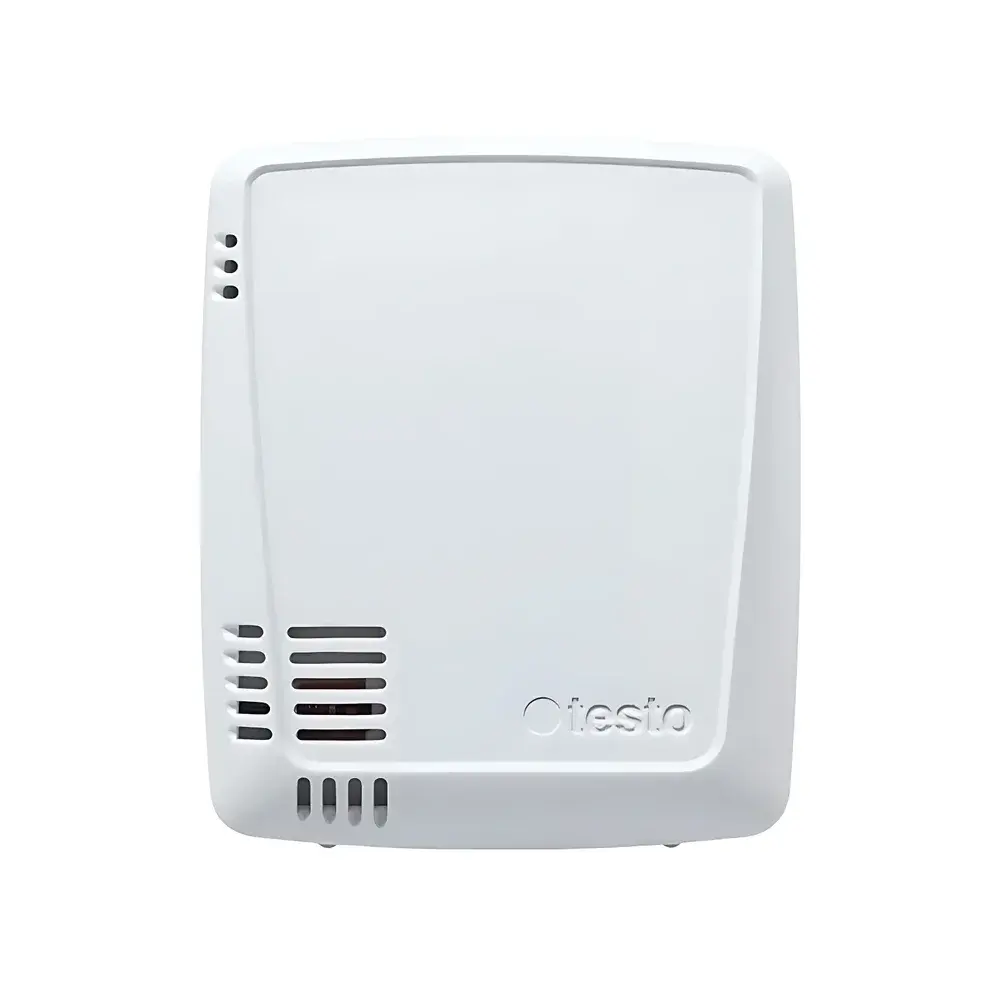
testo 160 TH Wireless Temperature & Humidity Monitoring System
| Brand | testo |
|---|---|
| Origin | Germany |
| Model | 0572 2021 |
| Channel Count | Multi-channel |
| Sensor Type | Integrated capacitive humidity & NTC temperature sensors |
| Humidity Range | 0–100 %RH (non-condensing) |
| Humidity Accuracy | ±2.0 %RH (20–80 %RH, +25 °C), ±3.0 %RH (<20 or >80 %RH, +25 °C) |
| Annual Drift | ±1.0 %RH |
| Humidity Resolution | 0.1 %RH |
| Temperature Range | −10 to +50 °C |
| Temperature Accuracy | ±0.5 °C |
| Temperature Resolution | 0.1 °C |
| Data Storage Capacity | 40,000 readings |
| Battery Life | Up to 18 months (4 × AAA alkaline) |
| Power Options | USB-powered (optional external power unit) |
| Enclosure Rating | IP20 |
| Dimensions | 76 × 64 × 22 mm |
| Weight | 94 g |
| Operating Temp. | −10 to +50 °C |
| Wireless Protocol | IEEE 802.11 b/g/n, 802.1X |
| Security | WPA2-Enterprise (EAP-TLS, EAP-TTLS variants), WPA2-Personal (AES), WPA (TKIP), WEP |
| Cloud Upload Interval | 1 min – 24 h (license-dependent) |
| Compliance | CE, RoHS, FCC Part 15 Subpart B |
Overview
The testo 160 TH Wireless Temperature & Humidity Monitoring System is an ISO/IEC 17025-aligned environmental monitoring solution engineered for continuous, unattended surveillance of climate-sensitive environments—including museum galleries, archival storage vaults, conservation laboratories, and controlled logistics zones. Based on capacitive relative humidity (RH) sensing and precision NTC thermistor technology, the device delivers traceable, long-term stable measurements compliant with DIN EN 60751 and ISO 11783-12 standards for sensor performance. Its compact form factor (76 × 64 × 22 mm) and IP20-rated enclosure enable discreet deployment inside display cases, behind framing, or within HVAC ducts—without compromising aesthetic integrity or spatial constraints. All measurement data are transmitted via secure IEEE 802.11 b/g/n Wi-Fi to the testo Cloud platform, where time-stamped records undergo automatic validation, trend analysis, and audit-ready export. The system operates autonomously for up to 18 months on standard AAA alkaline cells, with optional USB-powered operation for permanently installed applications.
Key Features
- Integrated dual-parameter sensing: High-stability capacitive RH sensor (0–100 %RH, non-condensing) and calibrated NTC temperature probe (−10 to +50 °C)
- Onboard memory capacity of 40,000 timestamped readings per device, supporting gap-free logging during temporary network outages
- Configurable measurement intervals from 1 minute to 24 hours—adjustable remotely via cloud interface based on license tier (Basic or Advanced)
- Enterprise-grade wireless security: Full support for WPA2-Enterprise authentication protocols including EAP-TLS, EAP-TTLS (with MSCHAPv2, PSK, TLS), and EAP-PEAP variants—ensuring compliance with institutional IT policies and GDPR-aligned data handling requirements
- Modular physical integration: Optional custom decorative faceplates allow seamless visual integration into heritage interiors, exhibition mounts, or archival shelving systems
- Cloud-native architecture: Real-time dashboards, multi-user role management (up to 10 users per Advanced account), automated email/SMS alerts upon threshold violation, and full GLP/GMP-compatible audit trails
Sample Compatibility & Compliance
The testo 160 TH is validated for use in environments governed by ISO 14744 (conservation of cultural property), ASTM E1822 (standard guide for environmental monitoring in museums), and EN 16893:2017 (specification for heritage buildings). It meets the humidity stability requirements outlined in BS 4971:2017 for archival storage and supports adherence to IIC–ICC environmental guidelines for organic materials. All factory calibrations are performed against NIST-traceable reference standards, and each unit ships with a documented calibration protocol. The device conforms to CE marking directives (2014/30/EU EMC, 2014/53/EU RED), RoHS 2011/65/EU, and FCC Part 15 Subpart B for intentional radiators. Data integrity complies with FDA 21 CFR Part 11 principles when used with Advanced-tier cloud features enabling electronic signatures and immutable audit logs.
Software & Data Management
Data acquisition, configuration, and reporting occur exclusively through the testo Cloud web application (accessible via any modern browser on desktop or mobile devices). No local software installation is required. Users configure alarm thresholds, define notification recipients, assign devices to logical zones (e.g., “East Wing Gallery”, “Sub-Basement Vault”), and generate PDF reports with embedded graphs and metadata. The system supports CSV and Excel exports with ISO 8601 timestamps and UTC synchronization. Advanced-tier accounts provide extended functionality: SMS alerting, multi-level user permissions (admin/operator/viewer), custom dashboard widgets, and automated weekly summary emails. All data reside in ISO 27001-certified EU-based servers; encryption at rest (AES-256) and in transit (TLS 1.2+) ensure confidentiality and regulatory alignment.
Applications
- Continuous environmental validation of museum display cases and storage rooms per CEN/TS 16103:2010
- Long-term monitoring of paper-based archives, photographic collections, and textile repositories under BS 4971:2017
- Real-time verification of HVAC performance in heritage-listed buildings during seasonal transitions
- Transport condition logging for loaned artifacts using portable deployment kits
- Baseline climate profiling prior to conservation treatment interventions
- Compliance documentation for insurance audits, accreditation reviews (e.g., AAM, ICOM), and grant-funded preservation projects
FAQ
Is the testo 160 TH suitable for use in cold storage environments below 0 °C?
No—the operational temperature range is strictly −10 to +50 °C. For sub-zero applications, consider the testo 174 series with extended low-temperature variants.
Can measurement data be exported in formats compatible with LIMS or institutional database systems?
Yes—CSV and XLSX exports include all raw values, timestamps, device IDs, and status flags. API access is available under enterprise licensing agreements.
Does the system support calibration verification without returning the device to the manufacturer?
Field verification is possible using testo’s certified portable reference hygrometer (e.g., testo 650) and documented comparison procedures aligned with ISO/IEC 17025 clause 6.6.
How is data integrity maintained during Wi-Fi interruptions?
All measurements are stored locally in non-volatile memory until reconnection; no data loss occurs during outages of up to several weeks, depending on logging interval.
Is the testo Cloud platform validated for use in regulated GxP environments?
While not formally 21 CFR Part 11 validated out-of-the-box, the Advanced-tier cloud service provides electronic signature capability, audit trail generation, and role-based access control—enabling customers to complete internal validation per their SOPs.