
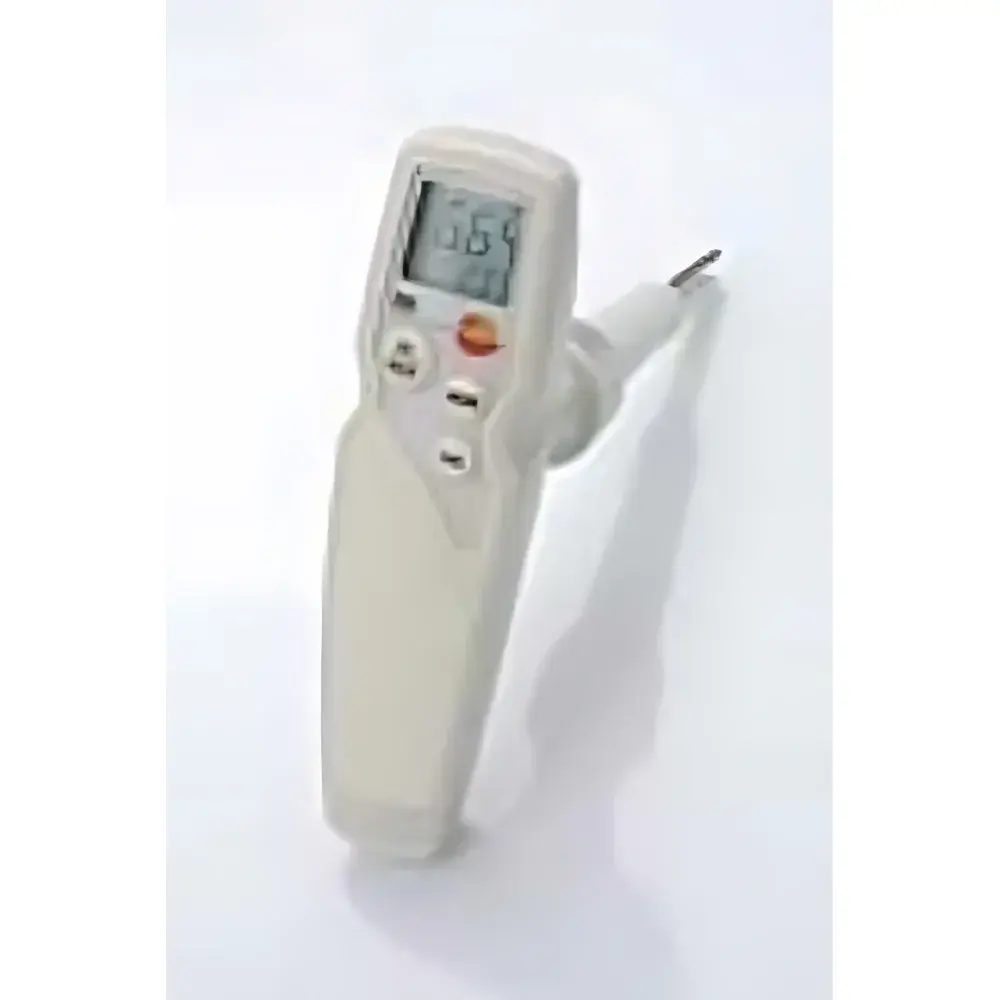
testo 205 Portable pH and Temperature Meter
| Brand | testo |
|---|---|
| Origin | Germany |
| Model | 0563 2051 |
| Instrument Type | Portable |
| Parameter Types | pH & Temperature |
| pH Range | 0–14 pH |
| pH Resolution | 0.01 pH |
| pH Accuracy | ±0.02 pH |
| Temperature Range (NTC) | 0–60 °C (short-term up to +80 °C for ≤5 min) |
| Temperature Accuracy | ±0.4 °C |
| Temperature Resolution | 0.1 °C |
| Calibration | 1-, 2-, or 3-point with NIST-traceable buffers |
| Electrolyte | Replaceable gel electrolyte |
| Probe Tip Diameter | 11 mm |
| Probe Shaft Length | 25 mm |
| Display | Dual-line backlit LCD |
| Housing Material | ABS |
| Protection Rating | IP65 |
| Weight | 135 g |
| Dimensions (L×W×H) | 145 × 38 × 167 mm |
| Operating Temperature | 0–50 °C |
| Storage Temperature | −20–+70 °C |
| Battery | LR44 button cell (≈80 h operation) |
| Compliance | CE 2014/30/EU |
Overview
The testo 205 is a purpose-engineered portable pH and temperature meter designed specifically for reliable, repeatable measurements in semi-solid matrices—particularly in food production environments where rapid, on-site assessment of meat quality, freshness, and process compliance is critical. Unlike general-purpose benchtop or handheld pH meters, the testo 205 integrates a robust, immersion-optimized pH electrode with an embedded NTC temperature sensor, enabling simultaneous, auto-compensated pH and temperature readings in accordance with ISO 29181 (meat pH determination) and AOAC Official Method 985.17. Its measurement principle relies on potentiometric detection across a glass pH membrane referenced against a stable gel-filled Ag/AgCl system, with built-in temperature compensation eliminating manual correction steps. The instrument’s mechanical architecture—including a reinforced 11 mm-diameter probe shaft and dual-membrane gel cap—ensures resistance to clogging, mechanical stress, and contamination during repeated insertion into dense, heterogeneous samples such as fresh muscle tissue, sausages, or cured products.
Key Features
- Integrated pH and temperature sensing in a single, field-rugged probe—no external thermocouple required
- Replaceable gel electrolyte cartridge: extends electrode service life and eliminates refilling maintenance
- Dual-membrane gel protection cap: prevents fouling from fats, proteins, and particulates common in meat processing
- Auto-endpoint recognition (Auto-Hold): locks stable readings with visual indicator, reducing operator variability
- Backlit dual-line LCD display: shows pH value and temperature simultaneously, optimized for low-light production floors
- IP65-rated ABS housing: dust-tight and protected against low-pressure water jets—suitable for wet processing zones
- Calibration flexibility: supports 1-, 2-, or 3-point calibration using NIST-traceable buffer solutions (pH 4.01, 7.00, 10.01)
- LR44 battery design: delivers ~80 hours of continuous operation; battery replacement requires no recalibration
Sample Compatibility & Compliance
The testo 205 is validated for direct insertion into semi-solid food matrices including raw and processed meats (beef, pork, poultry), dairy curds, fermented sausages, and seafood products. Its 25 mm probe length and tapered tip ensure penetration without excessive sample disruption, while the gel-filled reference system maintains stable junction potential even under high-protein load. Regulatory alignment includes compliance with EU Regulation (EC) No 853/2004 (hygiene rules for food of animal origin), ISO 29181:2015 (determination of pH in meat), and HACCP prerequisite programs requiring documented pH monitoring at slaughter, chilling, and curing stages. The device meets CE marking requirements per Directive 2014/30/EU (EMC) and carries no intrinsic safety certification—intended for use in non-explosive atmospheres only.
Software & Data Management
The testo 205 operates as a standalone, calibration-integrated instrument with no onboard data logging or Bluetooth/Wi-Fi connectivity. All calibration events, date stamps, and buffer IDs are retained in non-volatile memory and can be manually recorded per GLP/GMP documentation protocols. For traceability, testo offers optional DKD-accredited calibration services (DIN EN ISO/IEC 17025) performed in certified metrology labs using traceable reference standards. Users may document calibration history via testo’s free CalCheck software (when paired with compatible testo data loggers), though the 205 itself does not generate electronic audit trails compliant with FDA 21 CFR Part 11. Manual record-keeping—using printed calibration certificates and handwritten logs—is fully sufficient for routine QC in ISO 22000-certified facilities.
Applications
- Routine pH verification in abattoirs post-exsanguination and pre-chill (target: <5.8 for optimal tenderness)
- Quality control of cured meats (e.g., salami, ham) where pH <5.3 confirms lactic acid fermentation completion
- Monitoring spoilage onset in fresh ground meat (pH >5.8 indicates microbial degradation)
- Verification of brine penetration depth in injected pork or turkey products
- On-site validation of refrigeration efficacy during transport and storage (combined pH/temperature correlation)
- Training and internal auditing in HACCP teams requiring rapid, operator-independent measurements
FAQ
Can the testo 205 be used for liquid samples such as brines or marinades?
Yes—the instrument is calibrated and validated for aqueous solutions, but its probe geometry and gel junction are optimized for semi-solids; for long-term liquid use, consider the testo 206 series.
Is the gel electrolyte cartridge user-replaceable without tools?
Yes—replacement requires only finger-tightening of the cap; no screws, adhesives, or specialized tools are needed.
Does the testo 205 support automatic temperature compensation (ATC)?
Yes—integrated NTC sensor provides real-time ATC across the full 0–60 °C range, applying the standard Nernst equation slope correction.
What is the recommended calibration frequency in a daily meat processing environment?
Per ISO 29181, calibration before first use, after every 10 measurements, and following exposure to extreme pH or temperature shifts.
Can the probe be cleaned with chlorine-based sanitizers?
No—chlorine oxidizes the silver/silver chloride reference system; use 70% ethanol or mild detergent followed by thorough rinsing with deionized water.




