
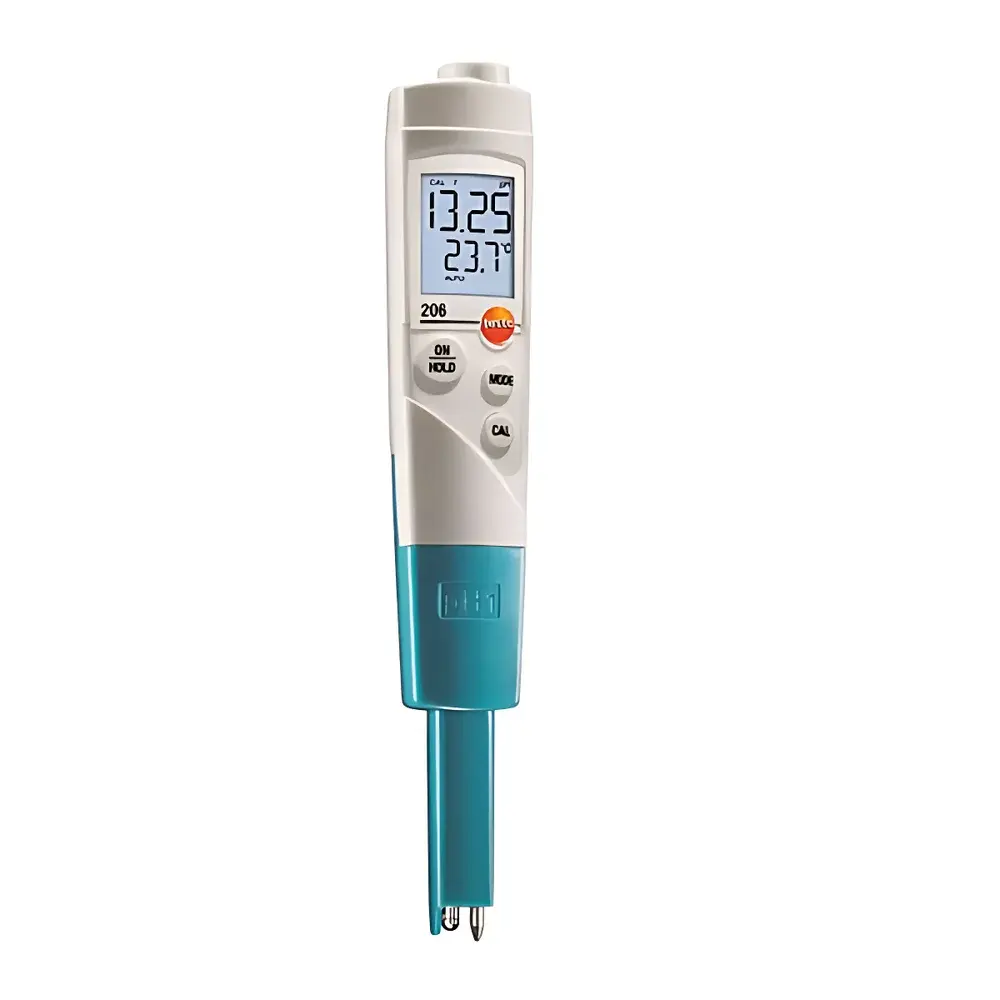
testo 206-pH1 Portable Dual-Parameter pH and Temperature Meter
| Brand | testo |
|---|---|
| Origin | Germany |
| Model | 0563 2061 |
| Instrument Type | Pen-style pH Meter |
| Parameters Measured | pH and Temperature |
| pH Range | 0–14 pH |
| pH Resolution | 0.01 pH |
| pH Accuracy | ±0.02 pH |
| Temperature Range (NTC) | 0–60 °C (short-term up to 80 °C for ≤5 min) |
| Temperature Accuracy | ±0.4 °C |
| Temperature Resolution | 0.1 °C |
| Calibration Standard | NIST-traceable buffer solutions |
| IP Rating (with TopSafe protective sleeve) | IP68 |
| Weight | 69 g |
| Dimensions (L×W×H) | 197 × 33 × 20 mm (including probe and TopSafe) |
| Display | 2-line LCD with backlight |
| Power Supply | 1 × CR2032 battery (≈80 h operating time) |
| Housing Material | ABS |
| Operating Temperature | 0–60 °C |
| Storage Temperature | −20–+70 °C |
| Compliance | CE 2014/30/EU |
Overview
The testo 206-pH1 is a compact, pen-style dual-parameter meter engineered for high-reliability field and routine laboratory measurement of pH and temperature in liquid and semi-viscous media. It operates on the principle of potentiometric pH measurement using a glass electrode coupled with an integrated NTC temperature sensor—enabling real-time automatic temperature compensation (ATC) per DIN 19266 and ISO 7888. Unlike conventional benchtop or handheld meters requiring frequent recalibration and maintenance, the testo 206-pH1 features a maintenance-free gel-filled pH electrode with double-junction reference system and sealed electrolyte reservoir—eliminating refilling, leakage, and clogging risks common in aqueous or particulate-laden samples. Its design prioritizes robustness and hygiene compliance, making it suitable for environments governed by HACCP, GMP, and ISO 22000 requirements—particularly in food processing, beverage production, cosmetics manufacturing, HVAC water quality monitoring, and cleanroom utilities.
Key Features
- Gel-filled pH electrode with double-membrane junction: Ensures stable potential response and resistance to contamination from proteins, fats, or suspended solids commonly found in foodstuffs and cosmetic emulsions.
- Integrated NTC temperature sensor (0–60 °C, ±0.4 °C accuracy): Enables precise ATC across the full pH range without external probes or manual input.
- IP68-rated enclosure with TopSafe protective sleeve: Fully submersible and dishwasher-safe (IEC 60529), supporting hygienic validation protocols in regulated production areas.
- Backlit 2-line LCD display: Simultaneously shows pH value and temperature reading, with auto-hold function that locks stable measurements and indicates stabilization via visual icon.
- Compact ergonomic form factor (197 × 33 × 20 mm, 69 g): Optimized for one-handed operation in confined spaces—e.g., pipe manifolds, fermentation tanks, or inline rinse stations.
- NIST-traceable calibration compatibility: Supports two-point (pH 4.01/7.00 or 7.00/10.01) and single-point calibration routines compliant with ASTM D1293 and USP .
Sample Compatibility & Compliance
The testo 206-pH1 is validated for direct immersion measurement in aqueous solutions, drinking water, process water, cooling tower fluids, cleaning-in-place (CIP) rinsates, dairy products, fruit juices, cosmetic lotions, and HVAC condensate. Its gel electrode exhibits low drift (<0.01 pH/h) and fast response time (<30 s to 95% of final value) even in viscous or low-conductivity matrices. The instrument meets CE marking requirements under the Electromagnetic Compatibility Directive 2014/30/EU and conforms to EN 61326-1 for industrial electromagnetic environment immunity. While not intrinsically safe, its ABS housing and sealed electronics meet IP68 criteria when used with the TopSafe sleeve—supporting audit readiness for ISO 9001, ISO 14001, and FDA-regulated facilities operating under 21 CFR Part 11–aligned documentation practices.
Software & Data Management
The testo 206-pH1 operates as a standalone, calibration-logged device with no onboard data logging or Bluetooth connectivity. All calibration events—including date, time, buffer values, slope (%), and offset (mV)—are retained in non-volatile memory and can be manually recorded for GLP/GMP traceability. For integration into digital quality management systems, users may pair the meter with testo’s optional calibration documentation kits (e.g., testo 206-pH1 Starter Kit with certified buffers and logbook templates). Calibration records comply with ISO/IEC 17025 clause 7.7 and support internal audit trails required under Annex 11 (Computerized Systems) and EU GMP Chapter 4.
Applications
- Food & Beverage: Monitoring pH stability during pasteurization, fermentation, brining, and shelf-life testing of ready-to-eat meals.
- Cosmetics: Verifying formulation pH consistency in creams, shampoos, and toners per ISO 18842 and CTFA guidelines.
- HVAC & Facility Management: Routine verification of chilled water, glycol mixtures, and humidification system condensate to prevent microbial proliferation.
- Education & Field Training: Teaching electrochemical fundamentals, calibration theory, and ATC principles in undergraduate analytical chemistry labs.
- Contract Manufacturing: Supporting supplier qualification audits where portable, traceable pH verification is mandated by OEM technical agreements.
FAQ
What calibration standards are recommended for the testo 206-pH1?
NIST-traceable pH 4.01, 7.00, and 10.01 buffer solutions at 25 °C are recommended; two-point calibration is advised before each measurement session or after exposure to extreme pH samples.
Can the electrode be used in hot liquids?
Yes—the integrated NTC sensor permits short-term exposure up to 80 °C for ≤5 minutes, but continuous operation above 60 °C is not advised to preserve gel electrolyte integrity.
Is the TopSafe protective sleeve autoclavable?
No—while dishwasher-safe (60 °C cycle), the TopSafe sleeve is not rated for steam sterilization; autoclaving would degrade the TPU material and compromise IP68 sealing.
How often should the electrode be cleaned or serviced?
The gel electrode requires no refilling or membrane replacement; periodic cleaning with mild detergent and deionized water suffices—no routine maintenance beyond visual inspection and calibration verification.
Does the device support GLP-compliant calibration documentation?
Yes—calibration parameters (slope, offset, date/time) are stored internally and can be transcribed into controlled lab notebooks or electronic quality records aligned with 21 CFR Part 11 requirements.
Related Products







