
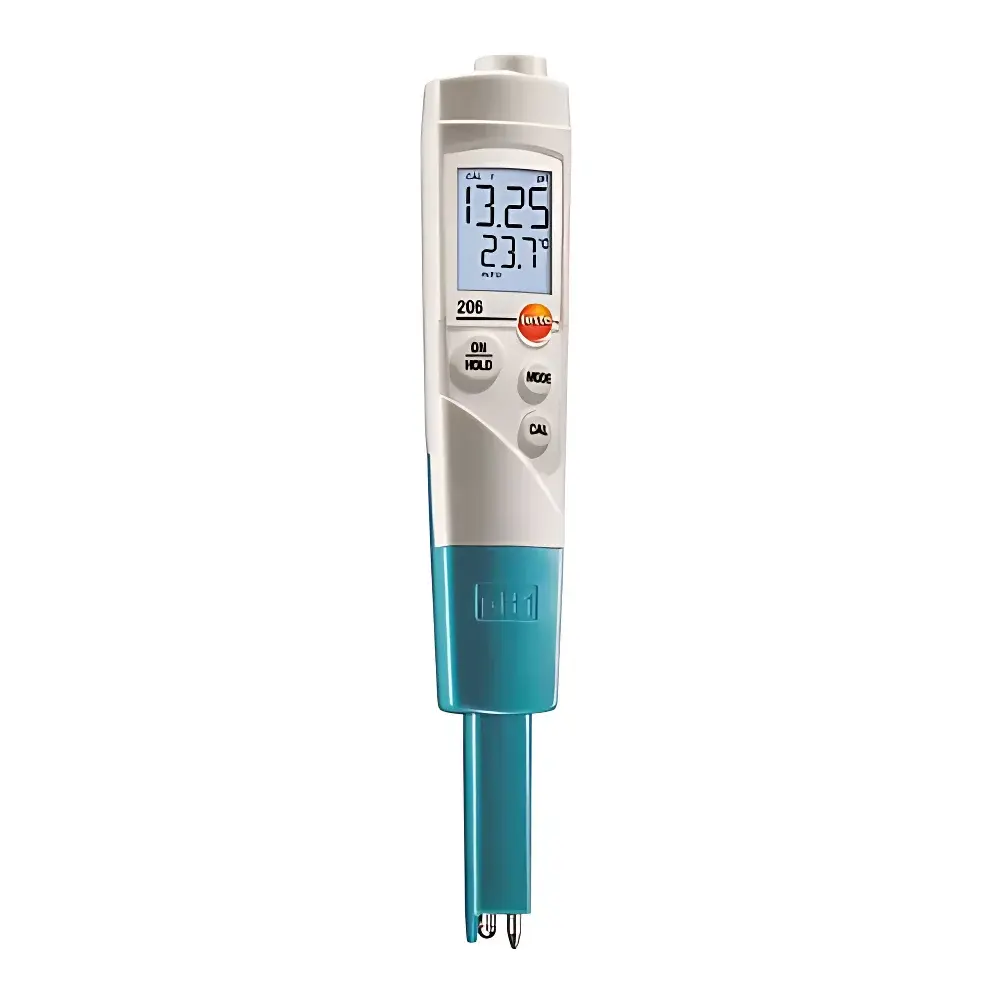
testo 206-pH1 Portable pH and Temperature Meter
| Brand | testo |
|---|---|
| Origin | Germany |
| Model | 0563 2061 |
| Instrument Type | Pen-style |
| Parameter Types | Dual-parameter (pH + temperature) |
| pH Measurement Range | 0–14 pH |
| pH Resolution | 0.01 pH |
| pH Accuracy | ±0.02 pH |
| Temperature Range (NTC) | 0 to +60 °C (short-term up to +80 °C for ≤5 min) |
| Temperature Accuracy | ±0.4 °C |
| Temperature Resolution | 0.1 °C |
| Calibration Solution Standard | NIST-traceable |
| Protection Rating (with TopSafe sleeve) | IP68 |
| Weight | 69 g |
| Dimensions (L×W×H) | 197 × 33 × 20 mm (with probe and TopSafe) |
| Display | Backlit 2-line LCD |
| Battery | CR2032 (≈80 h operation) |
| Operating Temperature | 0 to +60 °C |
| Storage Temperature | −20 to +70 °C |
| Housing Material | ABS |
| Compliance | CE 2014/30/EU |
Overview
The testo 206-pH1 is a compact, pen-style dual-parameter meter engineered for high-reliability field and process measurements of pH and temperature in liquid and semi-viscous media. Based on robust potentiometric measurement principles using a gel-filled combination electrode, the device delivers traceable accuracy compliant with international metrological standards. Its integrated NTC temperature sensor enables automatic temperature compensation (ATC), eliminating manual correction errors and ensuring pH readings remain thermally referenced across dynamic environments — a critical requirement in food safety verification, HVAC system monitoring, and cosmetic formulation QA. Unlike conventional glass-electrode meters requiring frequent refilling and fragile junctions, the testo 206-pH1 employs a maintenance-free gel electrolyte system with double-junction diaphragm architecture, significantly reducing clogging risk in turbid or particulate-laden samples such as dairy effluents, fruit pulps, or cleaning-in-place (CIP) rinse water.
Key Features
- Gel-filled pH/temperature combination probe with double-diaphragm reference junction for stable potential output and resistance to fouling in viscous or contaminated matrices
- Automatic endpoint detection with visual stabilization indicator and Auto-Hold function — locks reading once signal drift falls below 0.01 pH over 3 seconds
- Backlit 2-line LCD display showing simultaneous pH and temperature values, eliminating need for secondary instrumentation or mental cross-referencing
- TopSafe protective sleeve (IP68-rated when attached) — dishwasher-safe, impact-resistant, and chemically inert; validated for repeated sterilization cycles per EN ISO 15883-1
- Gel storage cap maintains electrode hydration and reference stability during non-use; prevents drying and junction crystallization without liquid refills
- Compact ergonomic form factor (197 mm length, 69 g mass) optimized for one-handed operation in confined spaces — e.g., inside food processing tanks, ductwork, or sterile cleanroom gloveboxes
Sample Compatibility & Compliance
The testo 206-pH1 is validated for direct immersion measurement in aqueous solutions, beverages, sauces, emulsions, and low-conductivity process waters. Its probe geometry (3.5 mm tip diameter, 35 mm active shaft length) permits insertion into narrow-necked containers and inline sampling ports. The instrument meets essential regulatory expectations for routine quality control: calibration traceability to NIST-standard buffers (pH 4.01, 7.00, 10.01 at 25 °C), CE marking under EMC Directive 2014/30/EU, and mechanical robustness aligned with IEC 60529 for IP68 ingress protection (dust-tight and submersible to 1.5 m for 30 min). While not certified for GMP-regulated final product release testing, its data integrity features — including non-volatile memory for last-calibration date and buffer IDs — support GLP-aligned documentation practices in R&D and environmental monitoring labs.
Software & Data Management
The testo 206-pH1 operates as a standalone, battery-powered instrument with no onboard data logging or Bluetooth connectivity. All measurement data must be manually recorded or transcribed. However, its design facilitates integration into structured QA workflows: calibration events are timestamped and stored internally (last calibration date, buffer used), satisfying basic audit trail requirements under ISO/IEC 17025 Clause 7.7. For facilities requiring electronic records, the device is compatible with testo’s optional calibration management software (testo ComSoft Basic) via USB interface on compatible PC hosts — enabling export of calibration logs, user-defined measurement templates, and PDF report generation. All firmware updates and configuration parameters adhere to IEC 62304 Class B software lifecycle standards.
Applications
- Food & Beverage: Routine pH verification of pasteurized milk, brine solutions, fermentation broths, and post-rinse water in CIP systems
- HVAC & Building Services: Monitoring condensate pH in chilled water loops and humidification reservoirs to prevent microbial growth and corrosion
- Cosmetics & Personal Care: Batch QC of shampoos, lotions, and toners where pH directly affects preservative efficacy and skin compatibility
- Environmental Monitoring: Field screening of surface water, wastewater effluent, and soil leachates prior to lab analysis
- Education & Training: Undergraduate electrochemistry labs requiring durable, intuitive tools for teaching Nernst equation fundamentals and ATC principles
FAQ
What calibration buffers are recommended for daily use?
NIST-traceable pH 4.01 and pH 7.00 standard buffers at 25 °C are recommended for two-point calibration. A third point (e.g., pH 10.01) may be added for extended-range verification.
Can the probe measure pH in non-aqueous solvents like ethanol or glycerol?
No — the gel electrode is optimized for aqueous conductivity >50 µS/cm. Non-aqueous or low-ionic-strength media cause unstable junction potentials and erroneous readings.
How often should the gel storage cap be replaced?
The cap is designed for indefinite reuse if kept filled with storage gel and cleaned after each use; replace only if cracked or leaking.
Is the TopSafe sleeve autoclavable?
No — it is dishwasher-safe (top-rack only, ≤75 °C), but not rated for steam sterilization. Autoclaving degrades the TPU material and compromises IP68 integrity.
Does the instrument comply with FDA 21 CFR Part 11?
No — it lacks electronic signature capability, audit trail encryption, or user access controls required for Part 11 compliance. It supports paper-based or hybrid record-keeping per ALCOA+ principles.
Related Products




